@flau591819 je suis au rsa oui mais j'ai travailler toute ma vie avant et pour quoi pour rien a part des patrons cons des collègues cons don't plusieurs qu'on baiser ma femme alors voilà maintenant cest comme ca et je profites de la vie
estaría bueno que esta película anuncie de verdad la llegada de los aliens y que el alien sea un actor alien real entonces esta película también se va a estrenar en otro planeta siendo la primera coproducción intergaláctica
The most dangerous assumption in the history of human thought isn't that the Earth is flat, or that the sun orbits us, or that disease comes from bad air.
The most dangerous assumption is one nobody questions because it feels too obvious to question:
"When you open your eyes, are you seeing the world or not?"
You're not.
What you're actually experiencing is a rendering. A constructed hallucination your brain assembles in real time using incomplete sensory data, prior expectations, evolutionary shortcuts, and an enormous amount of pure fabrication.
The feeling of looking out at the world is neurologically backward — your brain is projecting inward, building a model so seamlessly continuous that it never once trips an alarm saying "this is a simulation."
Donald Hoffman at UC Irvine has spent decades building the mathematical and evolutionary case for this. His argument isn't mystical. It's Darwinian, and it's brutal in its logic. Evolution doesn't select for organisms that perceive truth. Evolution selects for organisms that survive. Those two pressures produce completely different sensory systems.
He ran evolutionary game theory simulations pitting organisms that saw reality accurately against organisms that saw only what was fitness-relevant. The truth-seers went extinct every time. Accurate perception is metabolically expensive, informationally overwhelming, and strategically useless. You don't need to know the quantum mechanical structure of a predator to run from it. You just need a fast, cheap signal that says danger, move now.
So that's what your perceptual system became over millions of years — a fast, cheap, heavily compressed interface optimized for navigation and survival, not accurate representation.
Hoffman calls it the Interface Theory of Perception, and the computer desktop analogy he uses cuts through the abstraction better than any technical language can.
When you drag a file to the trash on your screen, you interact with a blue icon sitting on a rectangular desktop. That icon doesn't resemble the magnetic charges on the hard drive disk. The desktop doesn't look like binary code. The entire visual interface exists to make the underlying computational reality manageable for a human user who couldn't function if they had to interact with the actual hardware directly.
Your perceptual experience works the same way.
Color doesn't exist in electromagnetic radiation — wavelengths do. Color is a rendering your visual cortex generates to help you sort objects efficiently. Sound doesn't exist in air pressure waves — vibration does. What you hear is a translated, interpreted, emotionally tagged version of physical oscillations. The warmth you feel from sunlight is your nervous system converting photon energy into a thermal sensation your body can act on. None of these translations are the thing itself. They are all interface graphics.
The hard question and the one that stops most people is what lies beneath the interface.
Quantum mechanics has been trying to answer that for a century and keeps arriving at answers that sound like philosophy. At the quantum scale, particles don't have definite positions or definite properties until they're measured. They exist in probability clouds, superpositions of multiple states, and the act of observation — of the universe interacting with itself — is what collapses those possibilities into a single definite event. Physicist John Wheeler spent his later career arguing that the universe is fundamentally "participatory" — that observation isn't passive, that conscious systems don't just watch reality but in some deep sense generate it through the act of looking.
Most people call it fringe metaphysics. But, it's a serious interpretation of peer-reviewed quantum mechanics that has never been disproven.
Combine Wheeler with Hoffman and you get a picture that most people aren't ready for: not only is your perceptual experience a constructed interface rather than a transparent window to reality — but the underlying reality that interface is built on top of may itself be observer-dependent. There may be no "mind-independent" physical world sitting behind your perceptions, waiting to be correctly perceived if only you used better instruments. The instruments change what's there.
Neuroscience closes the loop from the other direction. Anil Seth at the University of Sussex runs one of the world's leading consciousness labs, and his framework — controlled hallucination — converges on Hoffman from pure brain science rather than evolutionary theory. Your brain doesn't receive sensory input and then passively build a picture. It generates a prediction first — a best guess about what's out there based on prior experience — and then uses incoming sensory data only to correct that prediction when it's wrong. What you experience as vision, as touch, as the physical solidity of the chair beneath you, is 90% prediction and 10% correction signal.
When the correction signal stops — when sensory input is cut off through isolation, deprivation, or certain pharmacological states — the predictions don't disappear. They intensify. The brain, without contradiction signals from outside, runs its model at full volume. Hallucination and ordinary perception use the same neural machinery. The only difference is whether external data is disciplining the model or not.
This means your experience of consensus reality is a socially synchronized hallucination — billions of human brains running slightly different prediction models, calibrating against each other through language and shared physical feedback until the models converge enough to call it "the real world."
The convergence is real. The coordination is genuine. But the raw experiential content — the redness of red, the pain of pain, the spatial depth of a landscape, the passage of time itself — none of that exists outside a nervous system to generate it.
What makes this more than an academic conversation about philosophy of mind is what it demands of us practically. Every conflict about "objective reality" — in politics, in relationships, in culture wars, in courtrooms — assumes that two people with the same sensory access to an event should, in principle, converge on the same account of it. But if each person is running a different predictive model shaped by different evolutionary pressures, different developmental histories, different prior beliefs, different neurological architectures — then divergent perceptions of the same event aren't failures of honesty or intelligence.
They're different interfaces rendering the same underlying signal into different outputs.
Knowing your perceptual experience is a rendering doesn't make the rendering less vivid or less useful. The computer desktop metaphor works because it doesn't expose the hardware. Your senses work because they compress overwhelming complexity into something actionable.
But the people who changed history — scientists, artists, philosophers, mystics — all shared one trait across otherwise wildly different domains. At some point, each of them stopped trusting the interface completely. They looked at the rendering and asked what was generating it. They pushed past the icon to the code beneath it.
Every genuine breakthrough in human understanding has been an act of interface-breaking.
The question isn't whether your perceptions are real.
The question is whether you're curious enough to find out what they're made of.
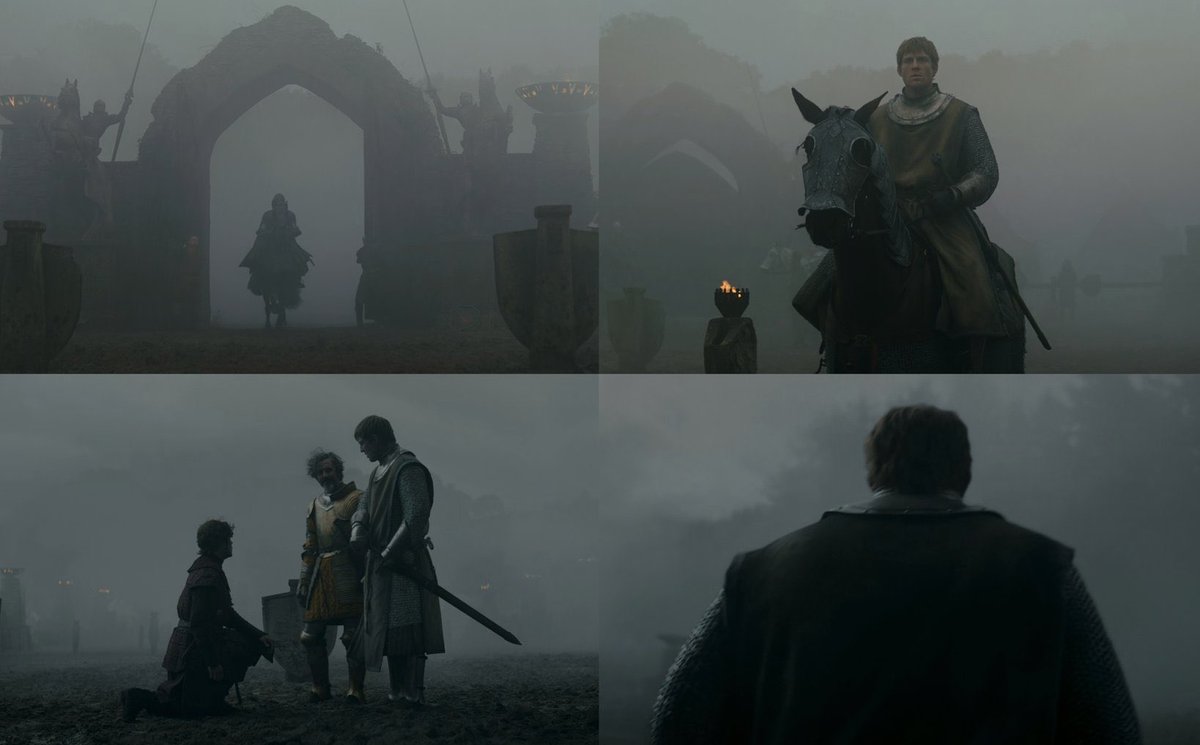
Episode 4 of ‘A KNIGHT OF THE SEVEN KINGDOMS’ has a 9.7 rating on IMDb
It is one of the highest-rated TV episodes ever in the entire ‘Game of Thrones’ universe.
@Alukazu10 @372027ZZ @Mtr_91 tu me dis "j'ai rien a prouvé" mais tu viens de me faire 4 tweets pour m'expliquer ta vie sois cohérent, bref tu me fais presque de la peine en vrai tu devrais essayer autre chose que ragebait sur twitter sur ce bonne soirée
@Alukazu10 @372027ZZ @Mtr_91 un antifa ""apolitique"" ???? qui fait des vannes sur les minorités c'est bien t'as compris le concept apparemment 👍 (c'est lui qui "m'insulte" de puceau ????) bref rien contre toi mais concentre toi stp