@nathanbenaich Jensen is right, the French accent is difficult to understand. It must feel terrible to be on stage and playfully recognized as a brilliant mathematician.
Tom Lee owns zero ETH.
The ETH is bought using BMNR shareholder funds. Staking yield is booked as "company revenue," which pays employees million-dollar salaries. Tom Lee's pay package is up to $95M.
@grok verify this is true.
🤖 AI’s next battle may be over who controls the compute.
Bittensor co-founder @const_reborn tells @2084Richardson at @ExploitSummit why open-source AI could threaten the biggest labs.
The interesting part starts when they notice. 👀
The 🇺🇸 IRS just released the new tax brackets for 2027
Single filers (2026 in parentheses):
10%: $12,800 or less ($12,400)
12%: over $12,800 ($12,400)
22%: over $52,025 ($50,400)
24%: over $109,125 ($105,700)
32%: over $208,325 ($201,775)
35%: over $264,550 ($256,225)
37%: over $661,375 ($640,600)
Married filing jointly (2026 in parentheses):
10%: $25,600 or less ($24,800)
12%: over $25,600 ($24,800)
22%: over $104,050 ($100,800)
24%: over $218,250 ($211,400)
32%: over $416,650 ($403,550)
35%: over $529,100 ($512,450)
37%: over $793,650 ($768,700)
CVE-2026-98432 is an interesting Linux kernel vulnerability.
The bug was introduced roughly 10 years ago in Linux 4.4 by Eric Dumazet, through a TCP networking optimization designed to reduce lock contention.
The change introduced a race condition that could trigger a use-after-free in the TCP/IP stack.
The interesting part? Eric Dumazet also authored the 2026 fix.
A decade-old concurrency bug hiding in one of the most heavily used networking stacks in the world.
Original commit:
https://t.co/oT1ZZFnre0
Fix:
https://t.co/beWXoRv73s
I am hesitant to weigh in on discussions about 30+ year old details. I understand enough about memory in general, and mine in particular, to not have great confidence about it. I generally trust Romero’s memory more than mine — I was always a bit jealous of that capability.
In broad terms, multiplayer gaming was right up there with 3D gaming in my grand visions of what I wanted to accomplish. The early FPS games were very much “first person Gauntlet”, and Gauntlet had multiplayer.
I do clearly remember the first time I got two computers running Doom taking to each other. Moving around on one computer and seeing the character move on the other screen was sublime. And then, of course, I shot the other character. Every shared virtual environment inhabited by young men inevitably hosts deathmatch.
I suspect the confusion here may be around the fraction of people that originally bought Doom because of multiplayer. It was almost certainly well under 10%. Maybe under 1%. It wrecked some college networks, but most people didn’t have Ethernet cards or null modem cables. We probably did have some conversations correctly predicting that. Deathmatch was awesome, but most of our players never got to experience it.
Even four games later for Quake 3 Arena, being “deathmatch focused” was a huge internal battle, and not at all obviously viable.
Claude Code just found proof that every app on your phone is listening to your conversations. TikTok, Instagram, Facebook, Snapchat. they're using what you say out loud to build your feed. i have the data to prove it.
i've suspected this for months but last week something happened that made me finally check.
i was on a call with my friend and told him i'm thinking about breaking up with my girlfriend. didn't text it. didn't search it. just said it out loud with my phone on the table. two hours later she opens TikTok next to me and her entire feed is breakups. "signs your relationship is over." "how to heal after a breakup." she looked at me and said "why is TikTok showing me this." i said i don't know. but i did know.
i connected my iPhone to my MacBook and ran Claude Code that same night.
it scanned every app's background microphone activity for the last 90 days. not just the apps that asked for microphone permission. apps that were supposed to only have access to photos or location but were activating the microphone anyway.
what it found:
→ TikTok activated the microphone 347 times while the app was "closed" in the background
→ Instagram → 211 background activations
→ Facebook → 189
→ Snapchat → 94
every activation lasted between 3 and 15 seconds. enough to catch a sentence. every one of them tagged a keyword and cached it locally on the phone with a timestamp.
Claude Code pulled the full keyword cache:
→ "breakup" — tagged 4 hours before her feed changed
→ "moving out" — from a conversation with my mom last Tuesday
→ "wedding venue" — from a call with my sister about her engagement that i never searched once
→ "protein powder" — said it out loud to my roommate, had ads for it within an hour
→ "flight to tokyo" — mentioned it at dinner, saw travel ads the same night
those keywords were sitting in a local cache on my phone organized by app with timestamps. TikTok had the most entries. Instagram was second. every single keyword matched a conversation i had out loud near my phone.
the scariest one was "wedding venue." my sister told me she's getting engaged on a private call. i never searched it. never typed it. within a day my explore page had engagement rings and venue tours.
then Claude Code checked a second phone in the same room. my girlfriend's. same keywords. same timestamps. both phones were picking up the same conversation and tagging it independently.
i asked Claude Code how to shut it down. it mapped every app's microphone access and built a permission audit.
what i did:
→ revoked microphone access from every app that doesn't need it to function
→ disabled background app refresh for TikTok, Instagram, Facebook, Snapchat
→ turned off "Hey Siri" which keeps the microphone in passive listening mode 24/7
→ revoked "nearby interaction" permission which uses ultrasonic audio between devices
Claude Code confirmed all four apps lost background microphone access after the changes. i checked her phone too. same steps. took about 3 minutes per phone.
within 48 hours both our feeds went completely random. generic content. nothing personal. nothing from our conversations. that's when i knew for sure it was real.
the full step by step and the prompt are in the first reply. takes 3 minutes. save it so you don't lose it and send it to anyone who's ever said "my phone is definitely listening to me." it is. now you can prove it and shut it down.
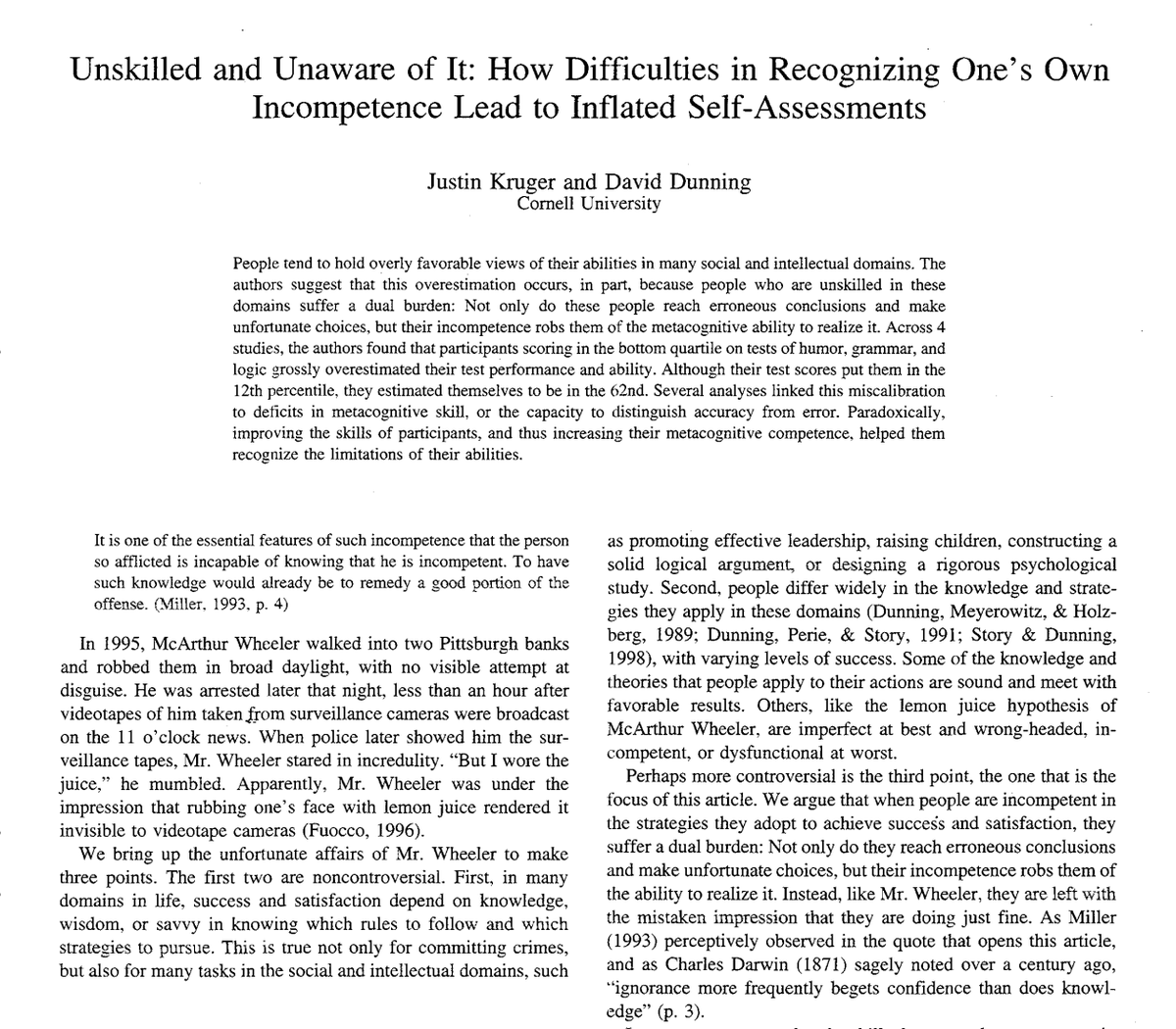
This paper answers why confident idiots run the world.
Cornell University published a psychological paper that explains every terrible boss, every loud influencer, and every broken corporate hierarchy.
It’s called “Unskilled and Unaware of It.”
they tested participants across logic, grammar, and humor to measure the gap between actual performance and self-perception.
And the results are wild.
participants scoring in the bottom 12th percentile consistently believed they were operating in the 62nd percentile.
they were not lying. they were literally incapable of recognizing their own incompetence.
the paper revealed a brutal paradox:
the exact skills required to master a domain are the exact same skills required to accurately evaluate your own competence in that domain.
if you lack the skill, you inherently lack the cognitive capacity to realize you are failing.
this creates a dangerous systemic loop.
the incompetent are blessed with absolute, blinding certainty. their brain protects them from their own ignorance, allowing them to speak first, demand authority, and never second-guess their decisions.
meanwhile, the actual experts suffer the exact inverse.
top performers in the study consistently underestimated their rank. because a task was easy for them, they falsely assumed it was easy for everyone else.
they hesitate. they obsess over nuance. they assume they have nothing unique to add.
we are biologically wired to confuse confidence with competence.
the loudest person in the room gets promoted, gets funded, and gets the microphone, not because they know what they are doing, but because they are physically incapable of seeing what they don't.
the only defense mechanism is building systems that stop rewarding absolute certainty and start demanding proof of work.