Assistant Professor in systems/cognitive neuroscience. Studying behavior and neural activity under dynamic, real-time, naturalistic experimental paradigm.
1/14 🧠 Our paper is out in Science Advances!
S. Amin Moosavi, Sai Sumedh R. Hindupur, Hideaki Shimazaki
Population coding under the scale invariance of high-dimensional noise
Science Advances 12, eadz9632, 2026
https://t.co/qlsxNWHVqy
🎨 Robin Hoshino
"The South Korean e-commerce platform Coupang has been engulfed by scandals over data breaches and dangerous work conditions. Having spent millions to lobby US politicians, the firm is now calling in their help to protect it from scrutiny by regulators." https://t.co/ihoEItc5Xa
I’m thrilled to share the preprint with @sangkjyuson. It’s a fun example of applying dynamical systems approaches to social behavior, and the first two-author manuscript from Y-Lab.
Sangkyu has put together a well-written thread to walk you through the ideas (see below ⬇️)
New print 📄!
0/ I'm excited to share my preprint with @neuromochi on how #observation shapes #socialinference.
(Full paper: https://t.co/KQgUCsDjGg)
+ 🗓️ I'll also present this work at #CCN2025 on August 12, poster A26—come find me there!
How does the brain bind action to value?
How does it navigate a tradeoff between this binding and generalization to novel situations?
Out today in Nature Neuro! https://t.co/YPiY2uHoFz
@JustFineNeuro @NeuroPolarbear @BecketEbs@neuromochi
See original 🧵 + updates below
Different brain regions encode different pain-related information, such as the expectation of pain or the intensity of a stimulus.
But where and how is this information integrated? My paper has just been published in @ScienceAdvances! (1/13) https://t.co/QWBuQV3ah3
Big shout out to my advisors @neuromochi and @choongwanwoo who helped me out for the project and @SuhwanGim for the valuable feedbacks and the dataset! (13/13)
🎉 Newly Initiated Happy Brain Fund Raising in CNIR
We are thrilled to announce that Prof. Seong-Gi Kim, Director of CNIR, has pledged a total of 3 billion KRW to the newly established Happy Brain Fund. @SeongGi_Kim#CNIR_IBS
Thrilled to announce the symposium titled "Exploring Natural Intelligence: Perspectives on brain evolution, development, and organization" with an awesome lineup: Paul Cisek, @celestekidd, @moira_dillon, Casey Paquola, Se-Bum Paik, and Alex Jordan! Stay tuned!
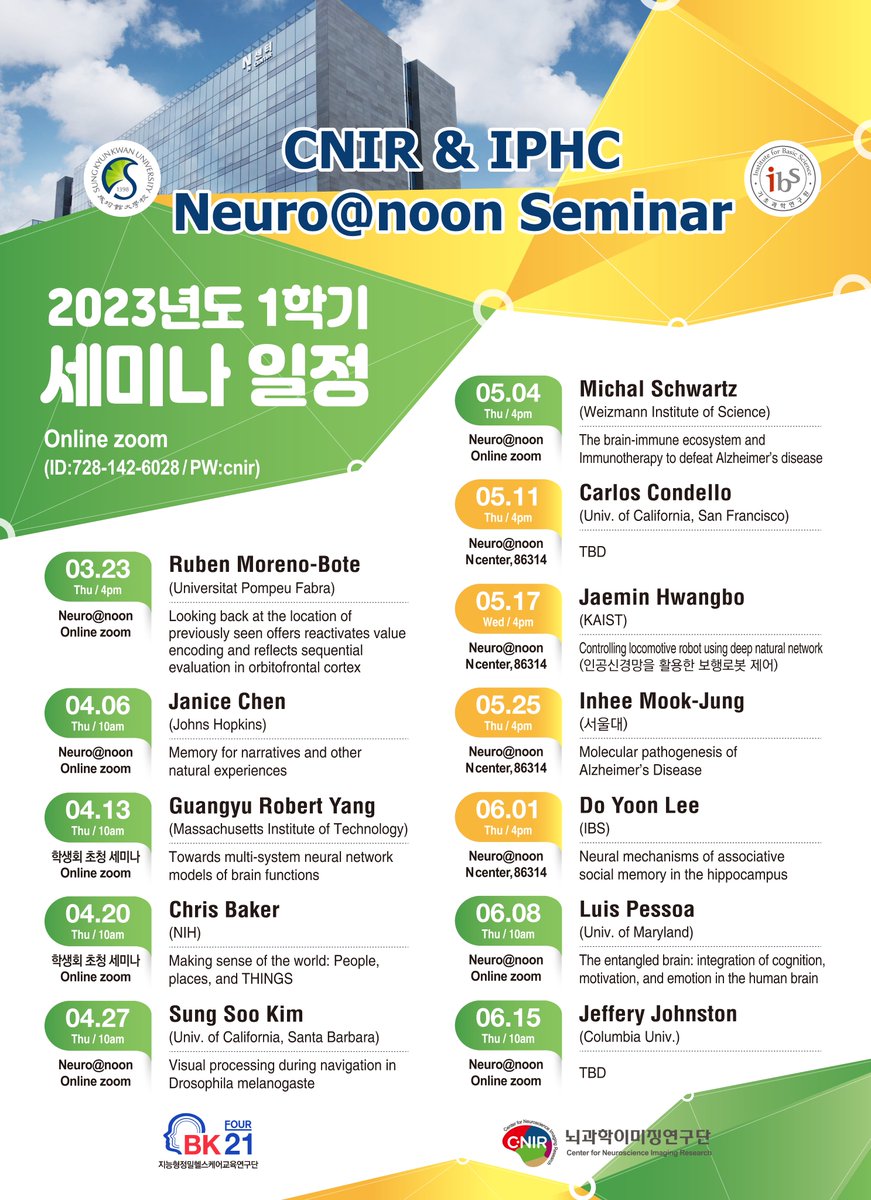
CNIR's Seminar Schedule (Korean standard time) for 2023 is finally up! 🔥🧠👨🏫
Get ready for a fantastic lineup of speakers covering cutting-edge topics in cognitive, computational, and clinical neuroscience as well as even robots!! 🌟🔬💻🤖
I’m presenting my first off-line poster at @SfNtweets on 14th Monday 1-2pm.
/location: 399.11 at UU7 /title: Geometrical features of neural trajectories as a computational motif for cue-stimulus integration for pain
#SfN2022
A new paper on (i) how to connect high-level cognitive theories to neuroscience / neural nets, and (ii) how learners can construct new concepts like number or logic without presupposing them. "Church encoding" is the metaphor we need.
https://t.co/1YDX74IoSJ
Come check out my neuromatch talk @ thurs 2:15pm. Using optimal feedback control to understand how monkeys play video games!
(with @neuromochi, @amitaishenhav, & @NeuroPolarbear)
YT: https://t.co/Pia1fCo0GZ
https://t.co/gnmNQe8yYx
Maybe putting "computing values" as a Marrian Computational Level goal, and looking for algorithms and implementation of that was a mistake?
Maybe the goal is correct behavior, and computing values is one algorithm, that the brain may implement only in specific situations?
/6