कर्मण्येवाधिकारस्ते मा फलेषु कदाचन । मा कर्मफलहेतुर्भुर्मा ते संगोऽस्त्वकर्मणि ॥
You've a right to perform your duty, but you're not entitled to the results. Never consider urself to be the cause of the results of your activities, and never be attached to not doing your duty.
You will find this clip super fascinating!
- how British kept paying slave owners till ….. and how come so many Indians in Guayana, Jamaica or Mauritius… and more
👑
All these govt appeals of asking people to stay back in India, build in India and for India, ease of business, contribute to our growth etc etc is very nice.
But it all falls flat when the people who come back or stay back, read stuff about random RTO inspectors, low level municipal Clerks, Village officers amassing crores of Rs in wealth and having more Gold in their homes than some African Countries have as reserves, while you are stuck in a traffic jam becsuse a road that was laid yesterday has been redug today
It becomes seriously demoralizing when you realize that no matter how hard you work or how innovative you are, you will be out earned by a low level clerk whose only skill is to sign.
I genuinely don't understand why everyone isn't using this yet
Andrej Karpathy, a co-founder of OpenAI, posted a simple idea that hit 16 million views: stop using AI to write code, use it to build a second brain.
You point Claude Code at a folder, drop in any source, an article, a transcript, a PDF, and Claude reads it, links it, and files it into a living wiki of everything you know. It compounds like interest, the more you feed it, the smarter it gets.
Here's the whole thing:
> Install Obsidian, create a vault, open it in Claude Code
> Paste Karpathy's wiki idea file and tell Claude to build it
> Claude makes three folders: raw for sources, wiki for its pages, a CLAUDE.md that runs it
> Drop any source into raw and say "ingest this"
> Ask questions across everything, forever
Five minutes to set up, and you never start from a blank chat again.
Full step-by-step guide with Claude and Obsidian, link below.
Bookmark this
During the Nuremberg Trials, Hermann Göring gave an interview to psychologist Gustave Gilbert and said:
“Of course the people don’t want war. Why would some poor farmer want to risk his life in a war when the best he can hope for is to come back to his farm in one piece?
Naturally, people don’t want war. No one wants war in Russia, England, America — not even in Germany. That’s obvious.
But in the end, it’s the leaders of a country who determine policy. And it’s always a simple matter to drag the people along, whether it’s a democracy, a communist state, a parliament, or a fascist dictatorship.”
Gilbert objected:
“But there is one difference in a democracy — the people have a voice through their elected representatives.”
To which Göring replied:
“That’s all well and good, but whether the people have a voice or not, they can always be brought to the bidding of the leaders. That is easy. All you have to do is tell them they are being attacked, and denounce the pacifists for lack of patriotism and for exposing the country to danger. It works the same in any country.”
— Nuremberg Diary, April 18, 1946
Doesn’t it sound familiar?
If you read this and don’t understand why it’s happening it’s an opportunity to reset your understanding of how the real world works.
The real world will need a ton of help actually getting agents going in the enterprise. Companies have legacy tech stacks they need to modernize, data in tons of fragmented tools, knowledge that isn’t captured or digitized, and change management needed to actually utilize agents effectively. And they have to do all this while still running their business day-to-day, unlike startups.
This is why there is so much opportunity for companies (software or services) to actually deploy agents in specific domains and workflows. This remains a big opportunity for both existing services providers but also tons of new startups as well. Every new technology wave produces a new era of consulting firms that can deliver on that technology.
It’s also why the FDE model is going to be alive and well for a long time because companies will want to have their vendor actually help drive the change management and implementation for their new workflows.
The people aren’t going away. Far from it.
India 🇮🇳 - Reliance Jio Infocomm Limited has allegedly been breached, exposing internal servers and a real-time algorithmic trading system containing NSE Futures & Options data and trading alerts. https://t.co/xvqQR2MZuc
Token consumption is the new vanity metric.
CEOs & Internet clowns are boasting “salary spend is equal to token consumption”
But, tokens are merely an input (much like human labor) to business logic, task execution & decision-making.
Saying you burned 1M tokens last week is a bit like a McKinsey partner bragging that he kept his back office awake for 2 nights straight to produce a mediocre client presentation which didn’t convert into a new project!
I measure our agentic transformation progress using a simple set of Qs:
The world we live in: foresight is cheating, common sense a sort of otherworldly superpower
In modern statecraft, foresight is viewed as cheating
Common sense is seen as a sort of superpower, where packing an umbrella before a storm is considered a work of genius.
Take Scott Bessent’s recent lament over China’s strategic petroleum reserves, which he confidently labeled “hoarding.” The word carries such moral weight, as if prudent logistics were a form of economic gluttony. Never mind that the United States was fully aware it was steering toward a major conflict in the Persian Gulf but somehow decided to skip the stocking up phase entirely. Meanwhile, Beijing quietly filled its tanks, secured its supply lines, and played geopolitical chess while Washington was busy drafting press releases. Practically calling it cheating, how dare the Chinese have saved up for a rainy (or martial) day!
Take Scott Bessent’s recent lament over China’s strategic petroleum reserves, which he confidently labeled “hoarding.” The word carries such moral weight, as if prudent logistics were a form of economic gluttony. Never mind that the United States was fully aware it was steering toward a major conflict in the Persian Gulf but somehow decided to skip the stocking up phase entirely. Meanwhile, Beijing quietly filled its tanks, secured its supply lines, and played geopolitical chess while Washington was busy drafting press releases. Practically calling it cheating, how dare the Chinese have saved up for a rainy (or martial) day!
More factories across Europe laying idle every day, but never fear, VdL, the intrepid EU leader, has the appropriate sound byte to hand “The cheapest energy is the energy you don’t use.” Apparently the solution to deindustrialization is to use less energy. Beautiful in its simplicity really.
The cumulative effect of this lack of foresight and common sense has led us directly to the Persian Gulf crisis. Cut off the mechanisms for control of Iran’s nuclear capacity, then not only cut off talks but launch a war in the midst, including targetting both the Iranian leader and its negotiators in the talks, and expect good to come of it. If you back a country into a corner, don’t be surprised if they are a bit hesitant to disarm. And, if perchance this country has a culture in which martyrdom forms one of its central tenets, even more. But to think about that would require foresight and common sense which is in somewhat short supply in the Trump White House.
The perfect symbol of where we are in the world right now is North Korea’s Kim Joon Un. For as long as any of us can remember he was the butt of jokes on late night TV monologues, the perfect role model for any aspiring geopolitical madman. Well, irony of ironies, Kim Joon Un is now the very symbol of prudence, foresight, common sense and strategic thinking.
What a world we live in.
https://t.co/g4ZLiKTibY
Substack 👇👇👇
🚨🇨🇳China's Underwater Data Centers: Huge Win in the AI Power Race
Deep under the South China Sea, China just took a major step toward AI supremacy.
🔸From Navy Tech to Commercial Compute
China has launched its first commercial underwater data center off Hainan Island. Sitting 35 meters below the surface, the Hailanxin-built facility connects to shore via submarine cable and already serves AI and big data clients.
Hainan Telecom and Atlas are online now. Tencent, Alibaba, https://t.co/HQ3bihQGDF, and Pinduoduo will join later this year. Each massive 1,300-ton pod uses smart seawater cooling to achieve an impressive PUE of 1.07 — far more efficient than most land-based centers.
🔸Tech Roots That Matter
Hailanxin wasn’t starting from scratch. The company once supplied intelligent systems to the Chinese Navy, with deep expertise in marine tech and seabed operations. In 2019, it acquired Canadian deep-sea firm OceanWorks and teamed up with China National Offshore Oil Corporation to build the pressure vessels.
This blend of naval know-how and commercial ambition turned Microsoft’s earlier underwater experiment into a working, scalable reality — built for speed and cost advantage in the AI race.
🔸Why This Gives China a Real Edge
By placing high-power servers directly in the ocean, China gains natural cooling without expensive infrastructure. The result: cheaper, denser, and more reliable compute capacity exactly when global AI demand is exploding.
With plans for 100 pods delivering 50–100 megawatts, Beijing is positioning itself to export low-cost AI processing power worldwide. This underwater strategy strengthens China’s overall tech infrastructure and accelerates its push for leadership in artificial intelligence.
An American analyst says it out loud: “The Gulf royal families didn’t reach their thrones through legitimacy. The British planted them, the Americans guard them, and they live off money pulled from land they never built.” Words no Arab channel will air — whispered in every Arab home.
NO LIMITS, NOT SHY
Putin: “They have no limits. They are not shy about anything. They killed Soleimani, an Iranian general. You can judge Solemani however you want, but this an official in another state.
They killed him on a territory of a third country and said, “Yes, we killed him.”
🤔 Might want to beware of continuing to set such dangerous, lawless precedents. Don't cry when those precedents come home on you.
The Great Indian Education Scam exposed!
Indian schools have become a billing machine. Schools today focus less on education and more on extortion!
You need to pay “donations” just to get admitted to schools. School textbooks are charging 10,000+ per year. Uniforms, books, shoes can be bought from fixed shops because schools take commissions.
The biggest irony is that these school make so much "profit" but are still classified in the non-profit category.
We need an Education system which has:
1. Transparent fee structures
2. A maximum limit on fees
3. Affordable Books & Uniform
4. Freedom to buy books from any seller
It is time for parents to raise questions! Share this video so it reaches every parent, teacher & government education authority!
🇮🇳 Ashok Leyland Data Allegedly for Sale – 3TB Dataset
A threat actor claims to be selling a massive dataset with Ashok Leyland, one of India’s largest manufacturing companies.
📊 Claimed Scope:
• ~3TB of data
• Priced at ~$8,000
• Tagged with “India” and “India military”
📂 Alleged Data Includes:
• Source code (Python, R)
• Employee data
• Customer data
• Truck details & logistics data
• Vehicle location information
• Additional internal datasets
🔍 What Stands Out:
• Inclusion of source code + operational data suggests deep internal access
• Fleet/location data could have real-world operational implications
• Low price relative to size → possible stolen bulk dump or urgency to sell
🧠 Threat Intelligence Insight:
• Potential supply chain or internal system compromise
• If validated, this is not just a data leak but a full operational intelligence exposure
• “India military” tag may indicate sensitive contracts or targeting narrative
⚠️ Potential Risks:
• Industrial espionage
• Supply chain compromise
• Exposure of logistics operations
• Targeted attacks against employees or customers
📊 Status: Unverified — high-impact claim under review
💬 Manufacturing and logistics datasets are increasingly targeted due to their strategic and operational value.
#CyberSecurity #DataLeak #India #ThreatIntel #DarkWeb #DailyDarkWeb
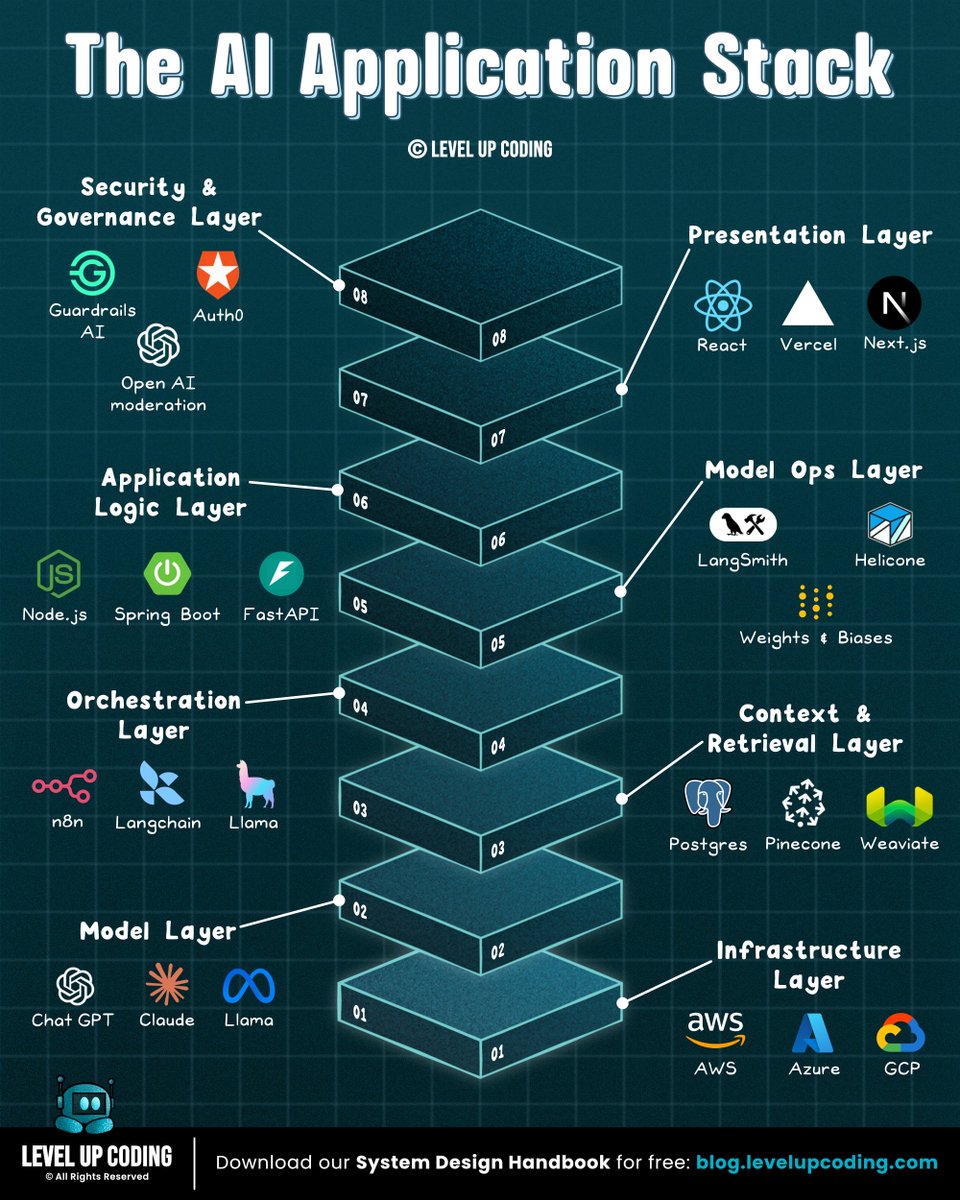
The AI Application Stack
These 8 layers are behind every AI application, and understanding them changes how you design AI systems.
1) Infrastructure layer
↳ Provides compute, storage, and networking to run and scale apps.
2) Model layer
↳ Generates outputs using models like GPT, Claude, Gemini, or Llama.
3) Context & retrieval layer
↳ Stores and retrieves context, including data and embeddings.
4) Orchestration layer
↳ Coordinates models, tools, and data across workflows and prompts.
5) Model Ops (LLMOps) layer
↳ Monitors performance, evaluates outputs, & improves models in prod.
6) Application logic layer
↳ Defines system behavior, including business rules, APIs, and component interactions.
7) Presentation layer
↳ Handles user interaction, including visuals, layout, and usability.
8) Governance & enterprise layer
↳ Ensures security, access control, safety, and compliance in production.
The main challenge? AI tools are fragmented, forcing developers to switch between multiple tools and lose context.
This is where Conversational Mentor comes in.
Instead of stitching tools across the stack, Mentor helps you go from idea to production-ready application in one system, while keeping your architecture and logic fully under your control.
You can generate and evolve apps through natural language, while built-in guardrails ensure what you’re building is actually production-ready.
It brings conversational development, AI-powered IDE workflows, and enterprise governance into one system.
Explore Conversational Mentor → https://t.co/Nv4bZ3EmrK
What else would you add?
——
♻️ Repost to help others learn AI.
🙏 Thanks to @OutSystems for sponsoring this post.
➕ Follow me ( Nikki Siapno ) to improve at system design.
Linux is the best software project of all time. It's the best operating system for a $4 computer or a $4M computer. It's free, modifiable, and available to all.
We have to make sure robotics software ends up like this too. Maybe openpilot, maybe not, as long as it's open.
This speech is less about celebration and more about signaling a shift in how the business will operate going forward.
The numbers already show a clear pattern 16 years for the first 100 MMT, and now every 100 MMT coming in ~2 years. That kind of acceleration usually happens when systems, not just assets, start scaling.
What’s interesting is the emphasis on decentralisation and last-mile execution. When leadership starts talking about pushing decisions closer to the ground and reducing hierarchy, it typically means the organisation has reached a size where speed becomes the biggest constraint.
The focus on workers and partners isn’t just emotional framing. In large infrastructure networks, reliability depends heavily on execution consistency and ecosystem strength, not just ownership of assets.
This looks like a transition phase from expansion-led growth to efficiency- and system-led scaling. If executed well, that’s what sustains high growth at this level.
If not, complexity can slow things down.
Prof. Jeffrey Sachs message to India🇮🇳 and China🇨🇳: DON’T let a border dispute created by Britain prevent cooperation between TWO GREAT CIVILISATIONS!
‘All the world’s problems go back to the British. The problem between India and China goes back to 1914, to a line drawn on a map arbitrarily in a conference in Shimla by a Mr. McMahon, who had never been to the places where he drew the line, with the British Empire putting its desired border of the British Raj someplace on the map in the middle of the Himalayas. And this has created the border disputes with China.
It’s a long, fascinating story. The point that I try to make to both leaders in both countries who are, in my view, you know, leaders of two great civilisations, is that a line drawn on the map in 1914 should not hinder cooperation between the two great giants of the world today who have a mutual interest in a multipolar world operating under international law.
So I very much want China and India to cooperate with each other. I want them to see the border dispute for what it is. It’s real. It’s caused by the British. It’s caused by events of the British Empire in 1914 in particular. And it should not dominate the current policy, political and economic interests of two great countries that should actually get along with each other.
And I think the BRICS is a very good mechanism for fostering that kind of cooperation because it also builds institutions like the New Development Bank and other initiatives on behalf of the world in which India and China are joined in a very practical, positive way.’
-Prof. Jeffrey Sachs on the latest episode of New Order
Watch the full interview in the quoted post, or watch it on Rumble, link below in the replies👇
200 years ago, people thought travelling at 60 kmph was impossible
150 years ago, people thought flying was impossible
100 years ago people thought speaking to each other across continents was impossible
85 years ago, people thought a bomb that can destroy an entire city was impossible
70 years ago landing on the moon was impossible
50 years ago people thought instant messaging from Antartica to the Arctic was impossible
40 years ago people thought knowledge of any subject that too for free, at the click of the button was impossible
35 years ago, people thought a communication device that would fit in your pant pocket but can connect you with anyone in the world, was impossible
30 years ago, people thought a 1 TB hard drive which is less than the size of a thumb, was impossible
25 years ago, people thought watching a movie on a device that would fit in your pant pocket, was impossible
20 years ago, people thought making a million dollars by making goofy faces on a camera was impossible
10 years ago, people thought writing an entire working software application, complex code, generating images and videos by simply typing your thoughts in broken English was impossible
5 years ago, people thought competing with Google in search was impossible
I guess what you think is impossible today, will be something that will be routine and taken for granted, in the next 5 years