Many, many thanks to @HRF for featuring our interview with Francisco Calderón (@negrunch) in the latest Financial Freedom Report! ⚡️⚡️⚡️
We deeply appreciate your helping us to highlight the work that Francisco and the team at @MostroP2P are doing to help the people of Venezuela 🇻🇪, Cuba 🇨🇺, Bolivia 🇧🇴 and beyond.
Links to the interview with Francisco and to subscribe to the Financial Freedom Report in the comments.
🚀 The Orange Rocket has landed!
Akhona Mabuto finished IRONMAN 70.3 Mossel Bay today: 14th of 202 in his age group, up 25 places from 39th in 2025.
5:20:09, 7 minutes faster than 2025, and 18 minutes faster on the bike.
1.9 km swim. 90 km bike. 21.1 km run. So proud of you, Akhona! 🧡
@OrangeRocketBTC@Machankura8333@tri_bitcoinza@IRONMANtri
⚠️Heads up: M-PESA seems to be having intermittent connection issues this afternoon, so some payouts aren't going through. If yours failed, your BTC is safe. DM us or message us in the app and we'll send it back to you. If you can, hold off for a little while. We'll post here once it's back to normal. We've reaching out to the M-PESA people already to let them know.
The rig is fully dialed for @IRONMANtri Sunday — shoutout to KK E-Bikes! Fresh lube, trued wheels, clean cassette, sealed. The machine is ready. Now it's up to the engine. 🚴⚡
Capitalism calibrates at a higher frequency than communism.
Why is that?
Because, as Tom Benner puts it, "it's a more decentralized way giving individuals economic decision making power."
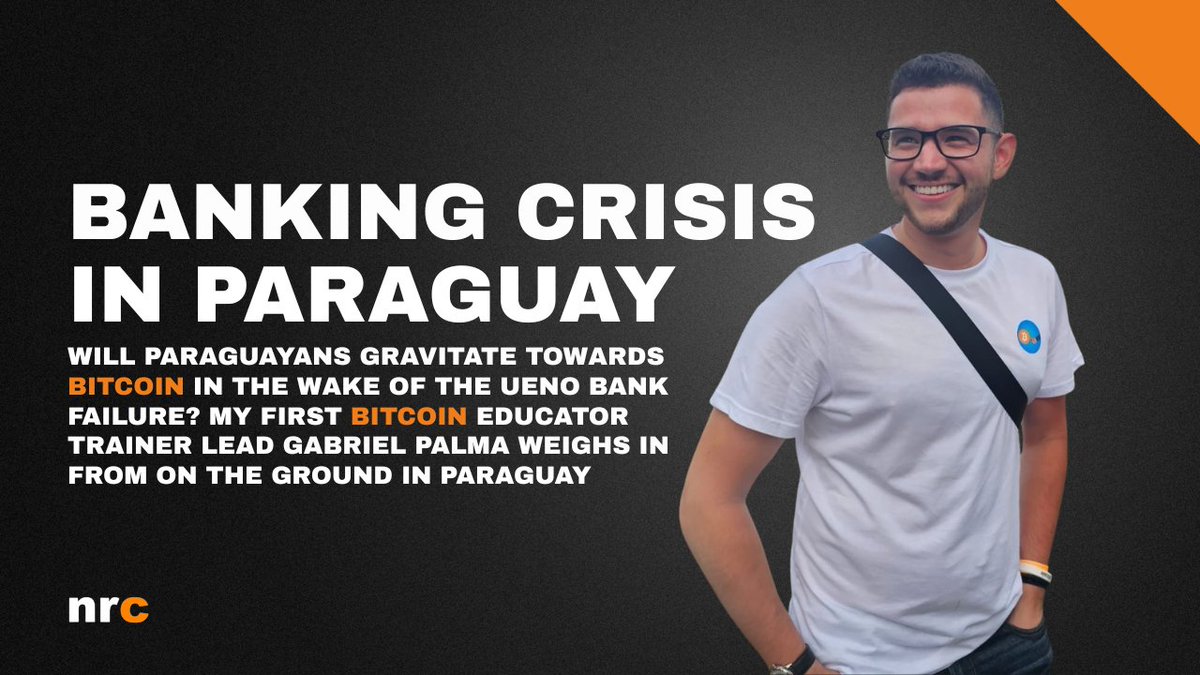
Will Paraguayans 🇵🇾 turn to Bitcoin in the wake of the Ueno Bank failure?
I asked this questions to @GabeBTCAdvisors of @MyFirstBitcoin_, who currently lives in Paraguay, and his response was sober, nuanced, and insightful.
Gabe also shared his thoughts and perspective on how Bitcoin enthusiasts in Paraguay foresaw the collapse of Ueno, how Paraguayans generally feel about Bitcoin, and whether or not Paraguayans will trust the banking system again.
This is an important listen for anyone looking to better understand the Ueno Bank crisis and what might happen in Paraguay in its wake.
1,985m Santos to De Bakke. 40:10, 2:01/100m. Cold Indian Ocean, early morning rhythm — @TheOfficial2XU doing its job. One week out from ISUZU IRONMAN 70.3 Mossel Bay. Swim leg locked in. 🌊⚡ #Triathlon
Capitalism calibrates at a higher frequency than communism.
Why is that?
Because, as Tom Benner puts it, "it's a more decentralized way giving individuals economic decision making power."
2hr morning ride on the @feltbicycles ✅ 60km • 28.2km/h avg
Puncture on the way back from Greatbrak — sorted at Reebok Total Garage. Appreciate the help 🙏
No excuses, just ride. 🚴🏿♂️🍊
Western society should feel pain until it starts treating privacy seriously.
This was one of the main messages the room at @bitcoinconfams agreed with… while not being much aware that by the end of this year everyone in the EU is set to have digital wallets on their phones (!)
We are gradually pushed to have ID for Internet access and… this digital ID on your phone will be most wanted thing for criminals to steal from your hands.
Why? To recall: these wallets will have simultaneous access to all your data, financial resources and communications, easy to steal, control and hack. And declared state protection seems not capable of responding to the most sophisticated threats we are observing now in Europe, hitting not only financial institutions but even grocery store refrigerators and blood banks.
I was glad to hear from privacy developers that they are working hard to respond to this challenge, while explaining that it is not a brand that will protect you, but your constant education and testing, investing in and safely operating the privacy tools you use.
Our panelists said we need better customer experience and protection for Bitcoin/Nostr payment and saving infrastructure, including hardware, while we cannot forget to protect privacy of communication, free speech as a fundamental human rights.
I'm grateful to everyone who joined our discussion and stays active in defending privacy tech. We definitely need to be more vocal.
Maybe we don't need to feel pain at all before privacy is recognized as a human right? What do you think?
Adopting Bitcoin Cape Town (@abcptza) has reached a crossroads.
For three years running, 2024, 2025 and 2026, we hosted three successful conferences, co-hosted by @Machankura8333 and ourselves, and run entirely by unpaid volunteers, without massive sponsorship. Pulling that off, three times in a row, is a significant milestone.
We also achieved something we set out to do: reach large civil society organizations and, through them, reach their members. And we didn't know who those organizations would be, but they showed up.
John Endres (@senderman) of the Institute for Race Relations (@IRR_SouthAfrica), Russell Lamberti (@RussLamberti) representing Sakeliga (@Sakeliga), and David Ansara (@DavidAnsara) of the Free Market Foundation (@FMFSouthAfrica) all spoke in 2024, 2025 and/or 2026.
This list is not exhaustive. And these aren't fringe groups. They're among South Africa's largest and longest-standing advocates for free market policy. And they have fought an uphill battle for exactly the kind of direction this country needs.
Our goal was to get them speaking to their audiences about Bitcoin, and that's happened.
Both The Free Market Foundation and the Institute for Race Relations have since published papers, videos and/or podcasts on Bitcoin:
https://t.co/d08jUm78z4
https://t.co/LopErApPfu
While both organizations occasionally discussed Bitcoin prior to 2024, since then both groups have formalized and significantly expanded their public commentary on the topic.
I'm not claiming we caused that single-handedly, but we definitely contributed to it, even if only in a small way.
So why are we at a Crossroads?
In 2026, the Treasury and the South African Reserve Bank dropped regulatory bombshells that were, to put it mildly, insane.
The direction they want to take is a walled garden: you can hold Bitcoin, you can use Bitcoin, but only through a regulated intermediary they control, one that can force you to sell at a price of their choosing.
Calling that a watered down version of Bitcoin is an understatement. It isn't a watered down version of Bitcoin. It's entirely fake.
And yes, there's been a reprieve with the SA Government recently backing down under intense pressure, but it's clear that they'll attempt it again.
That leaves us in a position where we have to decide: where does this conference go next? And the answer is right there in the name.
Adopting Bitcoin.
Adopting Bitcoin implies exiting fiat. You are not adopting Bitcoin if you are not exiting fiat. And if you claim to adopt Bitcoin while weaseling your way further into the fiat world, you are not adopting Bitcoin.
It’s quite simple. But easy to lose sight of.
"I'm into Bitcoin, but the fiat world is what it is, we have to play by their rules, we have to work with them, and we have to accommodate them."
This may all be true. But it invariably turns into an excuse to not exit fiat. And that's not a position we're willing to keep entertaining. And if you don't get that, what are we doing here?
To be clear, this isn't about refusing to talk to anyone. It's about being unambiguous about our goal. Adopting Bitcoin means actively and continuously looking for every opportunity to move further away from fiat.
Adopting Bitcoin does not mean buying Bitcoin and settling into fiat more comfortably while the BTC/FIAT price goes up.
This isn't a rebrand.
It's a re-alignment, a return to where @abcptza was always meant to go, but were slowly pulled away from by the realities of running a conference.
The companies that make real money are the ones that find ways to weave themselves back into the fiat system. It's brutally hard for a genuinely Bitcoin-only fiat-exiting company to turn a profit.
The massively profitable players in this space are crypto casinos and pseudo-banks selling you the idea that gambling is good. That's just the world as it is.
For that reason, funding a conference like this is genuinely difficult. When you're the one staring at a venue invoice, and you know half your speaker list won't show up unless you cover their flights, you end up working with people you'd rather not work with. Not because you sold out, but because there was no other way to pay for it.
So yes, we drifted. Not on purpose, but because of the economic reality.
But we never drifted so far that we've lost sight of where we're supposed to be.
So are are we going?
Bitcoin is a silent revolution. If you're not willing to be part of that, peacefully, but without compromise, then you're not adopting Bitcoin, and you're not exiting fiat.
Bitcoin is a paradigm shift. Paradigm shifts are not easy, gentle, comfortable, or profitable. They are, by definition, disruptive, unfamiliar and unsettling for almost everyone.
We don't know if this will work. We have no idea if we can even fund a conference like this going forward. And, if we take this stance, most of the sponsors who might have thrown us scraps will walk away.
@abcptza becomes a genuine grassroots conference, funded by ticket sales or not funded at all. The sponsors left willing to stand with us will be few. And none of them are the biggest players in this space.
But we'd rather attempt it that way, and fail, than keep drifting toward a place where the conference does not make it absolutely clear.
Adopting Bitcoin is all about exiting fiat.
And that is non-negotiable.
Tickets for 2027:
https://t.co/xiijayY0AJ
Conference website:
https://t.co/vLRrixtOU3
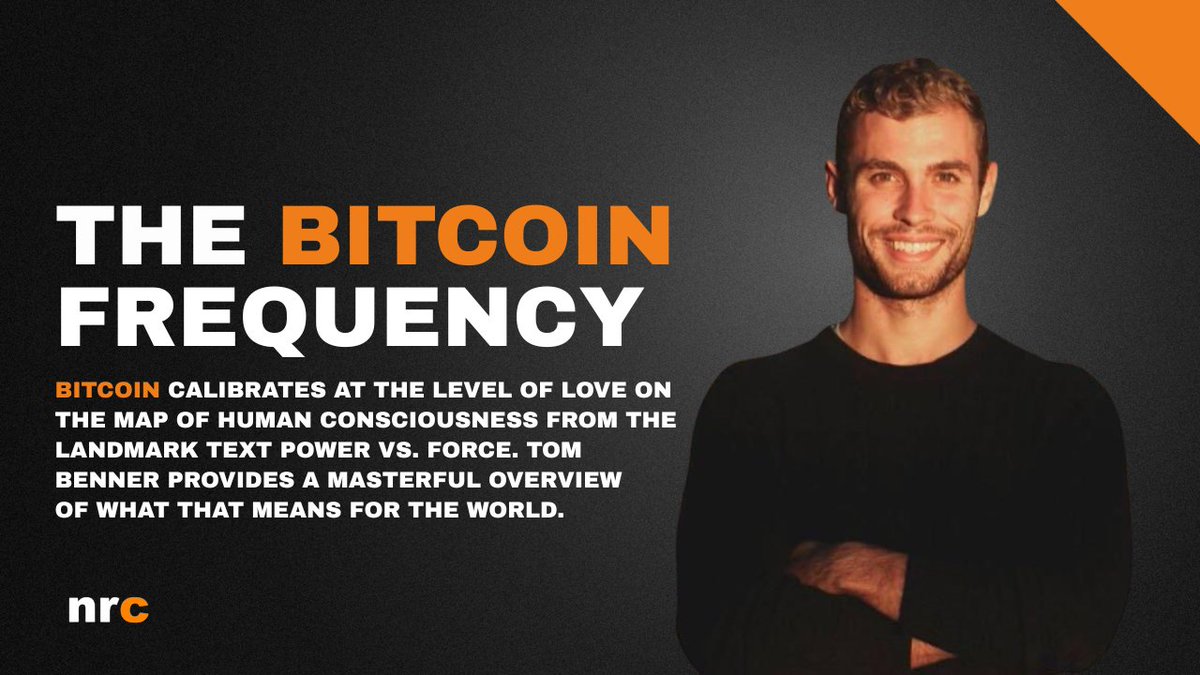
In the landmark text Power vs. Force, David R. Hawkins, M.D., Ph.D. shares a map of consciousness.
In the map, he quantifies different levels of consciousness via the frequency at which they exist using kinesiology as a diagnostic tool.
In the book, Dr. Hawkins shares the levels of consciousness of important world leaders as well as of systems like capitalism and communism.
One of the things he doesn't calibrate, though, is money itself.
This is where Tom Benner's work comes in.
Tom has worked with kinesiologists to calibrate both Bitcoin and various fiat currencies.
What he's found is that Bitcoin calibrates at the level of love, while fiat currencies calibrate at or around the level of fear.
In this conversation, Tom discusses his findings in detail and lays out what they mean for the world.
Enjoy!
Listen here (though, we highly suggest watching — the visuals are important):
Apple Podcasts: https://t.co/XuzQr89X7U
Spotify: https://t.co/mib0Hplj0i
Fountain: https://t.co/9X6LFeRfuD
In the landmark text Power vs. Force, David R. Hawkins, M.D., Ph.D. shares a map of consciousness.
In the map, he quantifies different levels of consciousness via the frequency at which they exist using kinesiology as a diagnostic tool.
In the book, Dr. Hawkins shares the levels of consciousness of important world leaders as well as of systems like capitalism and communism.
One of the things he doesn't calibrate, though, is money itself.
This is where Tom Benner's work comes in.
Tom has worked with kinesiologists to calibrate both Bitcoin and various fiat currencies.
What he's found is that Bitcoin calibrates at the level of love, while fiat currencies calibrate at or around the level of fear.
In this conversation, Tom discusses his findings in detail and lays out what they mean for the world.
Enjoy!