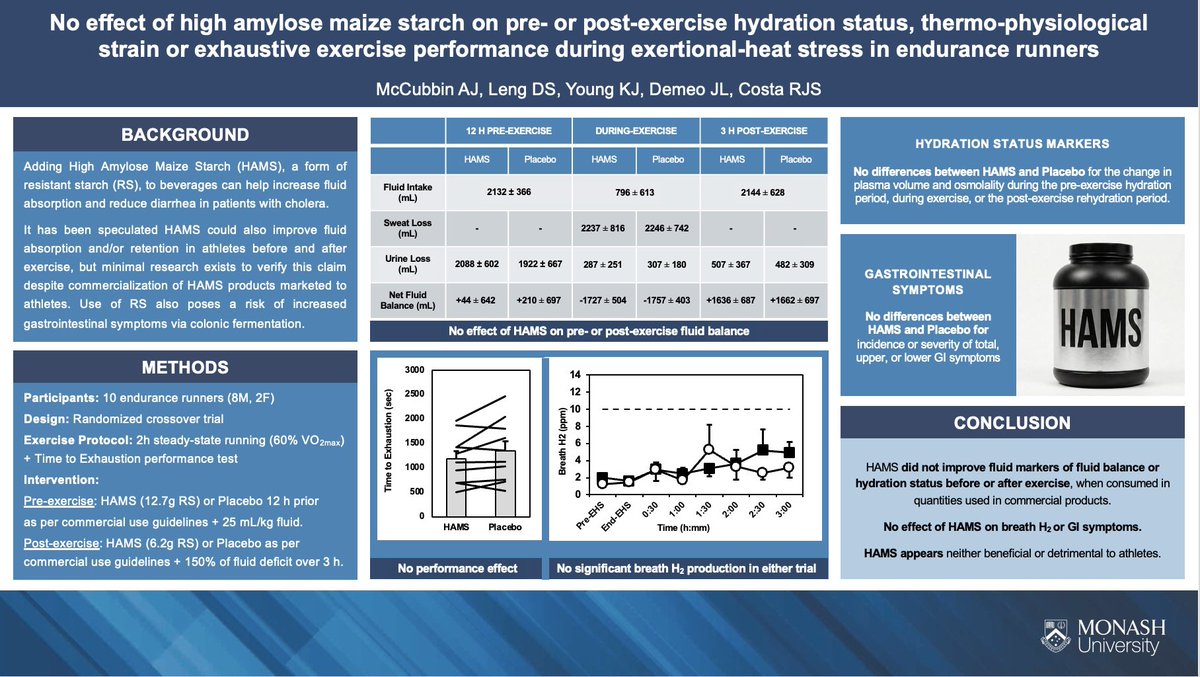
Interested in whether high-amylose maize starch (HAMS) can be used in an athletic context to improve exercise hydration? Read this paper by McCubbin and colleagues (2026) which features in our March issue.
🔗https://t.co/MdIqyvNo6J
NEW WEBINAR ALERT!
Join the webinar with Dr. Alan McCubbin on Sodium in Sport. You’ll walk away with a clearer understanding and a no-nonsense decision tree to guide when to use sodium, how to dose it, and when not to bother.
Secure your early bird spot now for £15: https://t.co/NZEdTmgtNc
Great news! This paper on the use of prebiotic supplementation for gut disturbances during exercise in the heat from our @MonashNutrExer team has been shortlisted for the @IJSNEMJournal publication of the year award 👏
Vote using the link below now! 🗳️
https://t.co/ohgdwt3r3y
1/3 Excited to see this published in the journal Performance Nutrition. For all the great research done, there's been a lack of clear, quantifiable guidelines for sodium intake before/during/after exercise, leaving a void for product marketing to fill. https://t.co/fz6QjBdEZY
🏃♂️💧New in #PerformanceNutrition: Alan McCubbin (@nextlvlnut) reviews sodium intake strategies for athletes before, during & after exercise. Key takeaway? It’s not just about sodium loss—it’s also about fluid balance.
🔗Read the article here:
https://t.co/FQ2doGOqoS
@TheBhupiThakur 2/2 Pretty rare someone can drink that much from a GI tolerance & practical perspective, & sweat rate >1.8L/h in ultraendurance (>4hr) sport is very rare because ex. intensity is lower. Key thing here is sodium replacement is linked to fluid & sodium BALANCE, rather than losses
@TheBhupiThakur 1/2 Signs are correct. Blood sodium stability (what the figure is about) means balancing water & sodium ins & outs. You need to drink ~ >70% of fluid losses for blood sodium to fall. If you're sweating >1.8L/h that means drinking almost 1.3L/h (or more), every hour, for >4hrs.
3/3 Big thanks @gareth_wallis & the editorial team at Performance Nutrition for inviting me to put this together, and of course colleagues, students & collaborators @MonashNutrExer & beyond who've contributed to work in the sodium space over the past 9 yrs https://t.co/fz6QjBdEZY
2/3 The paper is written specifically with practitioners in mind. It critically examines the common rationales given by athletes/coaches/practitioners/companies for sodium intake, and where possible provides implementable guidelines & scenarios for use. Open access = no paywall.
Incredibly happy to see this review from @Petermc8's PhD published in Comprehensive Physiology...with an online heat acclimation predictor!
https://t.co/XpgS14HbqW
https://t.co/mBWN8SQZX5
🚨 Calling all Western States Endurance Runners! 🚨
We’re recruiting for a research study on nutrition, core temperature, and GI distress during WSER! 🏃♂️🔥 If you're racing WSER 2025 and want to contribute to science, get in touch!
📩 Scan for details & please share!
Two papers.
On the left, a non-randomized, non-crossover study showing that a one-off sauna exposure significantly decreased arterial stiffness, with implications on cardiovascular health.
On the right, a randomized, crossover (more robust) study, showing no benefits on arterial stiffness or blood flow. Note the colossal difference in Altmetric score and media attention.
The media favors sensational but flawed studies over rigorous ones, distorting public understanding. #science #media
Thank you very much @nextlvlnut for inviting me to the podcast. A very well recognised and necessary project led by one of the best in the business.
So happy and grateful to be a little part of it, even if my English is not ideal (I tried it...) :) :)
https://t.co/BiFezWwmWJ
@mwkeenan@Bridie_OD great insight into Abrahamsen published earlier today - he went from 58kg to 78kg over a couple of years and started performing much better as a result https://t.co/EL8aiPvc8r
@__BenPrice Possibly a combination of this fluid retention effect and an ability for pros to stay in (or at least closer to) energy balance may be contributing
@__BenPrice But there are factors that alter all this regulation and have been documented in several multi-day ultra distance running & cycling events. One example: https://t.co/hOWJI5z90Y
@__BenPrice Sodium can skew fluid balance in the short term (hours to a day or so) but usually not in the longer term. Too many checks & balances for a high intake alone to induce that kind of fluid retention. Within hrs the kidneys ⬆️ sodium excretion & within days sweat glands do the same
Great to have @MckayAlannah on the pod last wk sharing the best way to take iron supp's.
https://t.co/jnSJnA2ldm
She's currently recruiting female runners/triathletes in Melbourne for the first ever head-to-head study in athletes of the 2 main iron supp types on the market 👇