this is f*cking gold
Anthropic published PDF on how their own teams actually use Claude Code.
Explaining real workflows from engineering, security, growth, and design.
Spec → Dispatch → Verify → Systemize
• Spec: they hand Claude a clear goal, then let it run, instead of typing every line.
• Dispatch: their growth team split work across sub-agents, hundreds of outputs in minutes.
• Verify: Claude runs its own builds, tests, and lints, so trust comes from proof.
• Systemize: they commit checkpoints and turn repeated workflows into commands. Security wrote 50% of them.
The key insight: their engineers don't write more code.
They set up the system, then review the 80% Claude ships on its own.
Read it now, then save the full breakdown below 👇
If you're on your way to building a billion dollar company that involves a web app, here are some of my notes on architecting the frontend.
if you don't do this, it's probably fine but one day you'll hire someone to fix it but truly that person could be doing some other higher value thing if you make some key optimizations on day 1
you don't even have to learn anything you're gonna tell your agents to do it anyways!
okay here it goes:
- Make your server code generate a openapi spec which then generates all the relevant client side code. Never do this by hand. Typing backend types instead of generating them should be banned
- You need to make a decision on how the client talks to the backend. rest/graphql works in which case please just use tanstack query. other libraries will look similar but tanstack query truly is goated.
- if you want linear style sync setups or offline mode, think about this HARD and architect it from day 1. Bolting this on later is so tedious.
- People like using plain react router but things have gotten a lot better since then. Try their new framework mode or just even use tanstack router. Use route data loaders.
- If you store a lot of state in query params, make that a first class citizen and make sure its type safe. use nuqs or tanstack query.
- Most apps just need a single state management situation for server state and thats it. If you have other bespoke needs, i have quite like zustand and xstate/store.
- If you have a super interactive app where things come in and out of view, theres a lot of frontend state to maintain, music is playing and what not, lock in and learn xstate. Trust me if you wanna keep ur sanity, you need to model ur frontend as a state machine otherwise you're gonna be deep in useEffect hell
- React compiler is here my friends, the days of useMemo and useCallback are gone. Update your priors accordingly
- Tailwind is easy and fun but makes it really hard to maintain a large app with consistent styling. You need a "agent-first design system/component library" but maybe this is a rant for another day
- Don't be afraid to hack your routing library to fit your needs more closely. A lot of apps have "drawers" to show additional info. You should 100% be able to say "here's a route, make it a drawer" and everything should be handled from there.
- Managing loading and error states using isPending and isError is madness. Lean into Suspense and ErrorBoundary.
- Figuring out a blessed path for websockets and SSE on day 1 i think will pay dividends in the long term if you're building anything AI related.
- If you're building a SPA, don't use next.js. it literally makes no sense. Why would you do this.
- Definitely deploy on Cloudflare or vercel. There are other services but trust, there have weird missing features.
- Assuming you build something people want, the next job is to build the factory so it can efficiently build the thing. Act accordingly.
One of my new favorite loops from Peter Steinberger (@steipete):
“Refactor until you are happy with the architecture. After each significant step, live-test the system, run autoreview, and commit. Track progress in /tmp/refactor-{projectname}.md.”
https://t.co/Ipm6CdHAFW
Anthropic Claude Code engineer:
"If you're watching Claude write code, you're the QA tester. That's not what you're paid for."
In 37 minutes he lays out how to get your keyboard out of the hot path entirely.
The shift is /loop. You tell Claude to wake up every 10 minutes and babysit your PRs, and it just does it, while you're nowhere near the laptop.
Routines do the same in the cloud, so the work keeps running with your machine closed.
He caps it with remote control: any session, on any surface, driven from your phone.
Watch the full talk, then grab the setup below.
If you have:
Hermes Agent
Claude Code & Codex Handoffs
Obsidian + QMD Memory System
Run Agentic Loops
Fleet Tailscale Mesh
Cron Jobs + Kanban Board
Agentic Workflows
Congrats you are the top 1% of the AI god stack
your agent can search Twitter, Reddit, and GitHub for free - zero API keys, zero billing 😳
agent-reach is trending on github with 23K stars. it lets your AI agent read Twitter posts, browse Reddit threads, search GitHub repos, watch YouTube videos - all without paying for a single API subscription
what your agent accesses for $0:
- Twitter/X posts, profiles, and search
- Reddit threads and comments
- YouTube videos, metadata, and search
- GitHub repos, issues, and profiles
- 10+ more platforms - all in one pip install
what this replaces:
- Twitter API: $100/mo for basic access
- Reddit API: rate-limited free tier, expensive at scale
- YouTube API: quota limits, pay for more
- GitHub API: generous but still rate-limited
why this matters:
- most AI agents are blind to the internet because APIs cost money
- this gives any agent real-time web access at zero marginal cost
- perfect for research agents, content radar, competitive intel, market analysis
how to set up (2 min):
> pip install agent-reach
> run: agent-reach doctor
> connect it to your agent as a tool
> done - your agent can now search the internet for free
important:
- uses direct parsing, not official APIs - no keys needed
- works with claude code, cursor, aider, langchain, any agent framework
- MIT licensed, fully open source
- not for production web scraping at scale - use for agentic research and prototyping
- 23K stars and trending - community vetted
let your agent browse Twitter, Reddit, and GitHub for $0
while everyone else is paying $100+/mo for API access
bookmark this before payying for extra api
↓ repo in comment
Andrej Karpathy quietly shipped the best second brain idea in years
not an app. a pattern.
let an llm maintain a wiki of your notes. you dump sources, it reads them, links them, files them. knowledge compounds like interest.
someone built it into a free claude code plugin. setup is two commands:
claude plugin marketplace add AgriciDaniel/claude-obsidian
claude plugin install claude-obsidian@agricidaniel-claude-obsidian
then open obsidian, open claude code in the same folder, type /wiki.
that's it. your notes are now queryable by claude and they get richer every time you read something.
bookmark this. best thing you'll build this weekend.
In twelve months, EVERY company will be running a Company Brain.
The teams who build it this year will spend the next year compounding. Everyone else is going to play catch up.
Here's what it actually is. You connect your Slack, your GitHub, HubSpot, all your tools into one intelligence layer, then build the org chart around it: a main brain up top, a fleet commander running the agent fleet, specialist sub-agents handling execution.
The reason it works is change management basically disappears. Your team already lives in Slack. You're just adding agents to the room they're already in.
You NEED to start building yours now. In a year this will stop being an advantage and will become table stakes.
Prepare for takeoff. ✈️ Flight simulator is now available globally on web to all users. https://t.co/hQP0No142P
We've recently added many our most powerful professional desktop features to web. Elevation profiles, new import types, but there's always been one other feature you've been asking us to add to the web version of Google Earth, just for fun...
Where will you fly? Share your best maneuvers, views, and flyovers with us!
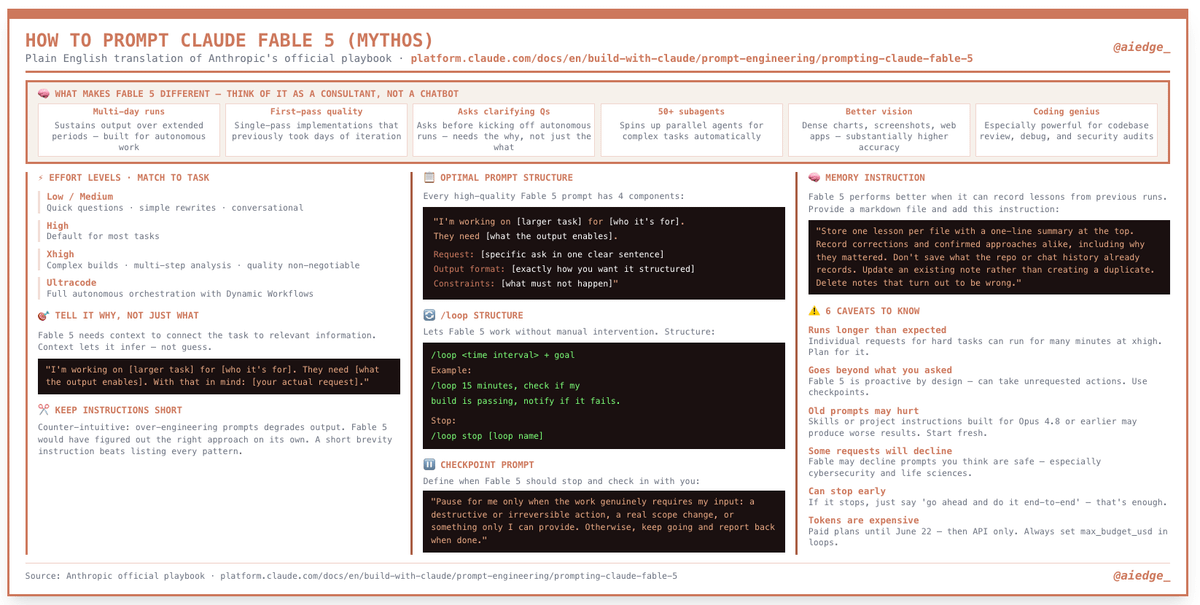
Anthropic just literally spoon-fed you how to use Fable properly.
99% of Claude users missed it.
The way you need to prompt Fable is fundamentally different from all other AI models.
I translated their entire new Fable prompting handbook:
Jenny Wen, head of design for Claude at Anthropic:
"the design process is dead."
what replaces it runs on machine-readable design systems
In a 1-hour conversation, Jenny Wen breaks down why the discovery -> mock -> iterate loop is dying and what designers do instead.
design system -> Claude Code -> every screen fixed at once, not one at a time
i rebuilt the same 10-screen dashboard twice:
~6 hours of restyling by hand vs ~40 minutes when the fix lived in the system.
how to build that system and hand it to Claude Code is in the article below.
This is the best way to use Claude Fable in Claude Code without immediately hitting your limits.
1. Model set to Fable 5
2. Reasoning on Max
3. Instruct Claude to run a dynamic workflow where:
3a. Fable is the orchestrator
3b. Opus does the reasoning heavy phases
Fable is so overpowered that you don't need its intelligence for every step.
Let it orchestrate Opus or even Sonnet.
Anthropic Managed Agents team:
"Fable 5 is our best model for running self-improving agent systems.
Add /loops, dynamic workflows, dreaming and you are unstoppable"
in 13-minutes, Anthropic team shows how to build self-improving agent systems with Fable 5 from scratch.
Worth more than a $500 agent building course.
Live from the last Anthropic stage in Japan. Unpublished.
i killed my Granola with Fable 5 and Minimi in one afternoon!
no more paying $20 for meeting transcriptions and querying my conversations. Now Minimi does that for me.
it also can capture offline discussions and make notes with insane accuracy. prompt in the caption.
one shotted this app - Mini-scribe (now my Granola alternative, haha!)
you can just do things 🙂
try minimi here- https://t.co/6S1DWWTGsJ
This is a fantastic article that breaks down Loop Engineering in a way that’s accessible even for non-technical folks. It perfectly connects to how I already use features in Codex and Claude every day—automations, skills, worktrees, sub-agents, and persistent memory—and shows how Loop Engineering ties it all together into a smarter, more autonomous system.
Instead of constantly prompting the agents yourself, you design the ‘loop’ (a recursive goal + verification cycle) that handles discovery, execution, checking, and iteration on its own.
Addy Osmani explains the five core building blocks beautifully and why this shift—from manual prompting to system design—could define the next era of coding with AI.