'Pathophysiological features of pre-clinical HFrEF and HFpEF models'
Alexa N. King (@uofg) examines the work of Méndez-Fernández et al. (2026) in this #JournalClub article ✍️
🔗 https://t.co/V5Ok1AYwwi
'Distinguishing #pathophysiological features of #heart failure with reduced and preserved ejection fraction: A comparative analysis of two mouse models'
Read the #Research by Abraham Méndez-Fernández (@TecSaludMX) and colleagues 👇️
🔗 https://t.co/e6pgwtDAUt
Lilly anuncia el estudio de Retatrutida en la pérdida de peso, a 80 semanas, con resultados espectaculares. Si éstos se trasladan a la clínica, la retatrutida opacará a la semaglutida y la tirzepatida.
Bien pudiera llegar a ser la droga de mayores ingresos en el mundo.
📣 Last few weeks to submit 📣
The deadline to submit to the Integrative human physiology in hypoxia special issue is 31 May.
Find out more here 🔗 https://t.co/pANNJSsPp7
JAPPL #APSselect for April 2026 (@Mick_Leahy_@UTSWMedCenter @UTSWPrimaryCareCoppell): The effect of sex on ventricular filling pressure during graded exercise in healthy young adults (https://t.co/b7696ZK0ej)
Please check this wonderful initiative supporting Mexican students through short internships abroad. Thanks to @DavidPosner13 and @CarlosMMinutti for this incredible effort to support Mexican science.
https://t.co/gOaGFWsIRn
Dr. Sanjiv Shah explains the H2FPEF score used to support clinical decision making. Watch “HFpEF Explained — Prevalence, New Advances, and How to Diagnose,” a new Double Take video, now available on our YouTube channel.
🎓️ EDITOR'S CHOICE🎓️
Skiles (@UofUPT) et al. show that an altered immune cell response and accumulation of senescent macrophages may disrupt tissue remodelling during recovery in aged muscle 🔬
🔗 https://t.co/HHio7U9XNu
Hoy es el Día Mundial del Riñón. ¿Tienes más de 40 años o diabetes, hipertensión o tomas analgésicos ? Debes conocer tu presión arterial, tu creatinina en sangre y un examen general de orina una vez al año. No te esperes a que te soprenda la necesidad de diálisis.
Both the UK and US Governments have pledged to end research using animals, but is such a goal
realistic? And how might it change medical research?
✍️ Talha Burki reports: https://t.co/LGA1Yxmj7r
Recent research by Melanie R. Bertossa and colleagues (@UniversitySA) observed that moderate #nutrient restriction dysregulates #molecular markers of calcium handling in the left ventricle of the non-human primate fetal heart 🫀 🍴
📜 Read the study: https://t.co/n4vSd5vttt
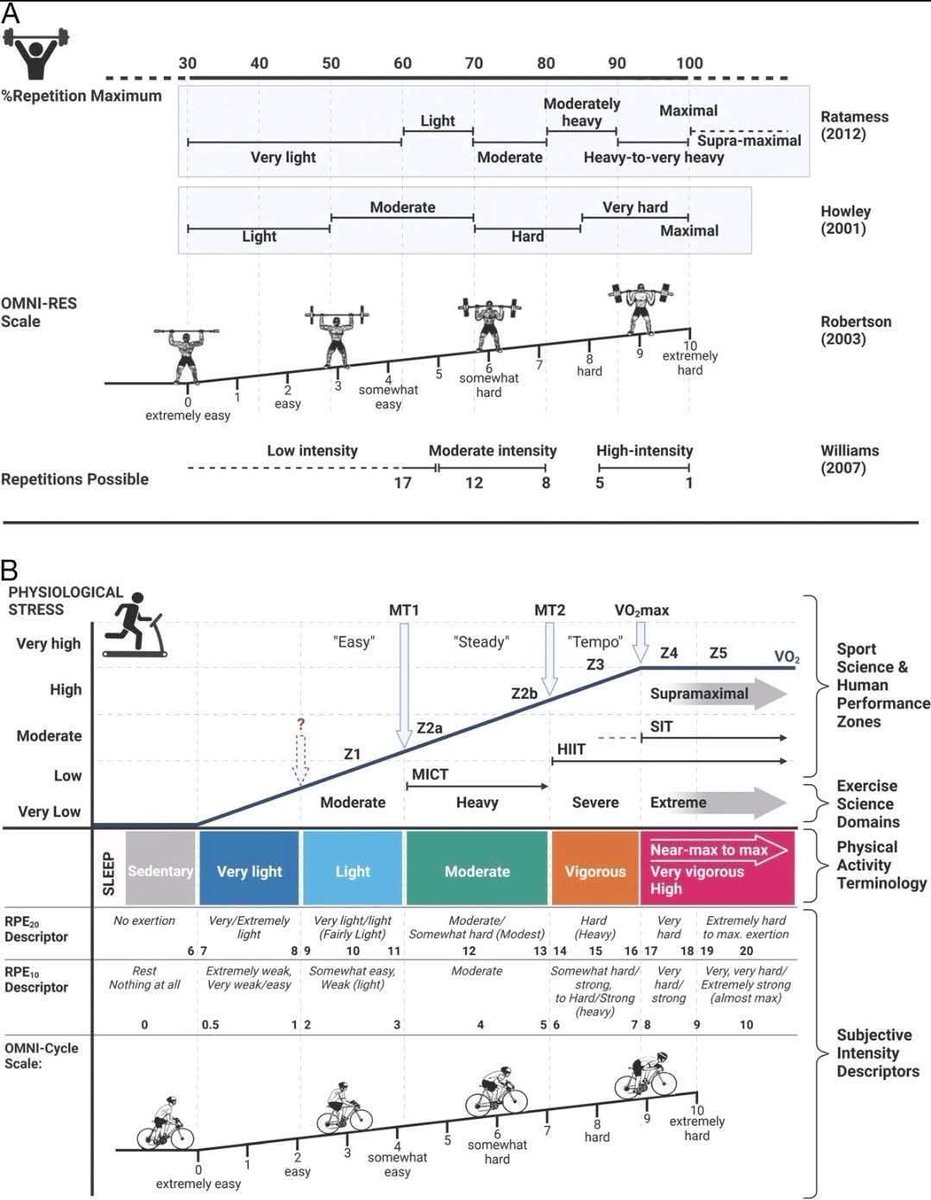
Understanding exercise intensity, effort, and physiological stress
This figure integrates both resistance training and endurance training frameworks to explain how exercise intensity, effort perception, and physiological stress align across different types of activity. It connects objective performance metrics—like repetition maximums and VO₂max—with subjective effort scales such as RPE and OMNI.
1️⃣ The intensity spectrum
Both resistance and endurance exercise exist along a shared continuum, from very light to maximal effort. As workload increases, so do oxygen consumption, heart rate, lactate accumulation, and perceived exertion.
🟢 Example: Low-intensity sessions (easy cycling or 30–40% 1RM lifts) promote recovery and aerobic base development, while high-intensity efforts (>85% HRmax or near-max lifts) target performance and power adaptations.
2️⃣ Resistance training zones (Panel A)
Resistance intensity is commonly defined by % of one-repetition maximum (1RM) and the number of repetitions possible before failure.
🟢 Example: 30–50% 1RM allows 15–20 reps for endurance work, while 80–90% 1RM allows 4–6 reps to build strength.
🟢 Example: “Very light” corresponds to an OMNI-RES rating of 1–3 (easy, long-duration sets), while “maximal” effort (OMNI 9–10) approaches neuromuscular limits with only 1–3 reps possible.
3️⃣ Endurance and metabolic thresholds (Panel B)
In aerobic training, intensity is structured around lactate thresholds:
LT1: The onset of lactate accumulation (transition from easy to steady aerobic work).
LT2: The point of rapid lactate buildup marking anaerobic transition.
🟢 Example: Zone 1–2 training below LT1 enhances mitochondrial density and fat metabolism, while Zone 4–5 work above LT2 improves VO₂max and anaerobic capacity.
4️⃣ Perceived effort and heart rate correlation
Across both modalities, the Rate of Perceived Exertion (RPE) mirrors physiological load. Moderate work feels “somewhat hard” (RPE 12–14), while maximal efforts (RPE 18–20) represent full exertion.
🟢 Example: Strength athletes use RPE or “reps in reserve” to auto-regulate intensity, while endurance athletes use heart rate and RPE to manage training load under varying conditions.
5️⃣ Training applications and adaptations
Understanding intensity zones allows for precise programming of stress and recovery to optimize adaptation.
🟢 Example: Endurance programs often follow an 80/20 structure—80% low intensity (Z1–Z2) and 20% high intensity (Z4–Z5)—while resistance programs balance heavy, moderate, and accessory work across weekly microcycles.
By integrating resistance and endurance frameworks, this model unifies how both strength and aerobic systems respond to progressive overload. It shows that whether lifting or cycling, exercise intensity is governed by the same physiological principle: the body adapts best when effort and recovery are carefully balanced along the stress continuum.
Bishop DJ et al. (2025). Physical Activity and Exercise Intensity Terminology: ACSM–ESSA Consensus Statement. Med Sci Sports Exerc, 57(11):2599–2613. DOI: 10.1249/MSS.0000000000003795
Ignacio Contreras-Hernandez and colleagues from @CprSpine investigated load and muscle-dependent changes in #triceps surae motor unit firing properties in individuals with non-insertional Achilles #tendinopathy 🦵 ⚙️
📜 Read the #Research: https://t.co/Sxas8ekUev
The brain’s immune response doesn’t run on mitochondria, at least not at first.
New research shows that microglia, the brain’s resident immune cells, respond to injury using a two-phase energy strategy. In the earliest moments after damage, these cells move, surveil, and begin cleanup using glycolysis (sugar-based energy), even though their cellular extensions initially contain few or no mitochondria.
Only later do mitochondria relocate into these active regions, once internal transport structures are reorganized to support sustained immune activity such as debris clearance and prolonged inflammatory signaling.
This reframes a long-held assumption in cell biology. Mitochondria are not always the first responders. Instead, cells appear to prioritize speed before efficiency (rapid energy first, long-term endurance second).
Microglia sit at the center of aging, neuroinflammation, and neurodegenerative disease. If early immune responses rely on glycolysis while later phases depend on mitochondrial support, then timing, metabolic flexibility, and energy routing become important variables in brain health.
This may help explain why mitochondrial dysfunction contributes to chronic neuroinflammation, and why therapeutic strategies may need to consider when and where mitochondria are engaged, not just how well they function.
In short, brain immune cells don’t just need energy. They need the right kind of energy at the right time.
Video Credit: Dartmouth College
References
- Pietramale AN et al. Nature Communications, 2025.
- Espinoza K et al. Nature Communications, 2025.
- MedicalXpress / Dartmouth College, 2026.