"Write Once. Run Forever: The Java Story" is coming July 17th! Check out the trailer now: https://t.co/Qvsbi2HnCR
The full film premieres on YouTube on July 17th at 7pm UTC. James Gosling, Java's creator, and other cast members, will join in the chat.
Hey Nico,
It looks like you didn't vibe code your data room but stole it from Papermark's open source and enterprise-licensed code.
We demand you take this copyright and license infringing product down immediately.
It's not moving fast and breaking things, it's fraud.
It makes the rest of your business questionable and the YC community look terrible.
cc: @garrytan@snowmaker@ycombinator
No software development organization needs a standardized process.
40 years ago, Watts Humphrey, funded by the US Department of Defense, came up with something called the Capability Maturity Model (CMM)—one of many grasping-at-straw attempts to get DoD spending and quality under control. The model was forced onto all DoD contractors and eventually infected the corporate world. Everybody at the time was doing hard-core, huge-design-up-front, phase-gated (waterfall) software development, and CMM assumed that was just the way the world worked. CMM thinking mandated that the entire organization standardize on a single process under centralized control. It was the military, after all. Hierarchy and uniformity were a given.
Like SAFe nowadays, CMM was better than chaos, but didn't really achieve its objectives by most measures. Nonetheless, ideas from CMM are the corporate version of the zombie apocalypse. They refuse to die and define an of-course-things-have-to-work-that-way alternative reality.
For example, it's a CMM notion that the entire organization must march in lockstep to the Scrum (or SAFe, or (formal) Kanban Method, or lately, Spec-driven-AI) drum. We don't. The people best equipped to figure out how to do the work are the ones doing the work. It's a system based on trust, based on the idea that the people you hired because of their competence are actually competent, and you have to trust them to get the work done.
In the best organizations, the teams come up with their own processes. Sure, they can draw on the Scrums and Kanbans of the world for ideas, but ultimately, no standardized process works everywhere (anywhere?). Processes must be customized to the needs of the teams. This is not a new radical notion, by the way. Toyota has been doing it on its lines for 60 years.
(Sidebar: the people in the "don't understand Agile but nevertheless hate it " community claim that Agile advocated no process at all. That's nonsense. Process is good, but you need agility in your process thinking. Self-organizing teams figure out the best way for the team to work. They have a process, just not _your_ process.)
Of course, you can't have an every-team-for-itself chaos. The system is not adversarial, full of lazy people who hate one another, as many seem to think. The teams coordinate with each other constantly and adjust and adapt as needed. (Spotify calls this "alignment.") If they can't find alignment, management provides coordination and guidance (not directives and force) and always provides active support. Alignment is hard to do remotely, so get everybody together in one room every so often.
So, process is good. Trusting teams to figure out how best to do their own work is good. Whipping people into uniformity is not. Let's all start acting as if we're a community, not a gulag.
🎉 To celebrate 15 years of Kotlin, we're offering free access to select Kotlin courses on Hyperskill.
Deepen your Kotlin knowledge with hands-on, project-based learning and continue building real-world experience.
Keep learning Kotlin 👇
https://t.co/wuu7P7cWf6
Startled to find out that there are young people who haven't read James Iry's magnificent "A Brief, Incomplete, and Mostly Wrong History of Programming Languages". Please drop what you're doing and head over.
https://t.co/bnzifwQ2p9
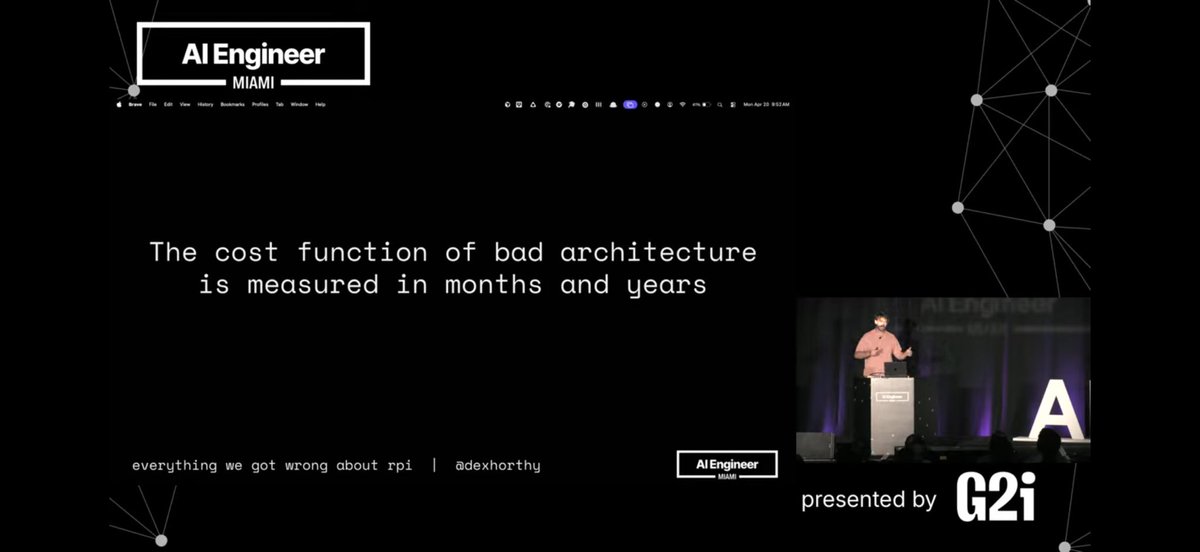
“why do we still need humans in the loop for the design of software”
Because the cost function of bad architecture is measured in months and years, and it’s hard to measure that in an RL environment/benchmark like SWE bench multilingual that is measures a 5-10 minute “can we write the code and get the tests passing”
Spoke about this at @AIEMiami - been Obsessed with this after a convo I had with @calvinfo back in April
https://t.co/C3rmDMBQnP
Most who interact with an LLM such as @OpenAI or @claudeai treat their interaction as a conversation with an intelligent and friendly pseudo-human.
I do not.
Rather, I frame it as my guiding the exploration of a latent space.
Imagine that you stand at the door of a library. It's not only filled with books, it has waldos - remote manipulators - that you can use to command devices to go to and fro at command, even building things as so directed.
But I steadfastly know that while the lobby may be filled with the latest bright and shiny things, if I want to do anything but the most common and mundane, I must wander through the rooms and stacks of books. If I look closely, I'll will see many books out of place. Some will even have meaningless content as if written by a madman (and some of them probably were). There will also be huge gaps, for where I'd hoped to find information, I'd instead see cobwebs and the occasional dusty, torn scrap of paper.
Sometimes, there are hints as to where I should turn, but best knowing my context and needs, I'm the only one in place to know if those hints will lead me to something of value. If I'm not paying attention or am just plain lazy, they will lead me down paths that in the end are a complete waste of my time. The library does not care: it gets paid no matter what I do as long as I remain within its walls.
Mind you, I enjoy visiting that library: I often learn things and build things of value.
But I don't outsource my life there, for were I to do so, I know I'd become even more cognitively lazy.
Prompting + human code review only works if the humans have technical knowledge, which will likely decline if humans are no longer writing code.
The devs of today will become the ivory tower architects of tomorrow.
What is the fundamental measure of quality in software? It isn't speed, and it isn't security. Those things are important, but the absolute fundamental measure of quality in our industry is our ability to change the software. Everything else is secondary.
🧵 1/5
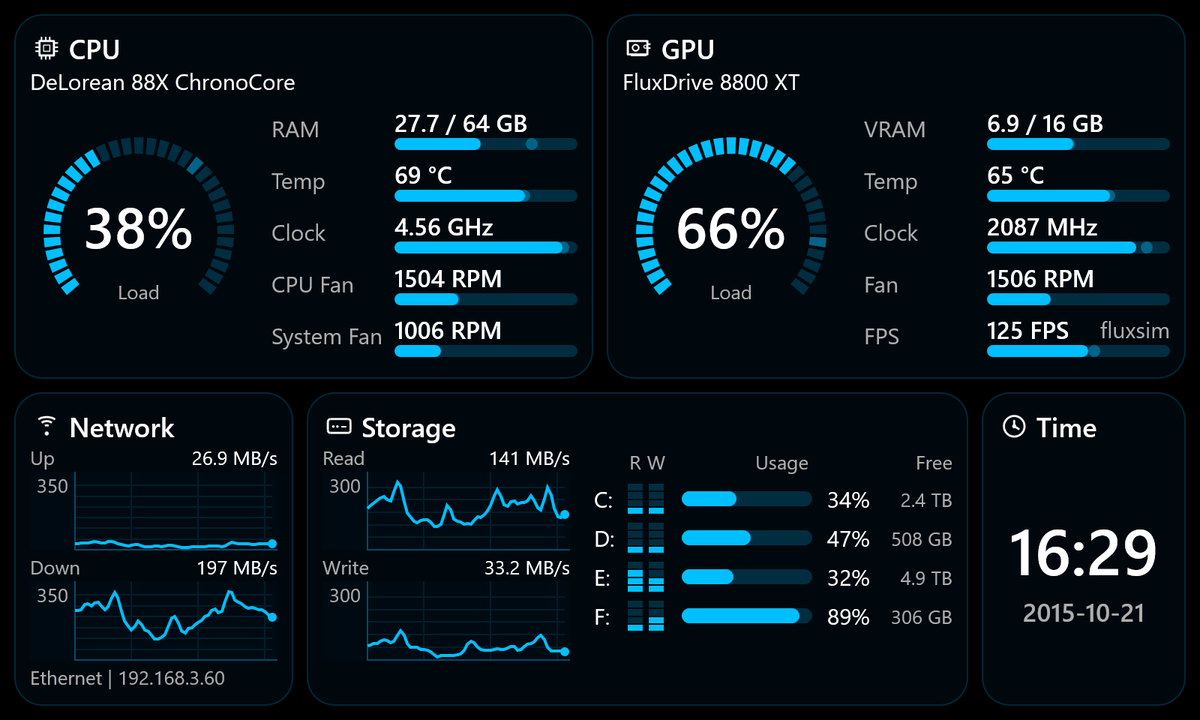
It is time to share the thing I’ve been building. Welcome CaseDash: a dashboard for PC telemetry screens. It shows CPU, GPU, FPS, memory, network, storage, board sensors, and time in a native interface built for always-on visibility.
Fragments: updated guide on AI coding, video on harness engineering, how long should a function be, the problems of Software Brain and why AI is unpopular
https://t.co/7jSOtMhEE8
When you write code with AI, the rules of software engineering do not suddenly disappear. A developer can turn code into unmaintainable mess in months, AI can do it in days. Just like it always was: if you need maintainable code, pay a lot of attention to architecture and tests.
This is not emphasized enough but architecture and tests are related. We spend a great deal of time on software architecture to enable testing of its components in isolation. That, in turn, is the only way to scale software without compromising its quality.
I think now is a great time to be a junior developer.
But I'm worried.
The pressure juniors feel: I was hired to do a thing. The faster I do it, the prouder they'll be.
But you can go very fast in exactly the wrong direction.
The most important skill, stepping back and starting over, is being optimized away.
Ep. 03 of Still Burning is out now.
https://t.co/Qbzib1mnzt
🇻🇳 Introducing - Wander Saigon
A field guide to Ho Chi Minh City - how to land, move, eat, drink, work, and live in a city of tiny plastic chairs
Built with Claude Design.
This started as the "Living Cashless in Saigon" article - And that wanted to be a field guide.
Monocle for Nomads 🧐
So I prototyped it in Claude Design - laid out the chapters, designed the typography, built the grid of photographs, and built a mega-directory.
When the scope got serious - I moved it to Claude Code and shipped it as a static site.
→ https://t.co/JwBjvHWe3S