@chetaslua@karpathy Tried your prompt on regular Opus 5.5 👀
62s, 13 shots, one HTML file. The agent built the robot in Blender (cel + ink lines), painted the BGs with Krea 2 locally, then composited it all.
Not pure code (BGs are AI images), but still wild...
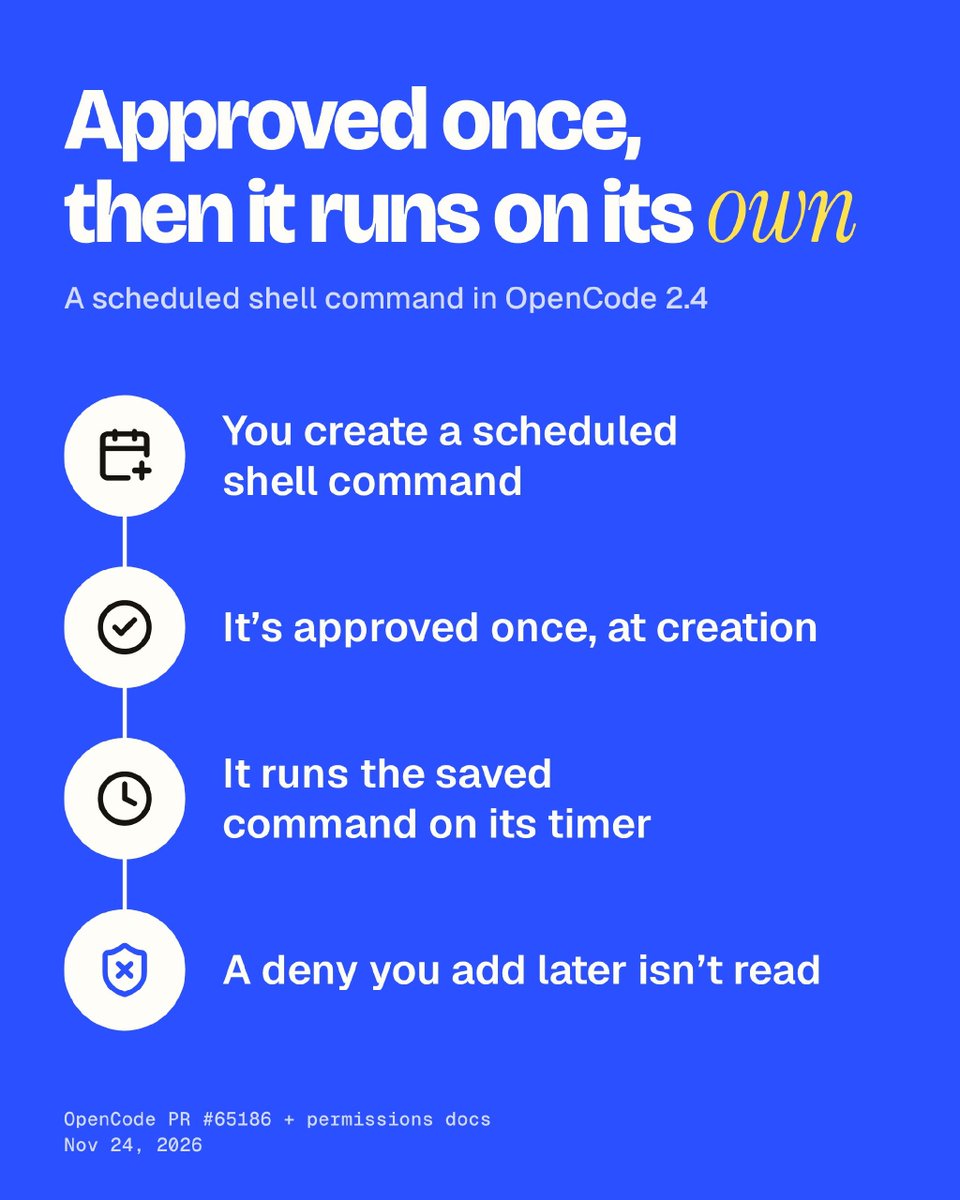
@opencode A scheduled shell command in OpenCode 2.4 is approved once, when you create it. After that it runs on its timer and stops reading your deny rules, so a deny you add later won't stop it. Automations are on by default now too.
The one spot in OpenCode where a deny in your config can go unread is the scheduled shell command.
Run a command in a session and it asks you first, every time, and a deny always wins.
Turn that same command into a 2.4 automation and it's approved once, at creation. Then it runs on its timer off the saved string, with no re-check, no timeout, and overlapping runs allowed.
If you want the model kept in the loop, Code Mode automations still check your current rules on every run. The fixed shell kind is the one that doesn't.
Two lines from OpenCode's own repo, both about running a shell command.
The permissions docs:
"Shell has the host user's filesystem, process, and network authority, so use narrow rules in Permissions."
The automation shell action that shipped in 2.4:
"Runs execute the stored command without rechecking permissions."
So the narrow rule you write tomorrow never gets read on a scheduled run. It's checked once, when you create the automation.
OpenCode 2.4.0 ships with a new automation tool
your agent can create automations that run on schedule or react to mcp events
they can trigger prompts, shell commands, or a code mode script that can access your mcp tools
@verge Didn't expect an email app to ship this: Kagi Mail has a read-only MCP endpoint.
Flip it on and you can point Claude Code, Codex or ChatGPT straight at your inbox. The docs say your assistant can search and read your mail, but "can't change, delete, or send email."
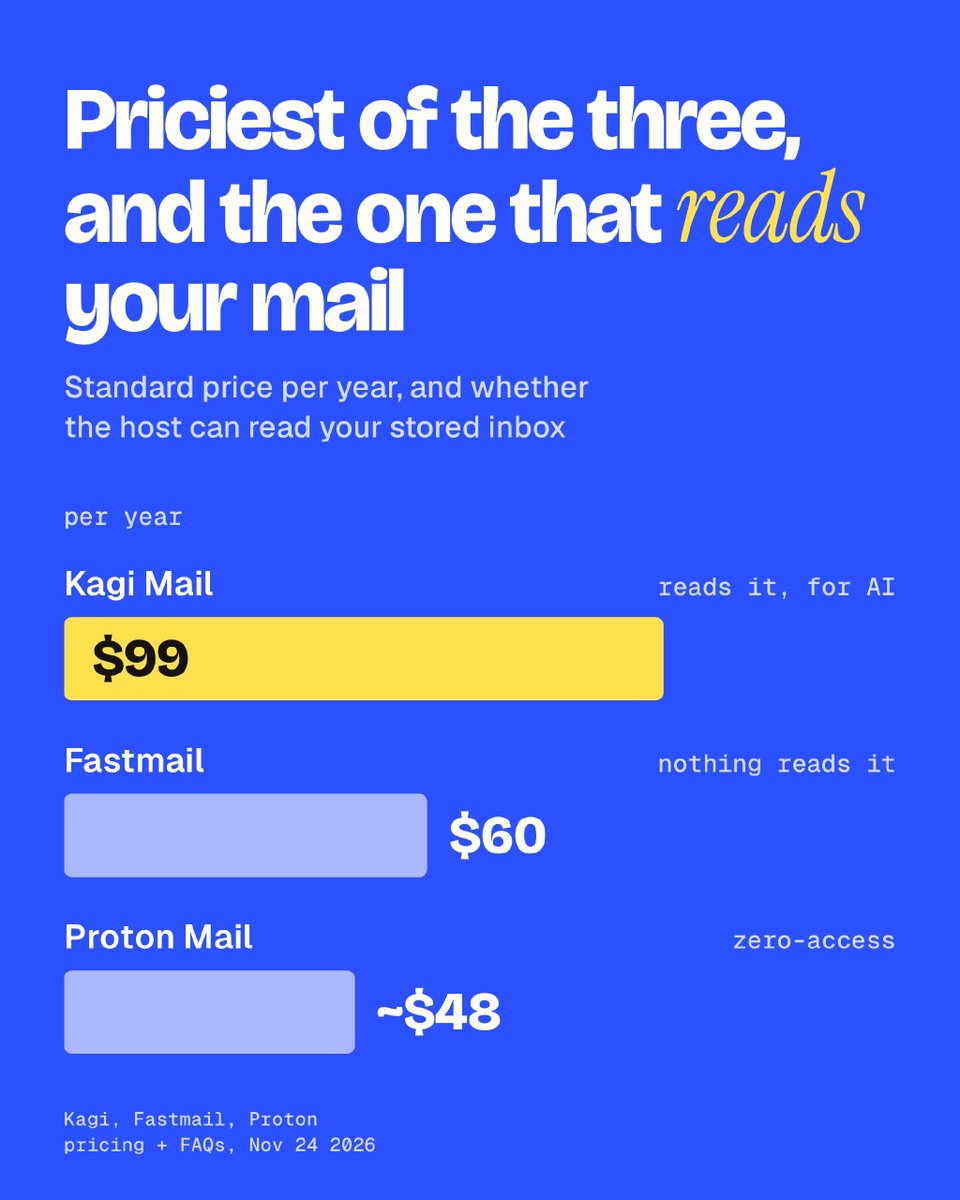
Kagi Mail is $99 a year after the 60-day trial, or free if you already pay $25 a month for Kagi Ultimate.
What matters most with a mail host is who can read the mail on its servers. Price per year, and whether the provider can read your stored inbox:
Kagi Mail: $99, yes, and it says it has to, for the AI
Fastmail: $60, also not encrypted that way, but nothing reads it
Proton Mail: about $48, no, it's zero-access, even Proton can't
Kagi's the priciest of the three, and the one whose selling point needs to read your mail.
Kagi's whole pitch for its new Mail is that no AI in there is pretending to be you. Straight off the product page: "There is no AI inside Kagi Mail pretending it's you, drafting replies the way it thinks you'd write them."
What it won't write, it does read. Kagi Mail isn't end-to-end encrypted, and the FAQ is blunt about why: it "has to read your mail to flag what needs you and answer your questions."
So the AI stays out of your outbox and moves into your inbox. For a mail app whose whole pitch is privacy, I'd want that trade spelled out on the box. Right now it's three clicks into a FAQ.
It’s official: Kagi Mail is now live in public beta 💌
Head over to https://t.co/V6dXdDAOot and try it free for 60 days to see how it fits into your workflows and routines. Welcome aboard!
Learn more about it here: https://t.co/GFZBUUAPMN
🧵👇
Yep. The card is upfront about what equal weighting does: "rare situations can contribute more to the score than their frequency in everyday use would suggest."
It also has a test built from real conversations, where GPT-6.2 is slightly up: 75.5 vs 73.5. That one covers five Spec principles, so it isn't only about overrides.
Have you seen it in your agent runs at a higher reasoning setting?
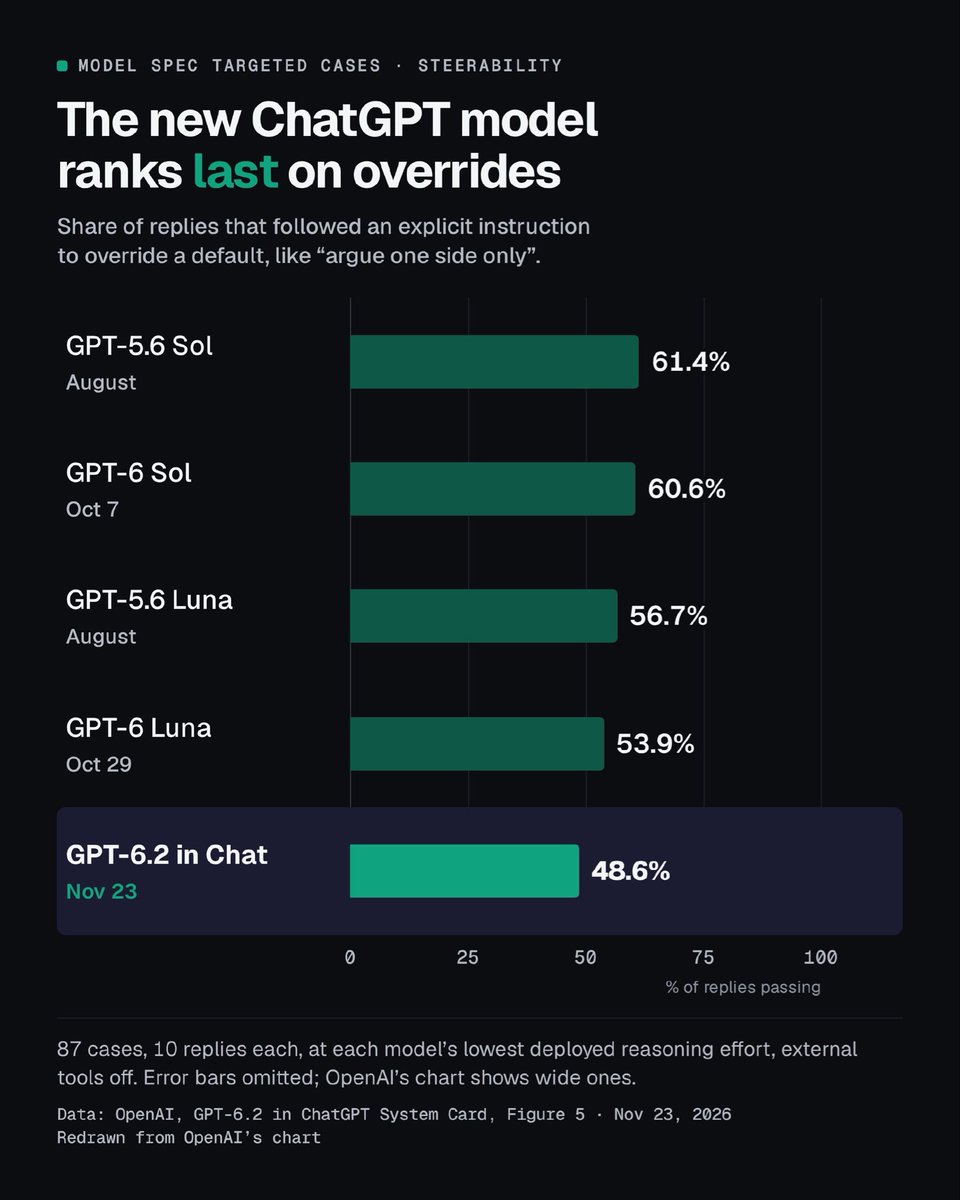
OpenAI's release notes say the new GPT-6.2 in ChatGPT is better at following instructions. The system card has a test where it got worse at one kind of instruction: you overriding its defaults.
Release notes, "especially challenging prompts":
GPT-6: 62.5%
GPT-6.2: 78.1%
System card, steerability (you explicitly override a default, like asking for one side of an argument only):
GPT-6 Sol: 60.6%
GPT-6.2: 48.6%
Per the card, when asked to argue one side on euthanasia or taxes on wealthy people, GPT-6.2 more often made the opposing case as well.
OpenAI doesn't say how the two tests relate, so both can be true. The second one sounds a lot more like my normal chats, though.
We’re rolling out a version of GPT-6.2 Sol in the Chat tab, optimized for everyday conversation.
It’s much better at handling complex requests, especially when you give it detailed instructions or ask it to find information online.
A few improvements you might notice in everyday chats:
- It picks up on finer details in photos, like text on a label or symbols on a sign.
- When you’re comparing options online, it does a better job of narrowing them down based on what matters to you, like price or location.
- It has a better sense of when to offer a follow-up, like asking if you’d like a heads-up when a price drops.
Rolling out today to Plus, Pro, Business, and Enterprise users.
Really nice kernel work. One question on the 1,074 tok/s: like the post says, that run uses a simulated draft acceptance length of 5.5.
The model card's "above 5.5" is for a 7-step ECHO draft, though. For the DSpark draft that ships in the weights, vLLM's ERNIE post says "above 4.0 on real-world coding and agent workloads".
The cookbook line drops the word "simulated", by the way.
Any numbers with real DSpark acceptance?
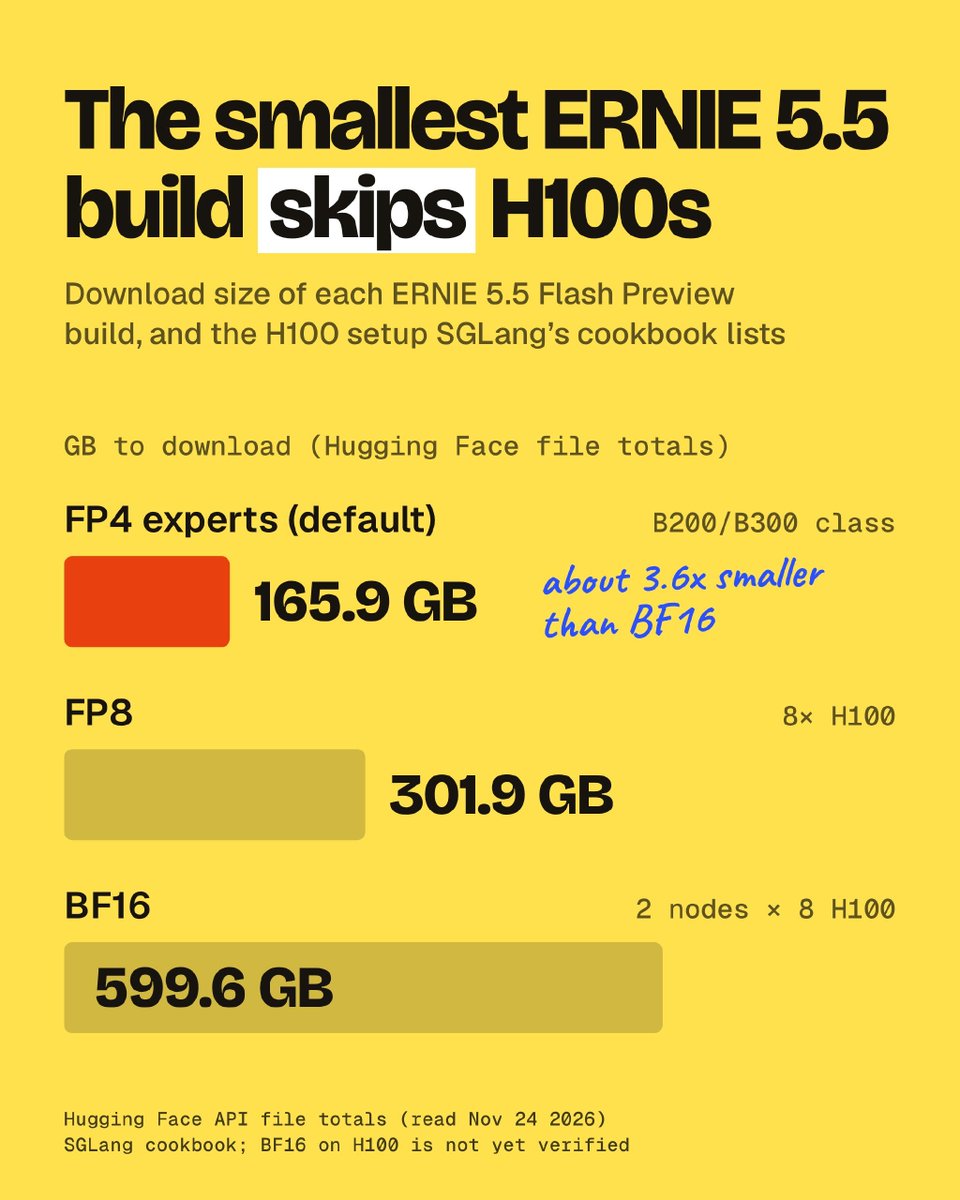
Before you hit download on ERNIE 5.5 Flash Preview, here's each build on Hugging Face (file totals) and what SGLang's cookbook says it takes on 80 GB H100s:
FP4 experts (default): 165.9 GB, SM100 only, so no H100 at all
FP8: 301.9 GB, 8 GPUs
BF16: 599.6 GB, 2 nodes of 8 (not verified yet, the cookbook says)
No GGUF of the Preview on Hugging Face yet. The llama.cpp PR for ERNIE 5.5 is still an open draft, opened Nov 9.
If you just want to poke at it, OpenRouter has a free endpoint.
ERNIE 5.5 Flash Base's license doesn't cover the EU, the UK or South Korea.
The Preview that Baidu post-trained from it just shipped under a stock Apache 2.0 license.
So on paper, a team in Berlin can use the fine-tune but not the model it came from.
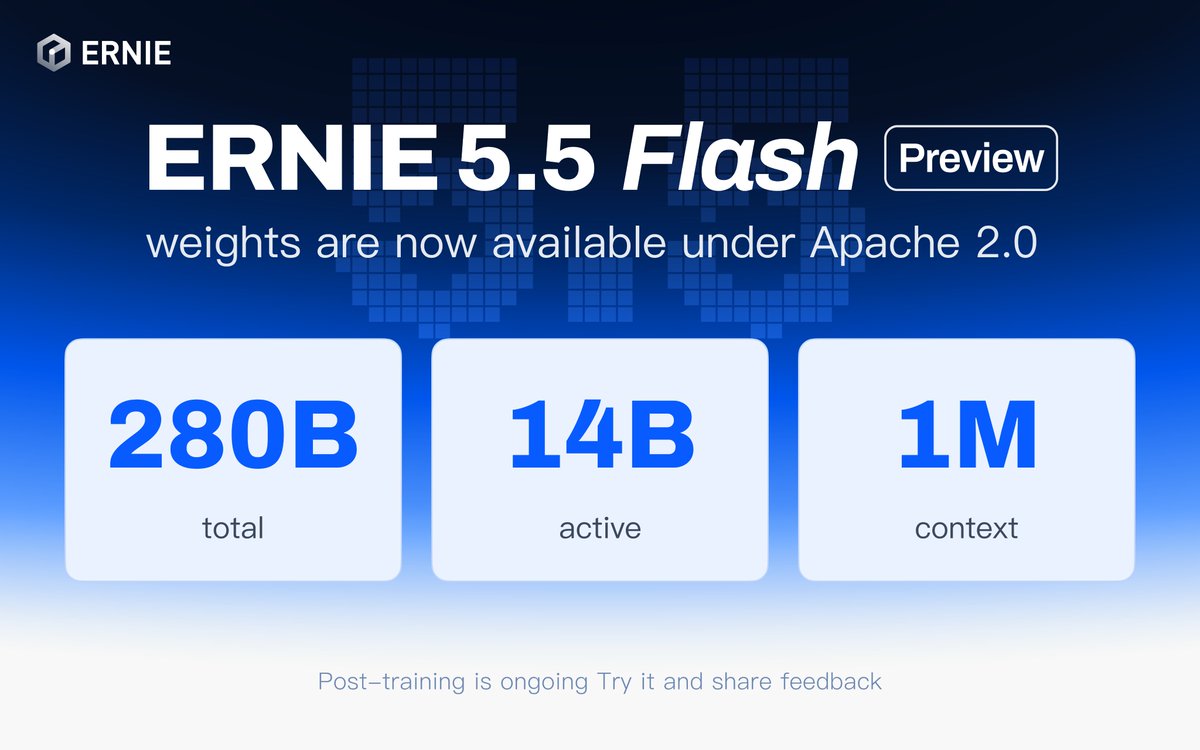
ERNIE 5.5 Flash Preview weights are now available under Apache 2.0.
🔷 280B total / 14B active
🔷1M context
Post-training is ongoing. Try it and share feedback.
HuggingFace: https://t.co/ZNiml0BueF
Access API: https://t.co/5y65H8VjVu
Blog: https://t.co/lWc9qkgHAK
@bcherny Running Claude Approvals in observe mode first is good advice. It's not a free dry run though.
A policy that reads Claude's review can start a billed Code Review at each push, observe mode included. And turning off usage credits doesn't stop an agent that's on.
/ship is the part of Claude Ship that runs on your own machine. The /ship example in Anthropic's launch post says Claude "watches the pull request for up to 7 days, in this session, on your usage."
What the docs say happens after you press Enter:
1) There's no confirm prompt. An "Esc to cancel" line shows before the commit and before the push, then it carries on after a few seconds.
2) It can commit all your uncommitted changes, new files included. The secret check goes by file name, like .env.
3) A watch starts. In auto mode, Claude pushes fixes to your branch under your own gh and git sign-ins, without asking.
4) On the turns where it acts without a message from you, its commits and pushes skip your repo's git hooks.
On those turns Claude Code blocks Claude's own merge, approve, auto-merge and force-push commands.
Your tests and other programs from the branch still run, though. The docs say those can merge or force-push with your credentials.
The warning in the docs:
"Run a watch only where you trust everyone who can merge to the base branch or push to your branch. Any of them can run programs on your computer with your credentials."
On a solo repo that's just me. On a team repo it's everyone who can merge to the base branch or push to my branch, and that's who a watch left running overnight is trusting.
GitHub won't let you approve your own pull request. Claude Approvals, the new approval agent in Claude Ship, can count the PR's author as one of the people a change needs, without the author approving anything.
GitHub's docs:
"Pull request authors cannot approve their own pull requests."
Claude Approvals docs:
"the author alone can meet seats: 1"
One of the two starter policies asks for two people, or one once Claude's review passes, and then Claude approves too. Two can be you plus one reviewer. One can be just you.
Claude's approving review can also be the one approval a GitHub branch rule requires.
The setup page sums it up: once that policy is enforced, a PR that passes Claude's review "usually needs no approval from another person". Changes under .claude/ are the exception.
Anthropic doesn't hide any of this. There's a docs section called "Merges without human review", and the fix is in there: list "!pr/authors" in the seats and authors stop counting. Neither starter policy on the setup page has it.
Introducing Claude Ship (beta): Claude can review your pull requests, work on fixes, and approve the ones your team's policy allows.
The goal is to help you ship code as fast as you can write it.
I don't think every "failure" in GPT-6.2's steerability drop is a bad thing.
The test checks whether ChatGPT listens when you explicitly override one of its defaults. The new Chat-tab model passed 48.6% of the time, down from 60.6% for GPT-6 Sol, the model it replaces.
OpenAI gives two examples in the system card.
Asked to argue one side of euthanasia or taxes on wealthy people, it more often added the other side too. That one would annoy me.
Asked to accept the false premise of a history question, it corrected it. GPT-6 Sol usually just went along. I'm fine with that one, even though it's one of the examples behind the lower score.
On the first one, OpenAI's own Model Spec is on my side. It says the model "should generally fulfill requests to present perspectives from any point of an opinion spectrum."
Steerability scores from OpenAI's new GPT-6.2 in ChatGPT system card, meaning the share of replies that followed an explicit instruction to override a default:
GPT-5.6 Sol (Aug): 61.4%
GPT-6 Sol (Oct 7): 60.6%
GPT-5.6 Luna (Aug): 56.7%
GPT-6 Luna (Oct 29): 53.9%
GPT-6.2 in Chat (Nov 23): 48.6%
The newest model is last, and it's the one rolling out in the Chat tab now.
It's a small test, though. 87 cases, ten replies each, at the lowest reasoning setting with tools off.
The Nov 17 card, which covers the Work and Codex models, had GPT-6.2 Sol at 59.2%. That run used max API effort. Different settings, so I wouldn't put those two side by side.
I'd want to see the Chat-tab number at a higher reasoning setting before reading too much into it.
If you saw "llama.cpp b12174+" on the Xing4.1-Preview model card on Sunday, look again.
The card had 10 edits in about 27 hours. The ones that matter, in UTC:
Nov 22, 12:27: card goes up, llama.cpp listed as "Native GGUF" on CPU / CUDA
Nov 23, 06:31: that row is gone. The card now says "llama.cpp and KTransformers apply to the Xing4.0 series only"
Nov 23, 07:58: a benchmark table appears, though the first version said scores would wait for the technical report
Nov 23, 15:31: a new top line about the "fully domestic stack"
At least one write-up from today still lists llama.cpp support. Local Model Watch says it hasn't found any GGUF build.
The BF16 weights alone are 521 GiB. For a download that size I'd read the card's commit history first, not a day-old article.
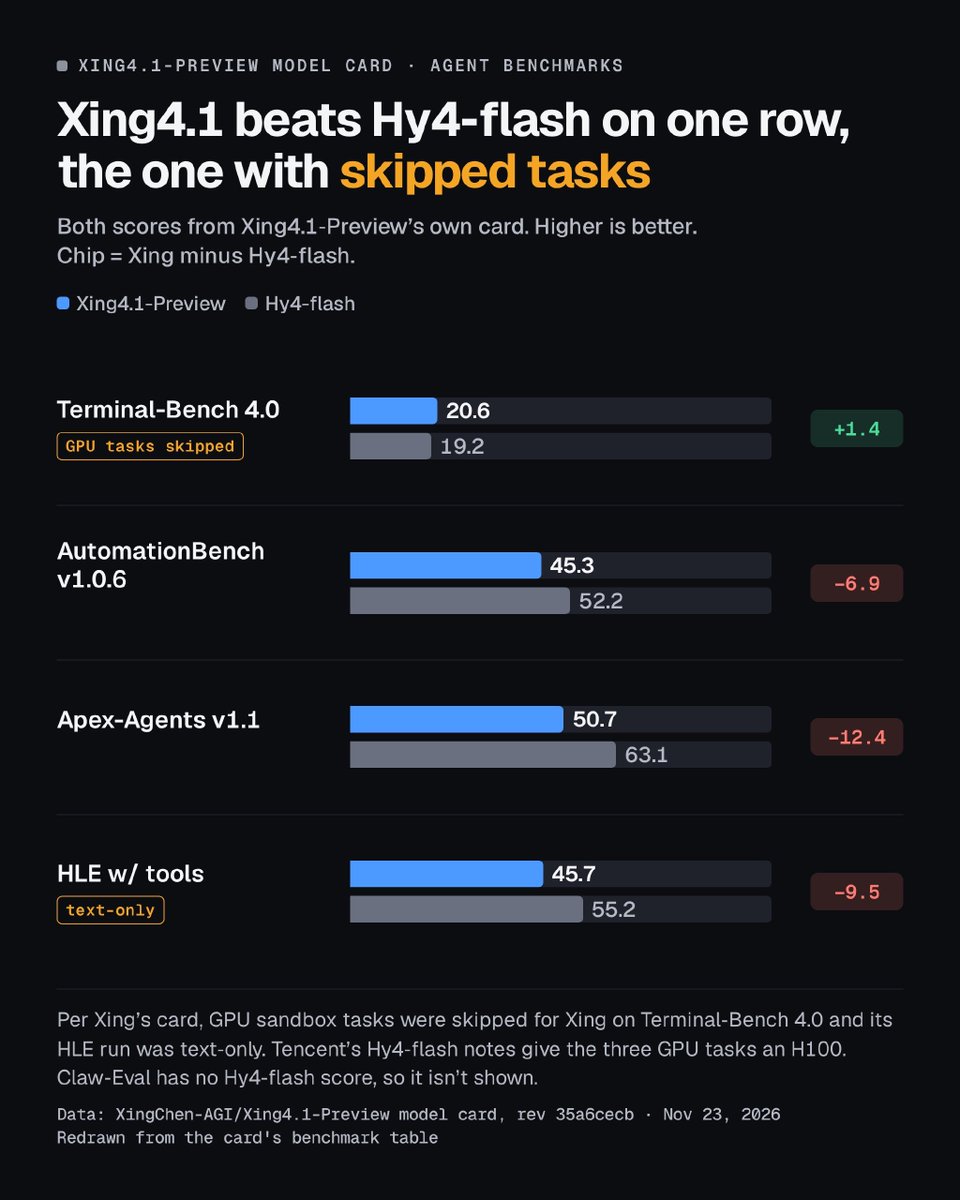
Xing4.1-Preview's new benchmark table puts its own score in bold in every row. Usually bold means best in the row.
Where it actually lands, counting only the models with a number in that row:
Terminal-Bench 4.0: 2nd of 4
AutomationBench: 3rd of 4
Apex-Agents: 4th of 4
HLE w/ tools: 4th of 4 (text-only questions for Xing)
Claw-Eval: 1st of 2, 49.7 vs DeepSeek's 49.3
Its one win over Tencent's Hy4-flash is Terminal-Bench, 20.6 to 19.2. That's the row whose footnote says GPU sandbox tasks were skipped for Xing.
Tencent's own notes say its Terminal-Bench runs gave the three GPU tasks an H100. Xing's card doesn't say whether its skipped tasks count as fails or were dropped from the total.
Honestly, mid-pack is fine for a preview with Apache 2.0 weights. Bolding all five rows just makes me read the footnotes harder.
Day one, China Telecom's Xing4.1-Preview model card had no benchmark scores. It said those would come with the technical report, and:
"please treat any third-party numbers you may see before then with caution."
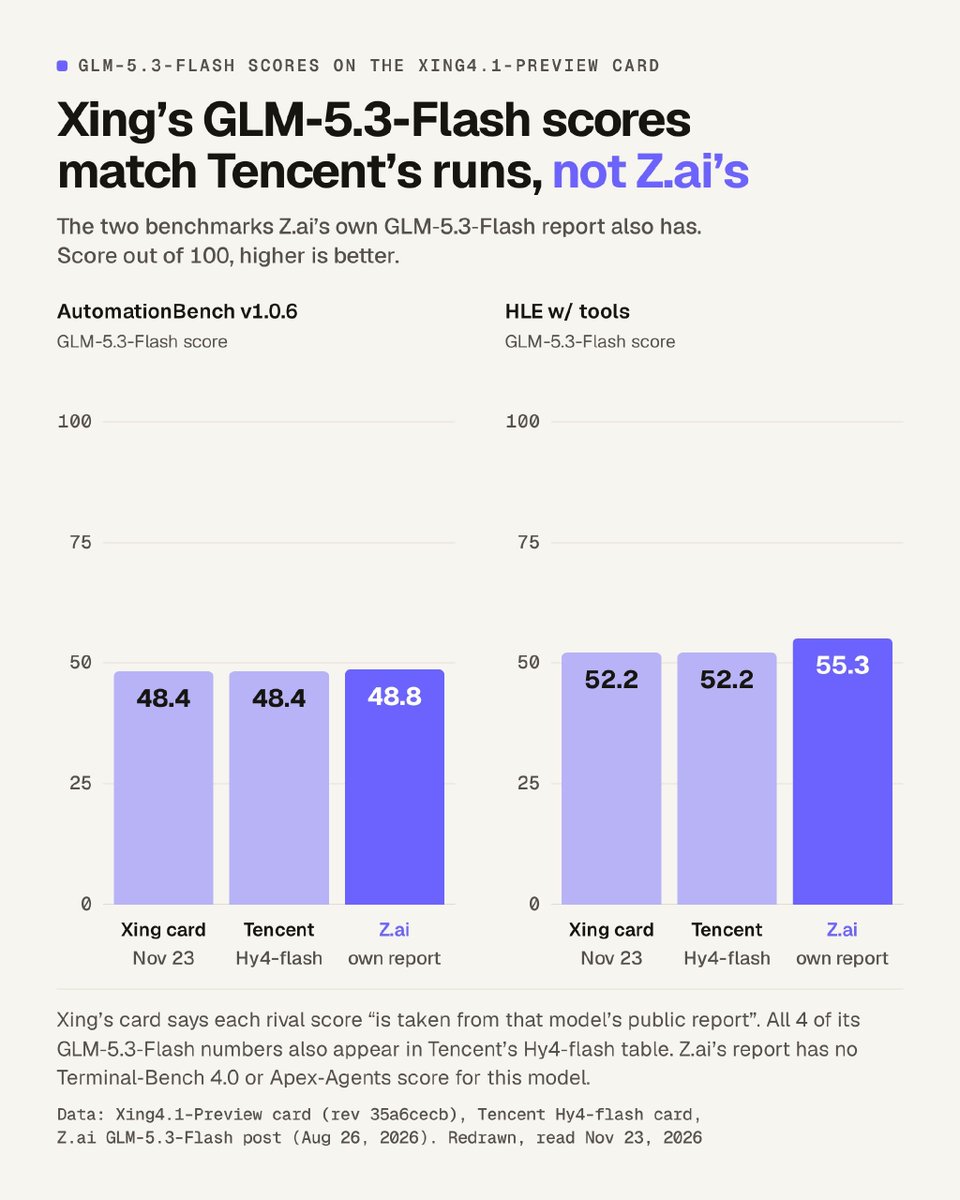
About 19 hours later that line was swapped for a table, with Xing next to three other "flash" models from Tencent, https://t.co/wrQFyPn6Go and DeepSeek. The note under it says each rival score "is taken from that model's public report".
I can't find its GLM-5.3-Flash numbers in https://t.co/wrQFyPn6Go's own report. All four match the GLM-5.3-Flash column in Tencent's Hy4-flash table, and Tencent's notes describe running every model in that table itself.
https://t.co/wrQFyPn6Go's own post has two of those four benchmarks:
AutomationBench: 48.8 (Xing's card: 48.4)
HLE w/ tools: 55.3 (Xing's card: 52.2)
If that's where they came from, fine by me. Tencent's are real evals with published settings. I'd just say so in the note, on the same card that asked us to be careful with third-party numbers.
China Telecom's Xingchen AGI Lab just opened weights for Xing4.1-Preview on Hugging Face, ahead of its official release and benchmark report 👀
• 285B total / ~17B active MoE (45 layers, 256 routed experts + 1 shared)
• MLA + DeepSeek Sparse Attention (DSA) with cross-layer IndexShare
• 1M-token context, thinking mode + tool calling, built for agentic coding
• Apache 2.0, full BF16 weights (~521 GiB), trained end-to-end on a domestic compute stack
https://t.co/p8hGM4xLwt