I’ve built and rebuilt Skills 1,000+ times across companies I’m involved in.
I’ve also helped 50+ friends build them for internal workflows and public use.
The biggest lesson:
Your company already has Skills.
They are sitting in old docs, Slack threads, customer calls, review rituals, onboarding notes, and the heads of the people who know how the work really gets done.
The method is hidden in the work.
A Skill makes it reusable.
This is the first article from what I’ve learned building Skills in the wild.
AI doesn’t create good systems.
It reveals whether you have one.
If your process is broken, AI just helps you fail faster.
If your process is clear, AI becomes a multiplier.
One corollary to the fact that AI agents take real work to setup in company at scale, is that the role of the forward deployed engineer -or whatever it gets called in the future- isn’t going away any time soon.
When a vendor sells any kind of agents into an organization, you’re no longer just selling a software tool that gets implemented and you’re done. You’re fundamentally selling some form of the actual workflow being done by your technology. This is far closer to a customer buying from a professional services firm than implementing traditional technology.
This will almost always require a deep understanding of the domain that the customer operates in, the ability to help a customer wire up their systems to support the agents, make sure all the context is setup in the right way, and help provide change management to actually get the company to adapt its business processes.
The ability to do this across customers, figure out best practices in a specific industry and customer segment, take new features back to go build in the product, and so on is going to be key. There’s no shortcut to getting this work done by the enterprise, and the vendors are going to have to do a lot of this or risk low adoption.
Finally, this is a big opportunity for existing and next gen professional services companies. There are all new practice areas emerging in every system integrator and consulting firm just to do this kind of work, and this is going to continue to be in demand for quite some time. Yet another example of jobs that aren’t actually going away.
The founder of Postman says you have to kill your existing org chart, especially if you're still operating with a pre ai hierarchy arrangement.
The modern org chart, according to @a85:
- wide span of control (even within exec team)
- work directly with ICs, not through layers
- either you're building, or you're selling
Projects are led by staff/principal engineers with high agency. They see across the board as well as deep in the stack.
Product managers are building APIs and prototyping in Claude instead of writing PRDs.
Designers are shipping PRs through Cursor directly instead of relying solely on Figma.
Everyone is building. And the management's job is to develop better judgment.
I spent $45 asking an AI what time it is.
Last week, I wired up my OpenClaw heartbeat agent to ping me every morning.
Check the time. Check the day. Send a workout reminder.
It ran perfectly. It also cost me $45 in a single billing cycle.
The reason: I had accidentally pointed it at gemini-2.5-pro-preview — a frontier reasoning model built for complex, multi-step analysis — to tell me it was Tuesday.
🤦
This is one of the least discussed costs of building AI systems.
It's not the big inference runs. It's not the long context windows.
It's the small, repetitive, ambient tasks you wire up once and forget about — running on a model you never re-evaluated after setup.
A heartbeat doesn't need to reason. It needs to check a variable and return a string.
Using a frontier model for that is like hiring a neurosurgeon to take your blood pressure.
When you're building agentic systems at scale, model selection isn't a detail. It's a cost control strategy.
The questions you need to be asking before you ship:
- What is this task actually doing? Reasoning, retrieval, generation, or routing?
- What's the minimum model capability this task requires?
- How often does this run — and what does that cost at volume?
One misconfigured background agent, running every morning on the wrong model, can silently drain your budget before you notice.
Right task. Right model. That's the discipline. 💪
Most people think rate limits are an infrastructure problem.
They’re not.
They’re a product design constraint disguised as an error message.
“API rate limit reached. Try again later.”
What it really means:
* Your system has no prioritization layer
* Your workflows aren’t designed for bursts
* Your users are hitting invisible ceilings you never exposed
In traditional software, scaling is about handling more requests.
In AI systems, scaling is about deciding which requests matter.
Because when everything is async, agent-driven, and always-on…
You don’t just hit limits faster.
You hit them unpredictably.
The teams that win won’t be the ones with the highest limits.
They’ll be the ones who:
* Queue intelligently
* Degrade gracefully
* Expose constraints as features, not failures
Rate limits aren’t bugs.
They’re where your system design gets exposed.
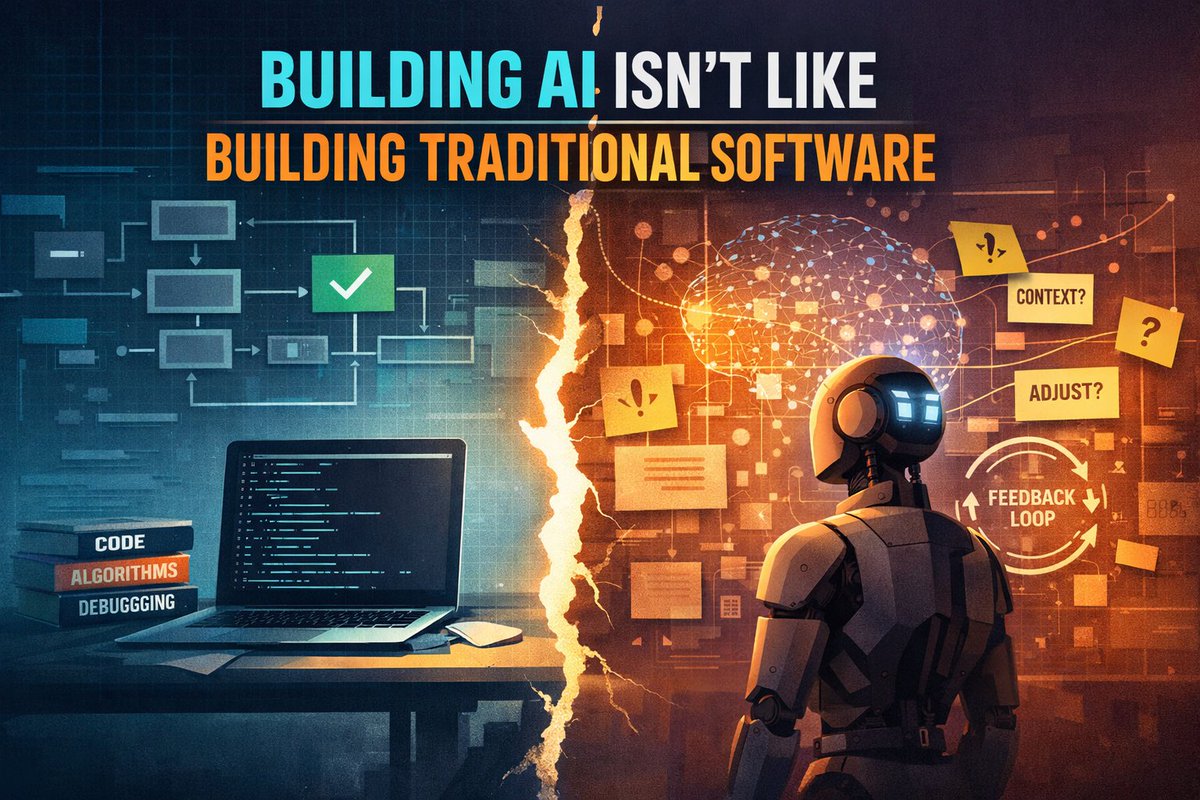
Building AI isn’t like building traditional software.
It’s like managing a brilliant, book-smart 18-year-old.
They can reason, write, and solve problems, but they lack context, judgment, and consistency unless you give it to them.
In traditional systems:
- You hardcode logic
- You test edge cases
- You get deterministic outcomes
In AI systems:
- You define context
- You constrain behavior
- You continuously evaluate outputs
The shift isn’t technical. It’s operational.
If you treat AI like software you ship once, it will fail in production.
Quietly.
AI systems need a feedback loop:
1. Capture decisions (outputs, traces)
2. Evaluate them against a golden set
3. Identify failure patterns
4. Adjust context, not just code
If you’re not doing this, your system is drifting whether you see it or not.
The real skill isn’t prompting.
It’s building systems that continuously correct how the AI behaves over time.
That’s the difference between a demo and something you can trust.
There are two types of developers: those who love the code and those who love the product.
For the "code artist," AI is a struggle because it skips the craft and the elegance. For the "builder," AI is a godsend, it’s just a faster way to ship something that works.
One seeks the perfect line; the other seeks the final result.
2/ Three principles that changed everything for me:
- Start with the world, not your product
- Use tension and resolution
- Make it human-centric
Let me break these down...
I used to think I was creative.
Then I read Rick Rubin's revolutionary book on the creative process.
He routinely asks 13 questions to unlock artistic potential & spark innovation.
Test yourself with these questions (the ultimate creativity playbook for your art & business):
Every Product Manager should know these websites!
1. kraftful. com - get insights to build products people love
2. commoncog. com - get good at business faster
3. prodmgmt. world - 10x product management with curated techniques
Share it with your friends! Thanks 💓