New year, new assemblies!
I'm excited to announce Autocycler, my new tool for consensus assembly of long-read bacterial genomes!
It's the successor to Trycycler, designed to be faster and less reliant on user intervention.
Check it out: https://t.co/NksiyESF7u
(1/5)
Together with @cdnsciencepub, we are highlighting our most-read article of 2024 in our Year in Review!
Are Illumina sequencers still essential? Evaluating Oxford Nanopore's tech for bacterial genomes. 🧬🔍 Learn more: https://t.co/zoYtUT0laA
#BestofCSP
Excited to share BakRep - our latest work published in @MicrobioSoc#MGen
>661,000 bacterial genomes, uniformly characterized & annotated, enriched with metadata, accessible via a flexible search engine
https://t.co/UKGlI6xUAV
👇 1/7
Daria Frolova's paper in plasmid relatedness now out in MGen! She uses rearrangement distances & shared seq content to build a relatedness network of plasmids, identifies hubs which are likely transposons, and then clusters related plasmids.
https://t.co/fG0GCYqKZO
@MicrobioSoc
🚨 New preprint! 🚨 We reveal that blaTEM-1 expression varies across the E. coli phylogeny, driving differences in co-amoxiclav resistance: https://t.co/1FYxK0VZRl
@naturepoker1@Hasindu2008@Psy_Fer_ this is a great resource! in your example here it looks like your fast5 files were split by barcode before blow5 conversion. did you use ont-fast5-api to get folders of fast5 by barcode or is that how your workflows output fast5s?
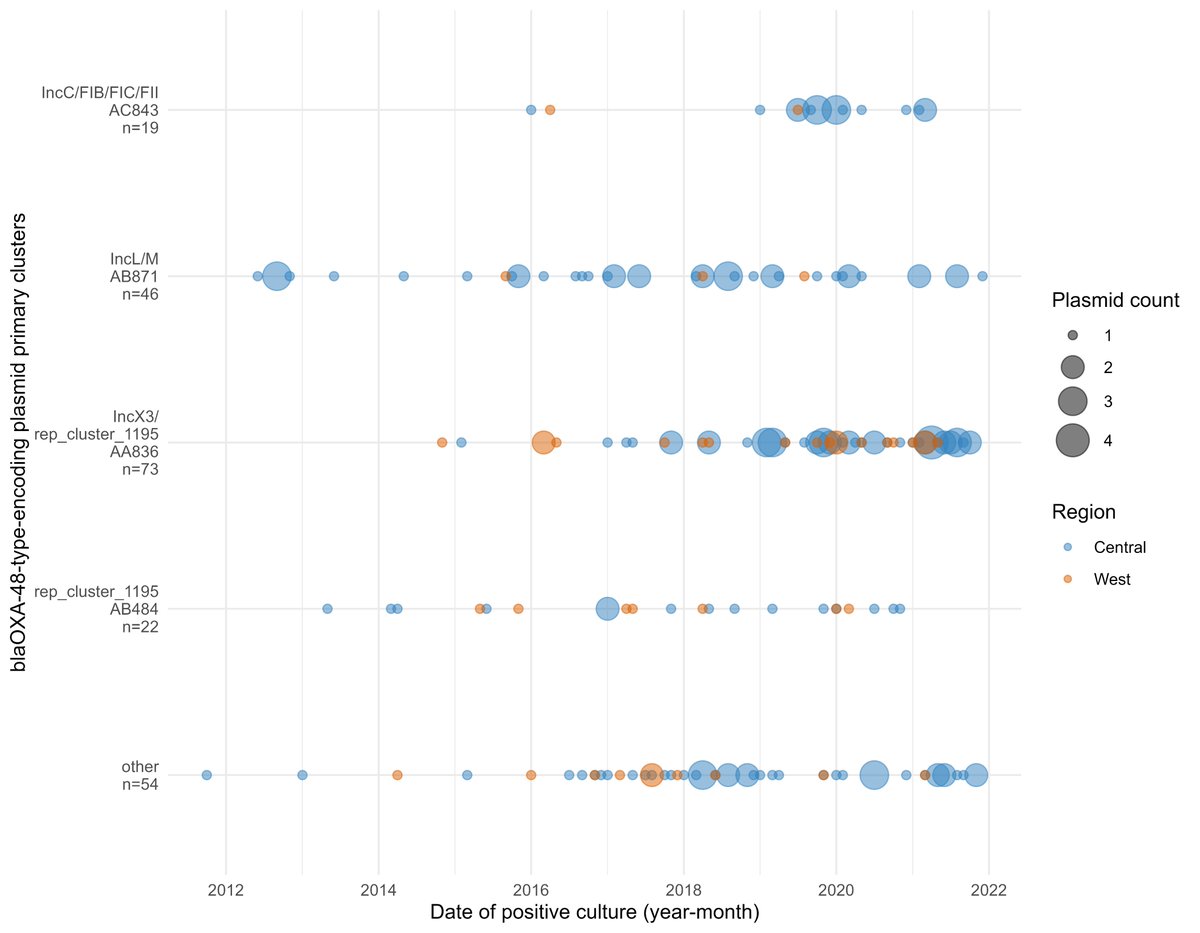
Finally, kudos to MOB-suite which enabled us to cluster plasmids to see how different groups have persisted in the Canadian landscape over time https://t.co/Qz9sd1Ki2l
6/6
Excited to see this out! We looked at OXA-48-type plasmid distribution across years of surveillance data and found multiple transmission routes (clonal & horizontal) have contributed to OXA-48-type spread and #AMR in Canada
1/6
Plasmid genomic epidemiology of carbapenem-hydrolysing class D β-lactamase (CDHL)-producing Enterobacterales in Canada, 2010−2021. Published #OpenAccess and fee-free in #MGen using a #PublishAndRead agreement: https://t.co/bnbp3gdzay
We also found clonal OXA-204 plasmids from a single site (IncF/IncC in C. freundii ST22), which we first observed in 2016 (https://t.co/27PyyDIgbU) but continues to be endemic. This clone/plasmid combo has not been observed elsewhere in the world
5/6
@Psy_Fer_@naturepoker1 Is this the same process for multi-barcoded runs where one giant tar.gz is created that includes all barcodes? Or is it recommended to split BLOW5 files by barcode first then upload to individual BioSamples?
First paper from my student Daria Frolova's PhD now on biorxiv:
https://t.co/Ex2tbOujgG
The key question: plasmids change structurally ~as fast as they mutate, so how can we decide whether 2 plasmids are "the same plasmid" for epi purposes?
1/n
The final version of our short-read polishing manuscript (headed by @rrwick of course) is out in @MicrobioSoc MGen!
Tldr: with R10.4.1+Dorado ONT assemblies, few errors remain, so short-read polishing can make assemblies worse at low depth; target >=25x
https://t.co/qrsiXFuuFN
Stoked to share that the final version of the Hybracter manuscript is now published (in MGen @MicrobioSoc)
If you have long-read only or hybrid sequenced bacterial isolates to assemble (especially if you care about plasmids) - give it a crack!
https://t.co/zc89PsTPvH