Subscription fatigue is real.
Seriously expect a lot of people to switch from subscriptions to self hosted libraries in the coming years. Big opportunity to package hardware + software and let people extend their library (with buy-to-keep media).
There's still space for a streaming product within that (for discovery, variance), but with a fair model where the conversion is the sale of the media.
Imagine lease-to-own on that: "you've streamed this song 20 times; own it for $0.50"
Prediction: corporate services will adapt to product-led growth. Agents act like developers and want instant access to data, systems, and actions.
If an agent finds two suppliers, one of which has a CLI and the other a 'contact us via email' button, guess which one it'll use
The token cost to build a production feature is now lower than the meeting cost to discuss building that feature.
Let me rephrase.
It is literally cheaper to build the thing and see if it works than to have a 30 minute planning meeting about whether you should build it.
It’s wild when you think about it.
This completely inverts how you should run a software organization. The planning layer becomes the bottleneck because the building layer is essentially free. The cost of code has dropped to essentially 0.
The rational response is to eliminate planning for anything that can be tested empirically. Don’t debate whether a feature will work.
Just build it in 2 hours, measure it with a group of customers, and then decide to kill or keep it.
I saw a startup operating this way and their build velocity is up 20x. Decision quality is up because every decision is informed by a real prototype, not a slide deck and an expensive meeting.
We went from “move fast and break things” to “move fast and build everything.”
The planning industrial complex is dead.
Thank god.
@adityaag wonderful way to describe that initial feeling of dread and then empowerment. I still go through cycles of this sometimes as parts of my job and the expected outcome get abstracted away
Very interested in what the coming era of highly bespoke software might look like.
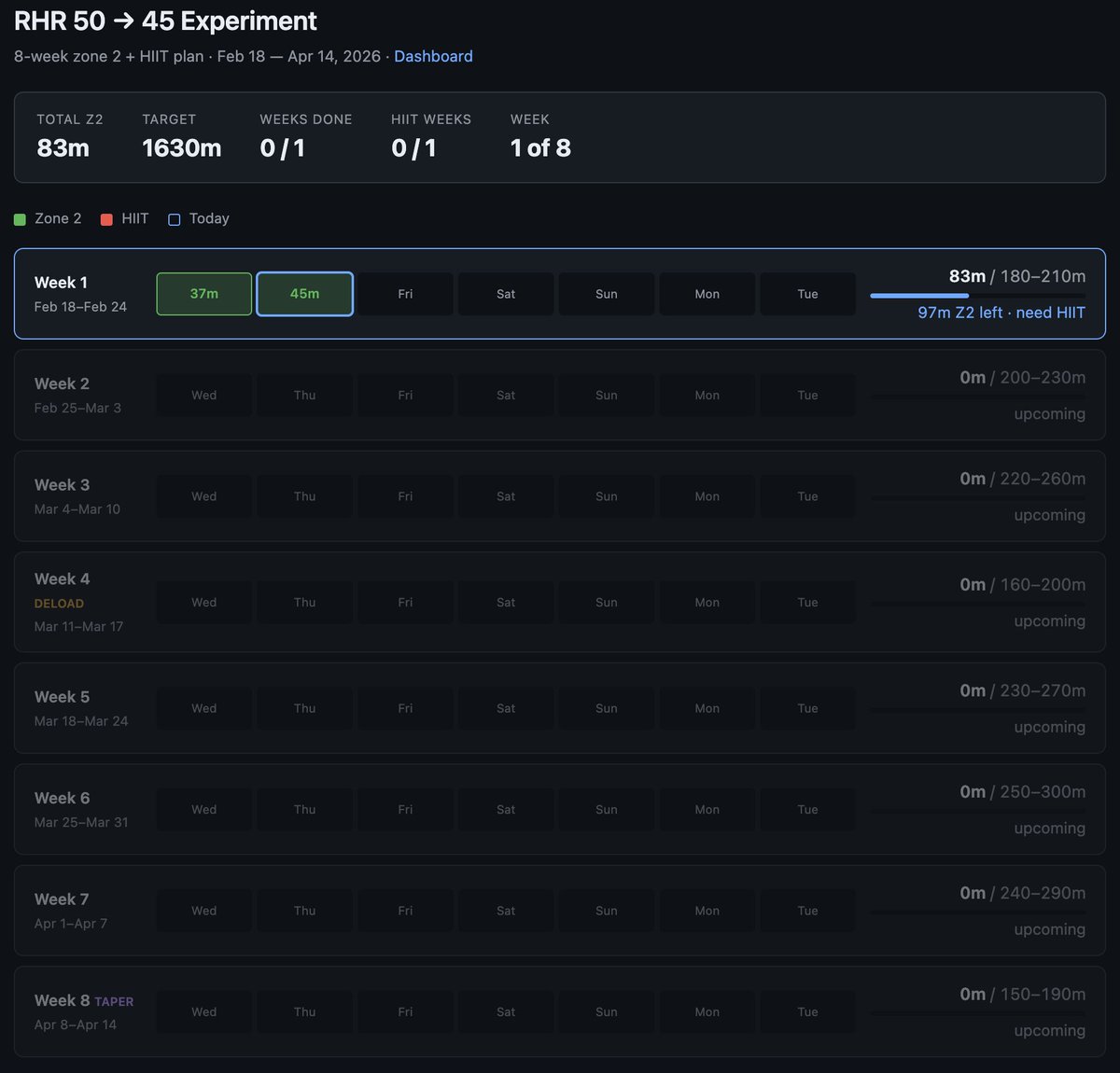
Example from this morning - I've become a bit loosy goosy with my cardio recently so I decided to do a more srs, regimented experiment to try to lower my Resting Heart Rate from 50 -> 45, over experiment duration of 8 weeks. The primary way to do this is to aspire to a certain sum total minute goals in Zone 2 cardio and 1 HIIT/week.
1 hour later I vibe coded this super custom dashboard for this very specific experiment that shows me how I'm tracking. Claude had to reverse engineer the Woodway treadmill cloud API to pull raw data, process, filter, debug it and create a web UI frontend to track the experiment. It wasn't a fully smooth experience and I had to notice and ask to fix bugs e.g. it screwed up metric vs. imperial system units and it screwed up on the calendar matching up days to dates etc.
But I still feel like the overall direction is clear:
1) There will never be (and shouldn't be) a specific app on the app store for this kind of thing. I shouldn't have to look for, download and use some kind of a "Cardio experiment tracker", when this thing is ~300 lines of code that an LLM agent will give you in seconds. The idea of an "app store" of a long tail of discrete set of apps you choose from feels somehow wrong and outdated when LLM agents can improvise the app on the spot and just for you.
2) Second, the industry has to reconfigure into a set of services of sensors and actuators with agent native ergonomics. My Woodway treadmill is a sensor - it turns physical state into digital knowledge. It shouldn't maintain some human-readable frontend and my LLM agent shouldn't have to reverse engineer it, it should be an API/CLI easily usable by my agent. I'm a little bit disappointed (and my timelines are correspondingly slower) with how slowly this progression is happening in the industry overall. 99% of products/services still don't have an AI-native CLI yet. 99% of products/services maintain .html/.css docs like I won't immediately look for how to copy paste the whole thing to my agent to get something done. They give you a list of instructions on a webpage to open this or that url and click here or there to do a thing. In 2026. What am I a computer? You do it. Or have my agent do it.
So anyway today I am impressed that this random thing took 1 hour (it would have been ~10 hours 2 years ago). But what excites me more is thinking through how this really should have been 1 minute tops. What has to be in place so that it would be 1 minute? So that I could simply say "Hi can you help me track my cardio over the next 8 weeks", and after a very brief Q&A the app would be up. The AI would already have a lot personal context, it would gather the extra needed data, it would reference and search related skill libraries, and maintain all my little apps/automations.
TLDR the "app store" of a set of discrete apps that you choose from is an increasingly outdated concept all by itself. The future are services of AI-native sensors & actuators orchestrated via LLM glue into highly custom, ephemeral apps. It's just not here yet.
@andreasklinger Ah man I have the same in Dutch. I’m always stumbling through sentences trying to quickly find the right translation of a word I’ve acquired in English first.
this somehow blew up. here’s what actually happened in that 5 hrs:
- I fixed the last 10%
- which of course surfaced another almost-done thing
- thought “10 more mins”, but it was so close I stayed for 30
- repeat loop a few times
- eventually I had an entire app deployed and friends playing with it
absolutely love living Jevon’s paradox. Now I'm shipping the thing tomorrow morning :) 🎮
@koeppelmann I wonder if it’s better to acknowledge there is no shared reality and embrace the 1000 different points of view instead of echo chambers and cults converging them all into us vs them. Collaboration is easier when the lines are blurry
We’re in this weird phase where AI agents are using tools (via computer use or APIs) instead of zeroing in on the molecular problems. I can’t really explain it but it feels like giving an ai access to photoshop and image libraries instead of using diffusion.