Estoy tratando de llamar al teléfono marcado en mi tarjeta como línea de ayuda internacional y no me conecta con nada ni nadie, es más. Me cambia el menú a la mitad de la llamada de español a portugués. No me dejan usar mi tarjeta de débito y estoy de viaje.
@SantanderMx
Everyone thinks the AP x Swatch "Royal Pop" dropping May 16 is just AP chasing MoonSwatch hype.
Maybe. But the timing is interesting.
AP just lost trademark fights in Japan (2024) and the US (2025). The courts ruled the octagonal bezel and tapisserie dial aren't "distinctive enough" to legally own.
Translation: knockoffs are coming, and AP can't really stop them.
So is it a coincidence that AP's now teaming with the one brand that can flood the market with a million "official" Royal Oak-shaped watches before the fakes do?
Maybe Swatch is actually defending brand.
Dostoevsky was 28 when they stood him in front of a firing squad. Blindfolded. Hands tied. He could hear the rifles being loaded.
At the last second a messenger on horseback arrived. The Tsar had commuted the sentence. The entire execution was staged. Psychological torture designed to break him.
It worked. He had a seizure on the spot.
They sent him to a labour camp in Siberia. 4 years. Freezing. Starving. Sleeping on wooden planks next to murderers. His epilepsy got worse. He had no paper. No pen. Nothing.
When he got out he was broke. His first wife died. His brother died. He inherited his brothers debts. He was so desperate for money he signed a contract with a publisher that would have given away the rights to everything hed ever write if he missed the deadline.
He wrote The Gambler in 26 days to make it. Dictated it to a 20 year old stenographer named Anna. Married her three months later.
Then the real work started. Crime and Punishment. The Idiot. Demons. The Brothers Karamazov. The greatest novels in the history of the Russian language. Maybe any language.
The man who stood blindfolded before the firing squad, who convulsed on the ground while soldiers watched, who slept next to killers in Siberia for 4 years, who was buried in debt and grief.
That man wrote: "every minute can be an eternity of happiness."
He earned the right to say it.
its never over. never give up fren.
Japanese kids are trained from childhood to read people without being told anything. The skill has a name: kuuki wo yomu, literally "reading the air." It's one of three concepts behind what that old woman did, all three traced to a 16th-century tea master.
Kuuki wo yomu is what happens when you learn to read tone, posture, and tiny habit shifts before anyone says a word. Japan is a high-context culture, where people communicate as much through cues as through actual words. Fail at it and you get a slang label, KY, short for kuuki yomenai, "cannot read the air," and people quietly stop inviting you to things.
The second concept is omotenashi, often translated as Japanese hospitality. Break the word down and you get "omote-nashi," hosting without a front or any pretense. The Japan National Tourism Organization traces the practice to Sen no Rikyu, a 16th-century tea master who codified seven rules for hosting guests. His seventh rule was simple: give every guest your full consideration. The deeper idea behind it is that a guest having to ask for something means the host has already failed. From the tea room, that mindset spread into almost every customer-facing trade in Japan, from sushi counters to neighborhood ramen shops.
The third is ichigo ichie, "one time, one meeting." Rikyu's apprentice Yamanoue Soji wrote it down in 1588. Ichigo is a Buddhist word for the whole stretch of a person's life, birth to death. Even if the same guest walks in tomorrow, this exact visit will never come back, so the host owes them full attention every single time.
Shop size also matters. Japan has around 935,000 restaurants, and most are tiny specialty places where the same person stands behind the counter for years, sometimes decades. A regular customer is called a jōren-san. Over time the owner builds a quiet mental file on you, your order, your seat, your timing, the tiny patterns you don't notice in yourself. After two years of the same order, an extra portion of noodles becomes data.
So when he came back from a month away and ordered just one bowl, the change was loud. The old woman knew nothing about his life. She'd been reading the chart for two years.
My favorite liang wenfeng story is that when he was in college, a buddy offered him a cofounder position in his drone startup. He turned him down to focus on academics. The drone startup became
DJI.
You would assume making such a decision would be the defining career moment of someone’s career. That they would regret it forever. But not this guy 😅
gonna play the heck out of GTA 6 simply because of its status as a cultural artefact: the final big game built before LLMs
no-one will ever invest this much in a game again, no software will ever encode this quantity of hands-on human labour again. the last of the great pyramids
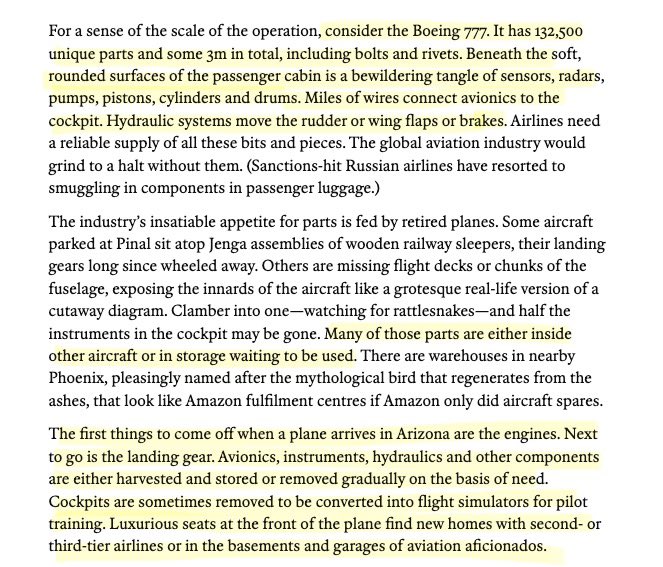
The Economist has great piece on Arizona’s airplane boneyard and business model of nearby facilities that store, maintain, convert and disassemble planes:
▫️$5k a month to store single-aisle jet ($10k for larger)
▫️for disassembly, large jet (eg. Boeing 777) has >130k unique parts (~3m total including bolts and rivets)
▫️airlines need a “reliable supply of all these bits and pieces” or “global aviation industry would grind to a halt without them”
▫️all parts have to be certified and need a comprehensive maintenance history to retain value
▫️the most valuable part (and first to come out) is the engine (airlines mix-and-match used parts to max extend lives of their engines)…next removed part is landing gears
▫️cockpit instruments “can be removed and reused in other aircraft of the same type” and “sometimes the entire cockpit is repurposed as a simulator for pilot training”
▫️avionics, instruments and hydraulics are sold or stored based on demand
▫️luxury seats at front of plane re-sold to 2nd and 3rd tier airlines (or aviation collectors)
▫️the “least desirable” part of the plane is economy seats (just like in real life)…these seats have 20-30 materials and usually shredded for landfill
▫️some carriers trying to do higher-end material for economy class (eg. Emirates has 14 tailors to “repurpose materials from its cabins into bags, wallets and suitcases, with proceeds from sales going to charity.”
The Arizona environment is great for storage: “The sun shines for some 300 days a year. Humidity levels hover in the low double digits. It is so dry that the soil, known as caliche, hardens to a cement-like consistency—ideal conditions for storing planes, heavy things whose enemy is corrosion-causing moisture. (Interior Spain offers a similar climate and some European planes end up there.)”
Older planes can stay in the air if smaller carriers buy them up (“A 15-year-old Boeing 737 or Airbus A320 may well find a post-retirement gig ferrying passengers around Africa.”) Richer airlines “prefer factory-fresh aircraft because of fuel efficiency and customer expectations”.
Another way for old commercial planes to stay in the air is to get converted to cargo planes. This adds 10-20 years (“Despite higher operating costs, second-hand planes offer better value to logistics firms than more-efficient but pricey new ones because freighters clock fewer hours in the air than passenger services.”)
***
Full read here: https://t.co/wyagtTtYJC
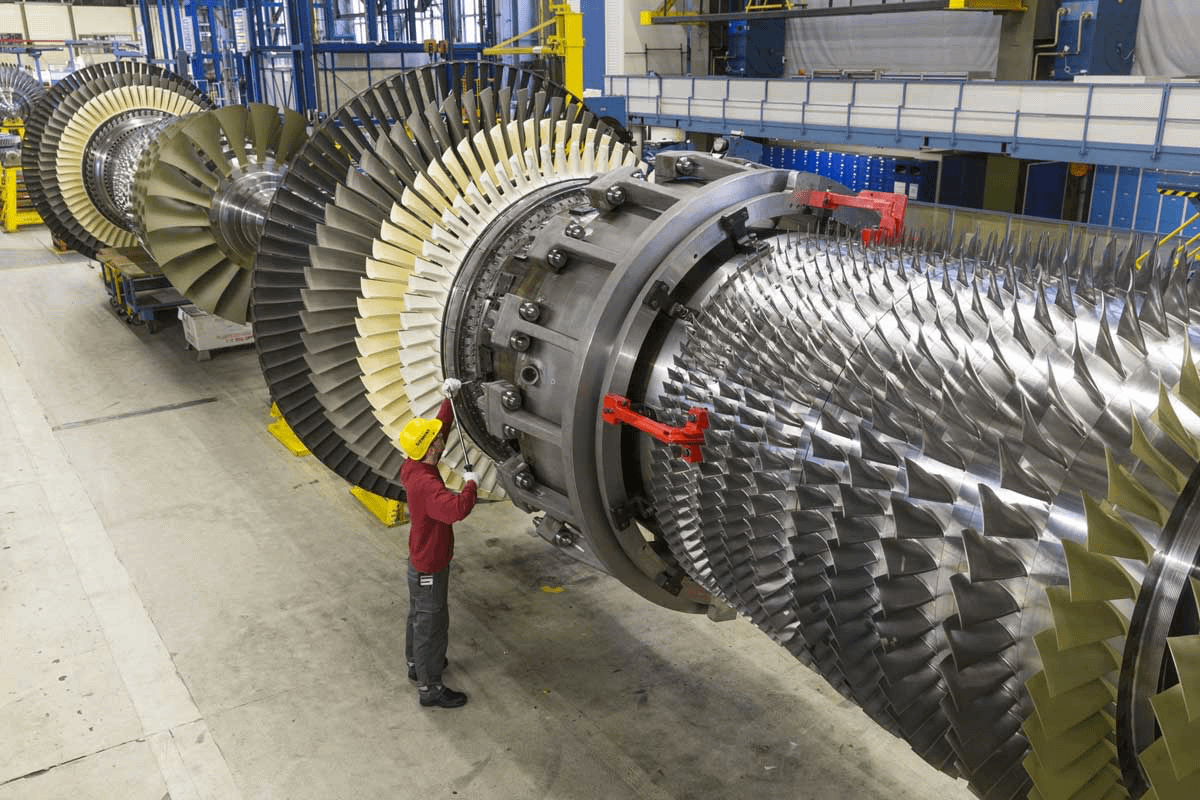
You cannot buy a new gas turbine until 2030. Order books at GE, Siemens, and Mitsubishi stretch to 2029. Turbine prices have nearly tripled since 2019. Every AI data center needs power and every gas plant needs a turbine. And every turbine has one part that bottlenecks the entire industry: The blade. It has to survive in gas 500°C above the melting point of the metal it's made from and spin at up to 20,000 RPM under 10,000 g of centrifugal force. Each blade is grown as a single crystal of nickel superalloy, pulled through a vacuum furnace at 3 mm per minute. A set of blades costs $600,000 and takes 90 weeks to grow. The same metallurgy powers modern jet engines. Only 3 companies on Earth can build one. China spent $42 billion trying to catch up. They bought a Russian fighter engine, took it apart, and copied every part. Their copy ran 30 hours between overhauls versus 400 for the original. Modern Western engines run 4,000. You can reverse engineer the shape of a turbine blade. You cannot reverse engineer 60 years of metallurgy.
Google’s level of disrespect is OFF THE CHARTS right now.
Anthropic really thought they had us locked down with Claude Design’s ridiculous rate limits…
…and now Google has literally countered it straight away by open-sourcing DESIGN.md 🤯
Two years ago, a developer I know launched a small product here in Nigeria.
Everything was going fine.
Users were signing up, logging in, and using the platform daily.
Then one morning he woke up to something strange.
Several users were complaining their accounts had been accessed… without their permission.
Kindly bookmark for yourself and retweet so others too can learn
A both funny and educational meme. Let me explain:
In the first panel, Joey is excited because the hotel’s “free Wi-Fi” is extremely fast. Anyone who has stayed in hotels knows their Wi-Fi is usually slow, overloaded, and frustrating. So when a connection suddenly feels blazing fast, it feels like you got lucky.
In the second panel, Joey checks his device and notices his IP address starts with 172.16.42.x. His expression instantly changes to shock — because that number means something very specific in cybersecurity.
That IP range is the well-known default network configuration used by a device called a WiFi Pineapple.
A WiFi Pineapple is a portable penetration-testing tool that attackers can use to create rogue Wi-Fi access points. It can imitate legitimate networks … like a hotel’s Wi-Fi and trick nearby devices into connecting to it instead of the real network.
Once your device connects, the attacker effectively becomes the network in the middle, allowing them to observe or manipulate traffic passing through it. This is a classic Man in the Middle (MitM) attack.
The reason the connection feels “fast” is simple: you’re probably one of the few people connected to it, and the attacker is letting your traffic pass through so they can monitor it.
So if you ever connect to public Wi-Fi and notice an IP address like 172.16.42.x, there’s a good chance you’re not actually on the hotel’s network…. you might be connected to a rogue hotspot controlled by someone else.