The majority of that money never gets to the homeless. It goes to non-profits who then pay salaries and "operational costs." In some NGOs as little as .17 cents for every dollar goes to services. I will say that @salvationarmysf, .85 cents per dollar goes to programs.
"If you go back 400 years, it would never have occurred to anyone to be introspective"?
More than 2,000 years ago, Socrates spent his life questioning his own beliefs, exposing his ignorance, and urging others to do the same, believing true wisdom begins only when one honestly confronts the inner self. For Socrates, the examined soul was the only path to virtue, and the unexamined life was simply not worth living.
In 1959, Fidel Castro promised to redistribute Cuba's wealth and create equality for all. Within a decade, the island that once exported sugar and cigars to the world couldn't even keep its own lights on. The wealthy fled, but instead of their riches trickling down to the poor, everyone just became equally poor together.
The revolucionarios had calculated that seizing the means of production would mean seizing prosperity itself. What they discovered instead was that prosperity isn't sitting in some vault waiting to be redistributed—it's created daily by millions of voluntary exchanges, investments, and entrepreneurial risks. When you abolish those mechanisms, you don't redistribute wealth; you redistribute poverty.
Today's politicians make the same mathematical error Castro did: they see inequality and assume it represents a fixed pie that just needs better slicing. They never ask why some pies grow while others shrink, or why the countries promising equality most loudly seem to deliver scarcity most efficiently.
The cruel irony is that the only truly "equal" outcome socialism reliably produces is making everyone equally worse off than they started.
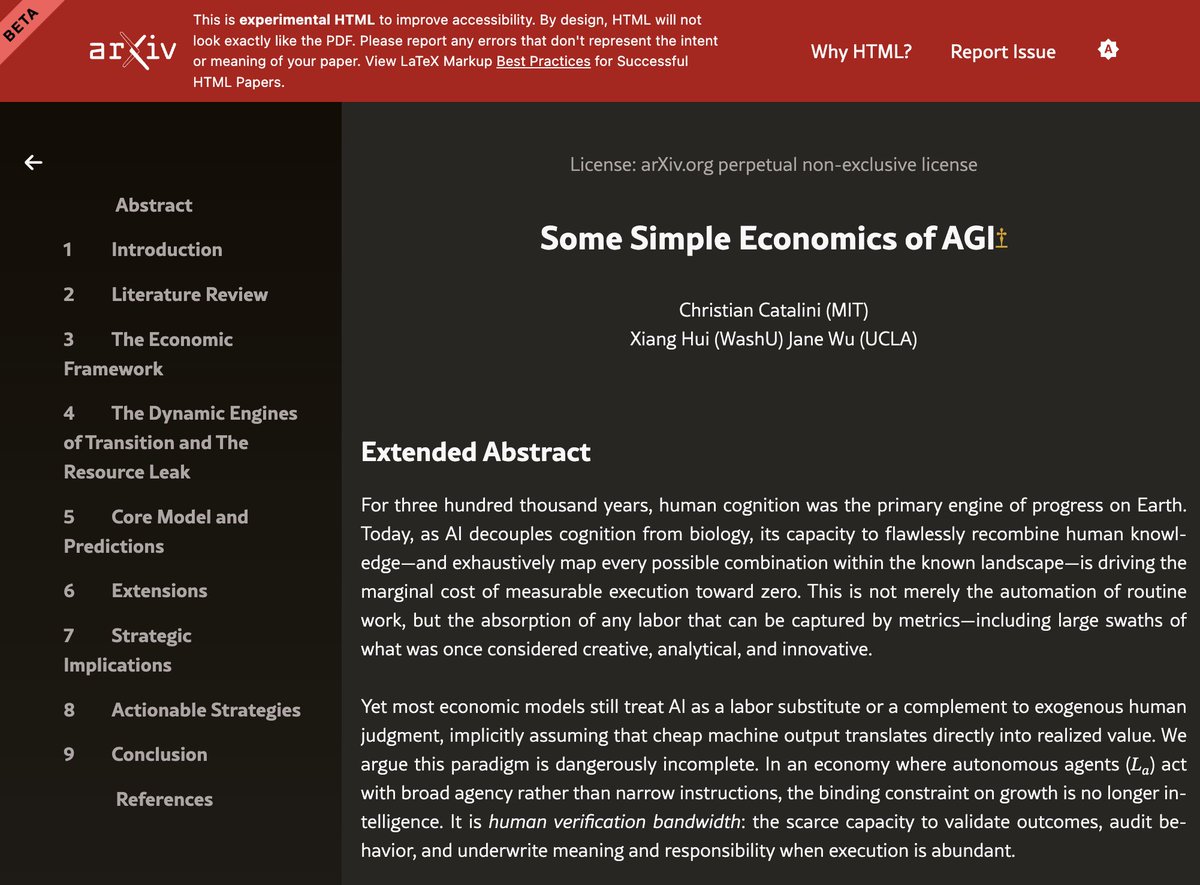
1/ Some Simple Economics of AGI—🔥🧵
Right now, there is a low-grade panic running through the economy. Everyone is asking the same anxious question: what exactly is AI going to automate, and what will be left for us?
A few geniuses solve problems and automate solutions for the rest of society.
Any society that can overcome envy to maximize the number and output of geniuses will thrive.
Biotech is risky and expensive.
If it were only risky, hot-blooded entrepreneurs would throw themselves in the fray, falling in droves until one manages to actually make the world a better place.
If it were only expensive, silver-haired financiers would gather round long tables to concoct contracts to fund grand monuments of medicine.
Being both, it remains a realm populated by idealists and other irrational men and women. People who show up because the puzzle needs to be solved, and because disease should not be.
People that you will not see on the cover of a maganize, but who are the reason that when you go to the doctor, there is anything at all he or she can do for you.