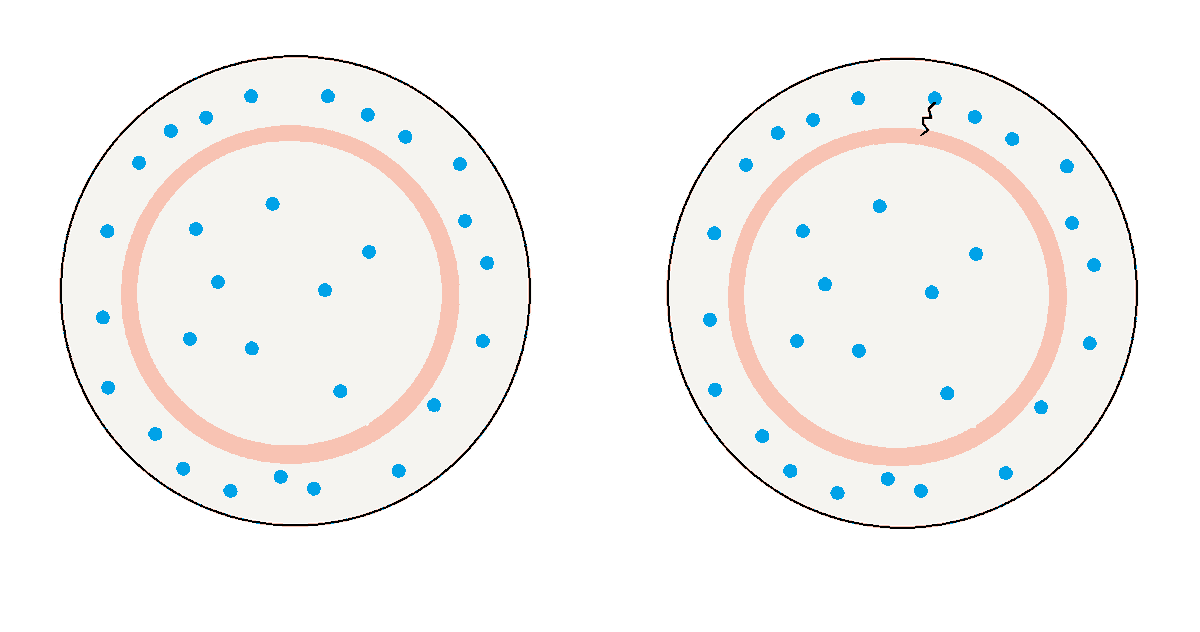
Researchers used two models to test and validate Brown and Susskind’s second law of #quantum complexity — which describes long-time behavior in chaotic quantum systems and, potentially, #blackhole interiors.
🔗 https://t.co/t7VdawuAAh
Perfect Christmas present :)Our paper on long time aspects of Brown -Susskind conjecture has been published in @PhysRevX. Technically, we proved that in two models of local random dynamics circuit complexity saturates at exp time and exhibits recurrence after exp^exp time.
@preskill@Caltech great list! i think you got all the classics. also, Mermin's 'Is the moon there when nobody looks' (iirc very similar to QM for anyone?), Wootters and Zurek's No Cloning, Tong's 'Physics and the Integers', and Wilson's Many Length Scales (leniently interpreting quantum science)
@vk_curt@ThomasVanRiet2@holographythms my understanding was, and HEP people should correct me if this is wrong or outdated, that when people say non-Lagrangian theory they often mean a theory with no *known* Lagrangian description but for which there are other methods to study it (string constructions, CFT, etc)
Circuit complexity, a concept that originated in computer science, has been appropriated to help explain the weird and wonderful quantum goings on after a system has reached maximum entropy. https://t.co/w1LZtoe4lR
This clearly written article by @gmusser explains how notions from computational complexity theory have advanced our understanding of quantum gravity and black holes. The video is good, too.
https://t.co/w096xm3Nkg
Taking inspiration from computer science, the physicists Leonard Susskind and Adam Brown have proposed a new physical law that governs how complexity increases in a quantum world.
@gmusser reports: https://t.co/HfjAMyGSY5