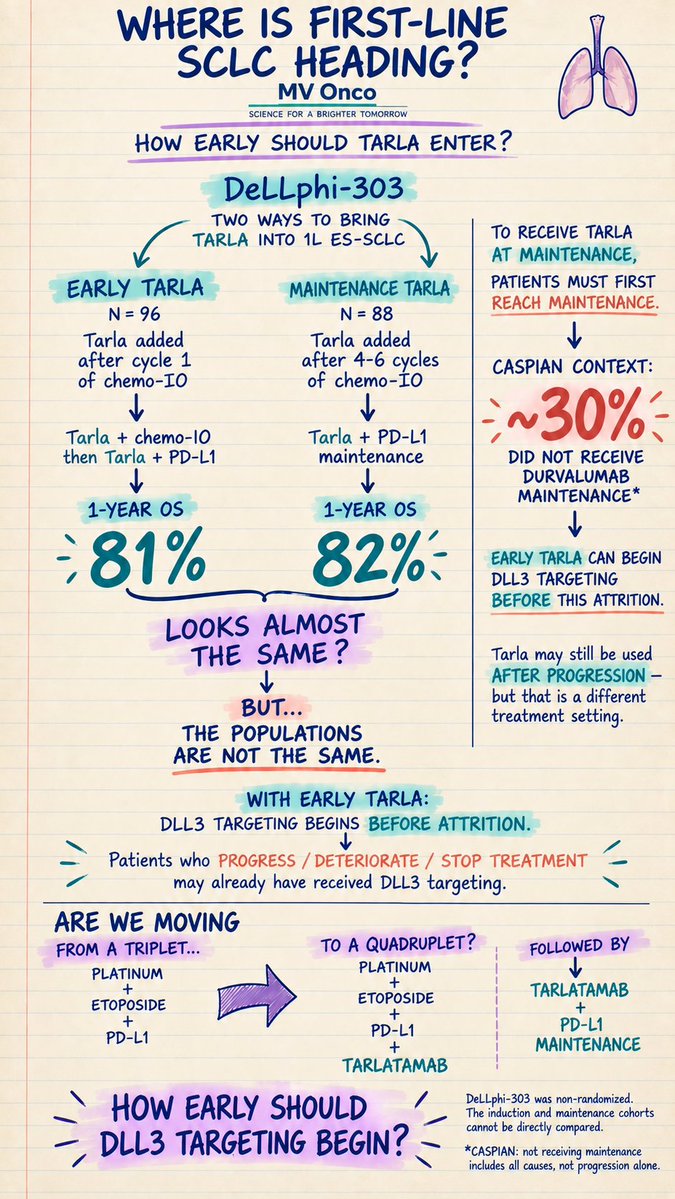
WHERE IS FIRST-LINE SCLC HEADING? 🫁
• DeLLphi-303 explores tarlatamab earlier in 1L ES-SCLC
• Early Tarla → 1-year OS 81%
• Maintenance Tarla → 1-year OS ~82%
• ⚠️ Not a head-to-head comparison — non-randomized cohorts
• The key question is timing: earlier DLL3 targeting may reach patients before attrition on the way to maintenance • Are we moving from a chemo-IO triplet → DLL3-based quadruplet?
How early should DLL3 targeting begin?
Refs: DeLLphi-303, NCT05361395; Wermke M et al., ESMO 2025, Abstract 2757O; Paz-Ares L et al. CASPIAN. Lancet. 2019;394:1929–1939.
DESTINY-Lung04: impressive PFS with first-line T-DXd, but the OS curve tells a very different story.
T-DXd vs pembrolizumab + platinum/pemetrexed:
• mPFS: 14.3 vs 8.3 months
• HR 0.63 | P<0.0001
• 37% lower risk of progression/death
But OS did not favor T-DXd:
• mOS: 29.3 vs 33.1 months
• HR 1.15 (95% CI 0.88–1.52)
• OS remains immature
Clinical verdict: A clear first-line PFS win in HER2-mutant NSCLC, but the survival story remains unresolved.
#WCLC26 #LungCancer @IASLC@OncoAlert
🚨 KEYNOTE-826: 5-year follow-up confirms durable survival benefit in advanced cervical cancer
Pembrolizumab + chemotherapy ± bevacizumab continues to deliver a striking long-term benefit in first-line persistent, recurrent or metastatic cervical cancer.
At ~5 years follow-up:
🔹 PD-L1 CPS ≥1
• 5-year OS: 33.9% vs 19.7%
• Median OS: 28.6 vs 16.5 months
• HR 0.62
• 5-year PFS: 27.3% vs 9.9%
• HR 0.58
🔹 ITT population
• 5-year OS: 33.0% vs 18.1%
• HR 0.64
• 5-year PFS: 26.2% vs 9.0%
• HR 0.61
Importantly, the survival curves remained separated throughout long-term follow-up, with a PFS plateau suggesting a subset of long-term responders.
✅ Benefit maintained across major subgroups
✅ No new safety signals
✅ No additional treatment-related deaths since the final analysis
Clinical verdict:
KEYNOTE-826 has moved beyond showing an early immunotherapy benefit. The 5-year data establish the durability of pembrolizumab + platinum/paclitaxel ± bevacizumab as a first-line standard in advanced cervical cancer.
⚠️ This was an exploratory, descriptive long-term analysis without prespecified hypothesis testing.
@ASCO@OncoAlert
#CervicalCancer #Immunotherapy #KEYNOTE826 #GynOnc
TWO IOs. TWO MAINTENANCE STRATEGIES.
ES-SCLC maintenance is evolving.
IMforte: Atezolizumab → add lurbinectedin
DeLLphi-305: Durvalumab → add tarlatamab
Different IO backbones. Different maintenance partners. Different biology.
But one emerging strategy:
don’t wait for relapse — intensify while the disease is still controlled.
Is maintenance becoming the new battleground in ES-SCLC?
Cross-trial comparison is conceptual; these strategies were not directly compared.
#MVOnco #SCLC #ES_SCLC #IMforte #DeLLphi305 #Lurbinectedin #Tarlatamab #LungCancer #ThoracicOncology
KEYNOTE-564: the 5-year update strengthens the case for adjuvant pembrolizumab in high-risk ccRCC.
994 patients after nephrectomy ± metastasectomy were randomized to pembrolizumab for ~1 year vs placebo.
At a median follow-up of ~70 months:
• 5-year DFS: 60.9% vs 52.2%
HR 0.71 (95% CI 0.59–0.86)
• 5-year OS: 87.7% vs 82.3%
HR 0.66 (95% CI 0.48–0.90)
• Benefit remained broadly consistent across key subgroups, including risk category, tumor grade and sarcomatoid features.
Safety was unchanged from prior analyses, with no new treatment-related safety signal emerging with longer follow-up.
Why it matters:
The DFS benefit has matured into a sustained OS advantage. This is no longer just recurrence delay.
Clinical verdict: ✅ Practice-changing and practice-confirming.
For appropriately selected patients with resected ccRCC at increased recurrence risk, adjuvant pembrolizumab remains the benchmark standard.
@ASCO@oncoalert
#KidneyCancer #RCC #KEYNOTE564 #Immunotherapy
RxPONDER revisited: was “premenopausal” really the biomarker?
RxPONDER showed a striking divide:
• Postmenopausal + 1–3 nodes + RS ≤25 → no chemotherapy benefit
• Premenopausal + 1–3 nodes + RS ≤25 → chemotherapy benefit
But why did younger women benefit—direct cytotoxicity, or chemotherapy-induced ovarian suppression?
A new RxPONDER biomarker analysis looked at pretreatment ovarian reserve.
🔹 AMH ≥10 pg/mL: clear chemotherapy benefit
→ IDFS HR 0.46
→ 8.5% absolute 5-year IDFS benefit
🔹 AMH <10 pg/mL: no demonstrated chemotherapy benefit
→ IDFS HR 1.27
Importantly, 20.6% of women classified as premenopausal <55 years had AMH <10 pg/mL.
The emerging idea:
Menstrual status ≠ ovarian reserve.
The chemotherapy signal in RxPONDER may be closely linked to functioning ovarian reserve, supporting the hypothesis that ovarian suppression contributes substantially to the observed benefit.
⚠️ Not practice-changing yet: this does not prove that OFS can replace chemotherapy, and the 10 pg/mL threshold requires an ultrasensitive AMH assay—routine assays are not automatically interchangeable.
Take-home: Perhaps the better question is no longer “Is she premenopausal?” but “How much ovarian reserve does she actually have?”
Reference: Kalinsky K, et al. Ann Oncol. 2026;37. SWOG S1007 (RxPONDER).
#BreastCancer #RxPONDER #OncotypeDX #AMH #OvarianReserve #MedicalOncology #BreastOncology #MVONCO
🚨 NEW ASCO 2026 Living Guideline: HR+/HER2− Stage I–III Breast Cancer
A few recommendations worth bookmarking 👇
🔹 Endocrine therapy remains the backbone of systemic treatment.
🔹 Low ER expression (<10%), stage II–III: neoadjuvant treatment may follow a TNBC-style regimen with taxane + carboplatin + anthracycline + pembrolizumab.
🔹 Neoadjuvant CDK4/6 inhibitors: insufficient evidence for routine use.
🔹 Adjuvant CDK4/6:
• Abemaciclib × 2 y for monarchE-eligible patients
• Ribociclib × 3 y for NATALEE-eligible patients
📌 ASCO suggests using absolute risk to guide CDK4/6 treatment:
25% 10-y breast cancer mortality risk → recommend
10–25% → consider
<10% → generally do not recommend
⭐ If eligible for both, the Panel favors abemaciclib over ribociclib, citing shorter treatment duration + demonstrated OS benefit.
🧬 High-risk germline BRCA1/2 or PALB2 → offer 1 year adjuvant olaparib; ASCO prioritizes olaparib over CDK4/6 inhibition when both apply.
Verdict: Early HR+/HER2− breast cancer management is becoming increasingly risk-adapted, genomically informed, and targeted.
@ASCO@OncoAlert #BreastCancer #Oncology
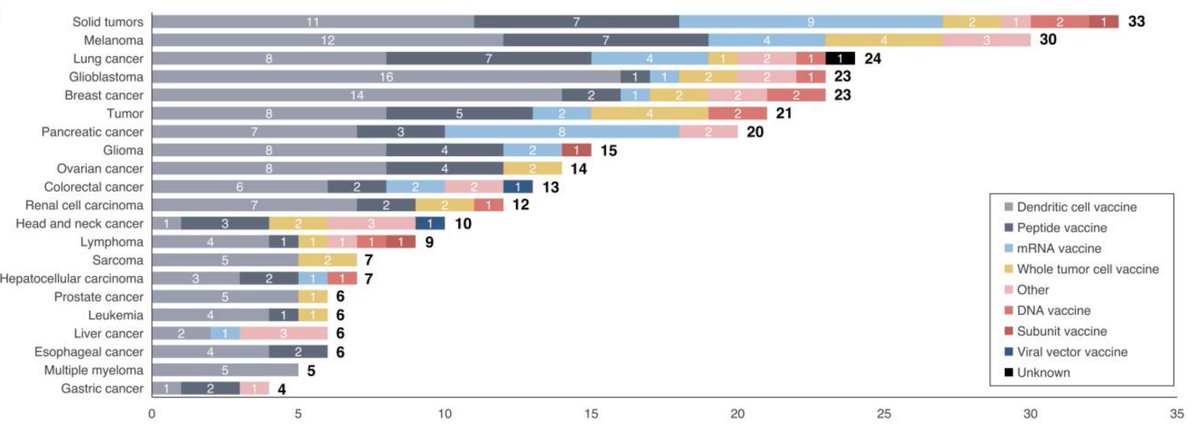
Cancer vaccines in development, by indication.
Most are being trialled in melanoma (30), then lung cancer (24), glioblastoma (23), breast cancer (23), and pancreatic cancer (20).
🚨 ASCO updates the living guideline for Stage IV NSCLC with driver alterations
The major new change: EGFR exon 20 insertion NSCLC now has 2 strong first-line options:
• Sunvozertinib monotherapy
• Platinum-doublet chemotherapy + amivantamab
📌 WU-KONG28
Sunvozertinib vs carboplatin-pemetrexed:
• mPFS: 10.3 vs 7.5 months
• HR 0.65
• ORR: 58.9% vs 31.1%
• DoR: 11.2 vs 7.1 months
⚠️ No head-to-head comparison exists versus chemo + amivantamab, so the optimal frontline strategy remains uncertain. OS is also immature.
🩺 Clinical verdict:
Sunvozertinib is now a guideline-backed, chemotherapy-free frontline option for EGFR exon 20 insertion advanced NSCLC.
@ASCO@oncoalert
#LungCancer #NSCLC #EGFR
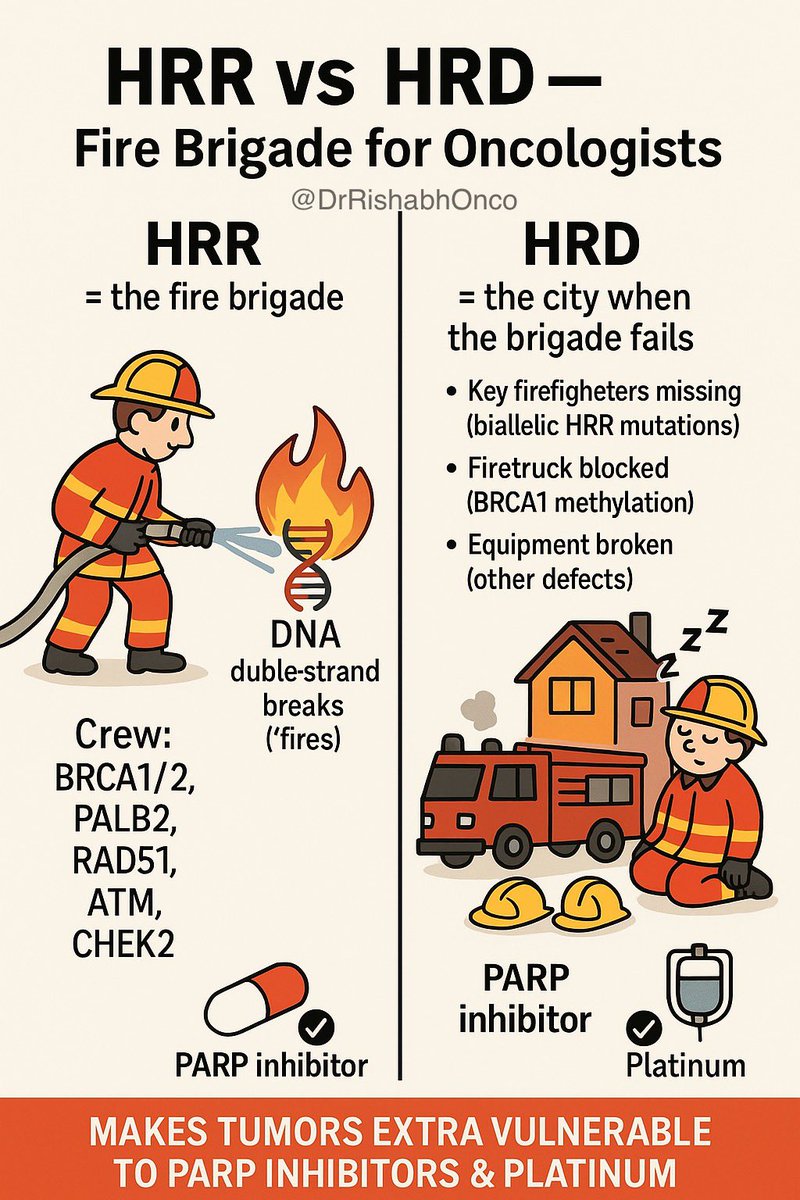
🚒 HRR vs HRD - Fire Brigade for Oncologists
👨🚒 HRR = the fire brigade
•Homologous Recombination Repair pathway
•Crew members = BRCA1, BRCA2, PALB2, RAD51, ATM, CHEK2
•Job: put out the DNA “fires” (double-strand breaks) with precision
🔥 HRD = the city when the brigade fails
•Brigade missing key firefighters (biallelic HRR mutations)
•Firetruck blocked (BRCA1 promoter methylation)
•Equipment broken (other defects)
👉 Outcome: Fires spread → genomic chaos (scars, LOH, instability)
This chaos ironically makes tumors extra vulnerable to PARP inhibitors & platinum 💥
⚕️ Clinical pearl:
•HRR = the pathway (who’s supposed to fight fires)
•HRD = the phenotype (city actually burning because the squad isn’t functional)
•Not every HRR mutation causes HRD → need biallelic inactivation or scar signatures.
🔖 Save this: next time you interpret an NGS report or trial readout, you’ll know exactly whether the “fire brigade” is working or not.
#OncoTwitter #MedTwitter #CancerResearch
@OncoAlert@myesmo@asco@esmo_open