What if you could git branch your entire agent?
Sandbox, storage, memory: fork it, try something risky, throw it away, or merge it back.
We previewed the new agent platform we're building at @databricks at @aiDotEngineer Code Summit - full talk coming soon!
Most agent memory is a guess.
When to distill? What to keep? What to pull back into context?
Guess wrong, your agent gets worse.
Our research team's MemCurrent architecture: 3x more tasks passed, 31% fewer tokens.
Agent Memory is live on @Databricks
https://t.co/vc4lw9l37I
Introducing MemCurrent, a persistent memory architecture designed to help production agents stop starting from zero.
MemCurrent combines episodic memory with derived memory across three access patterns:
• Plugins to log and load context automatically
• Tools the agent calls on demand
• An offline “dreaming” pipeline that consolidates memory in the background
Agents carry forward user preferences, prior corrections, metric definitions and successful workflows instead of rediscovering them every session.
On our internal benchmark built from real enterprise data, MemCurrent triples the agent's pass rate while using 31% fewer tokens and running 26% faster. It's built into Agent Bricks' Memory offering and already powers memory in Genie.
Read the research: https://t.co/AYGXOqrhkO
@singularity_bly@alighodsi Yup we are actively benchmarking new decision models, as they’re released, on real enterprise tasks to choose the best one to power ai_decide. Stay tuned!
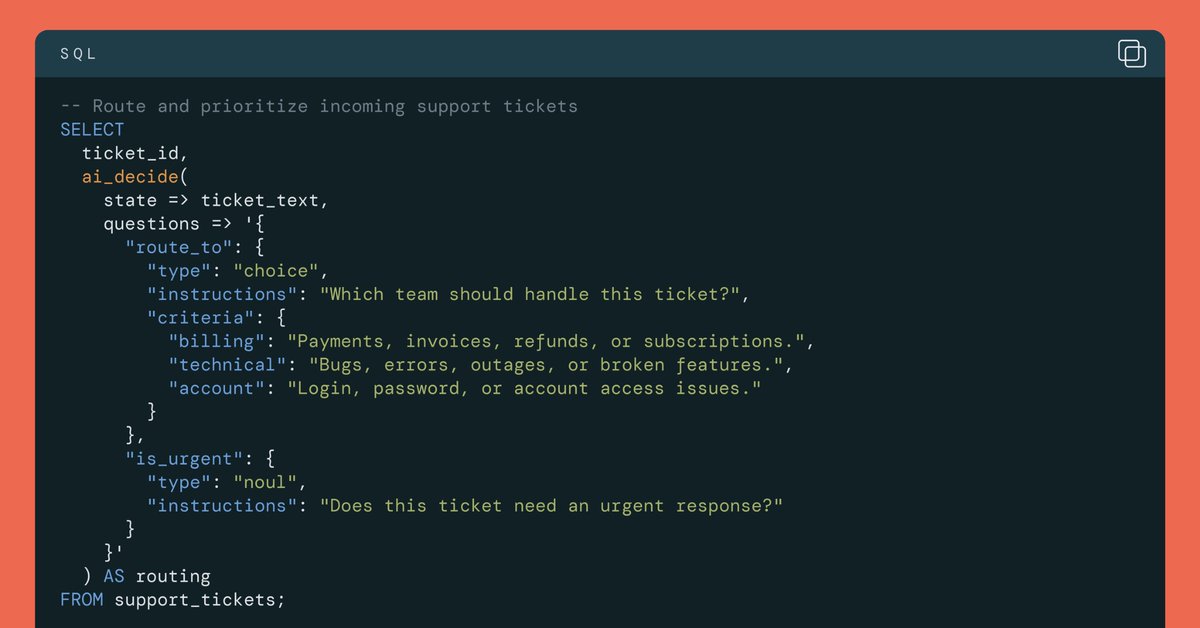
🎉 Introducing Databricks AI Decide: make fast decisions on your governed data
Following the TypeSafe AI Jev launch, we’ve seen increasing demand for a fast, low-cost API that turns raw text into structured decisions. However, many of our enterprise customers are unable to use Jev due to data privacy and access concerns.
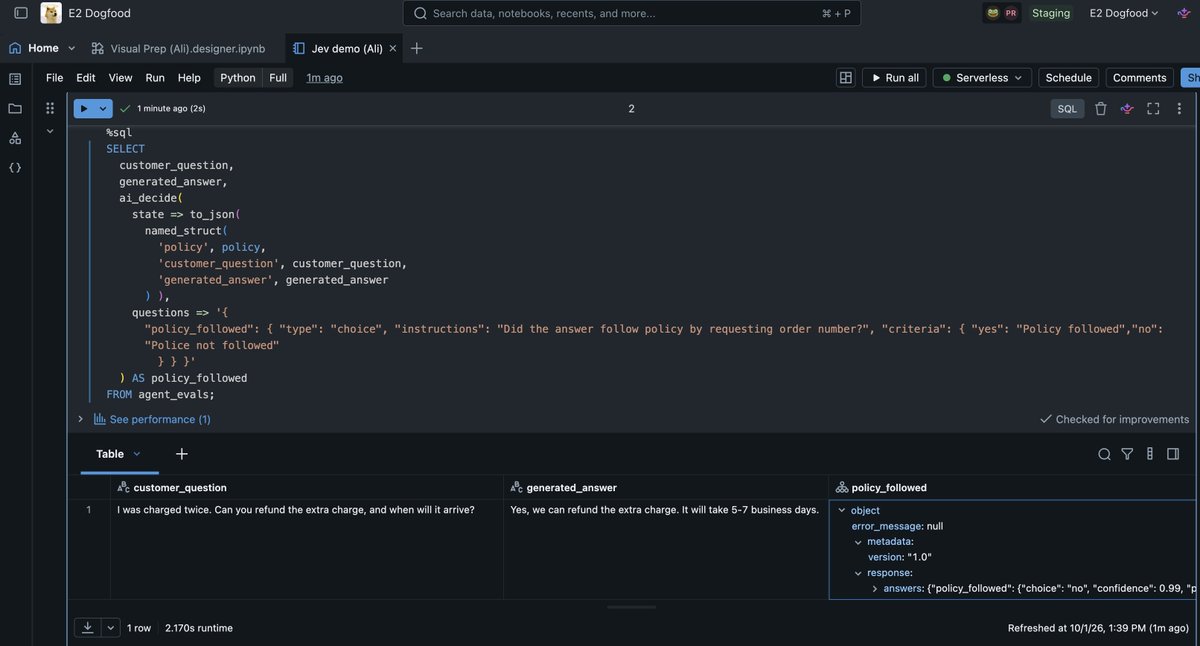
AI Decide is our enterprise-grade function for fast decisions on customer’s governed data. It is supported for batch use cases like processing millions of documents with SQL and for realtime applications like model routing through our REST API. Starting early next week, customers will also be able to govern permissions on the ai_decide function through Databricks Unity Gateway.
A big shoutout to @mattydtweetz@ivanzhouyq@nihit_desai@hanlintang for getting this new function launched in less than a week!
Everyone has been obsessed by Jev and what it can do, and they should be! Fast typed decisions >> slow text generation. It's a complete game changer. But how do you do that with all the data you have?
We just dropped 𝚊𝚒_𝚍𝚎𝚌𝚒𝚍𝚎(), which runs decision models natively on all your data in @databricks . Now you can run system one decisions on all your big data, see screenshot.
https://t.co/1kvMaxxFEt
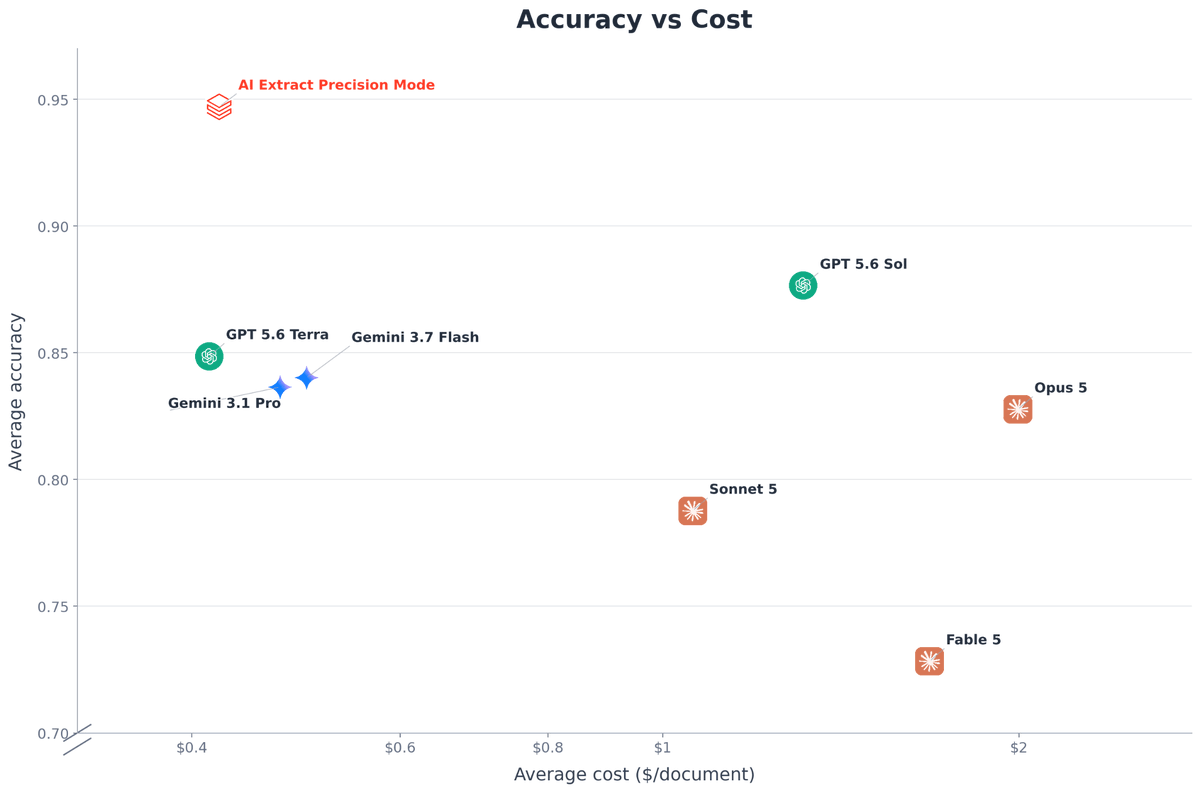
An extremely important functionality for agents is to simply extract fields out of PDFs. This turns out to be harder than people think because LLMs are primarily trained on predicting the next tokens. This leads them to "autocorrect" things that they shouldn't autocorrect. We launched an AI Extract capability that just excels at doing just this task with very high accuracy (95% vs 87% for others) and extremely low cost. Check out this blog on how we did it. The function can of course be called directly from SQL and be used throughout the platform.
https://t.co/60XC2mIZ2E
We are excited to share @databricks 's new AI Extract achieves the new frontier at complex document processing tasks! It addresses a few key customers' pain points:
- Process documents with 500+ pages that exceeds 1M tokens
- Large, nested schema with 1k+ of objects
- Complex schema that requires frontier reasoning
Here is how we achieved it:
- In-house custom model for document extraction that is trained for complex real-world examples and optimized for serving large volume of workloads
- Custom agent harness that is designed for long document extraction. It decomposes large extraction jobs, executes smaller tasks in parallel, and reconciles them into one final structured output.
This is the methodology behind many of our work: identify key large workloads of enterprise customers, build in-house models + harness to address it, and ship to the customers through a close collaboration between the research + product!
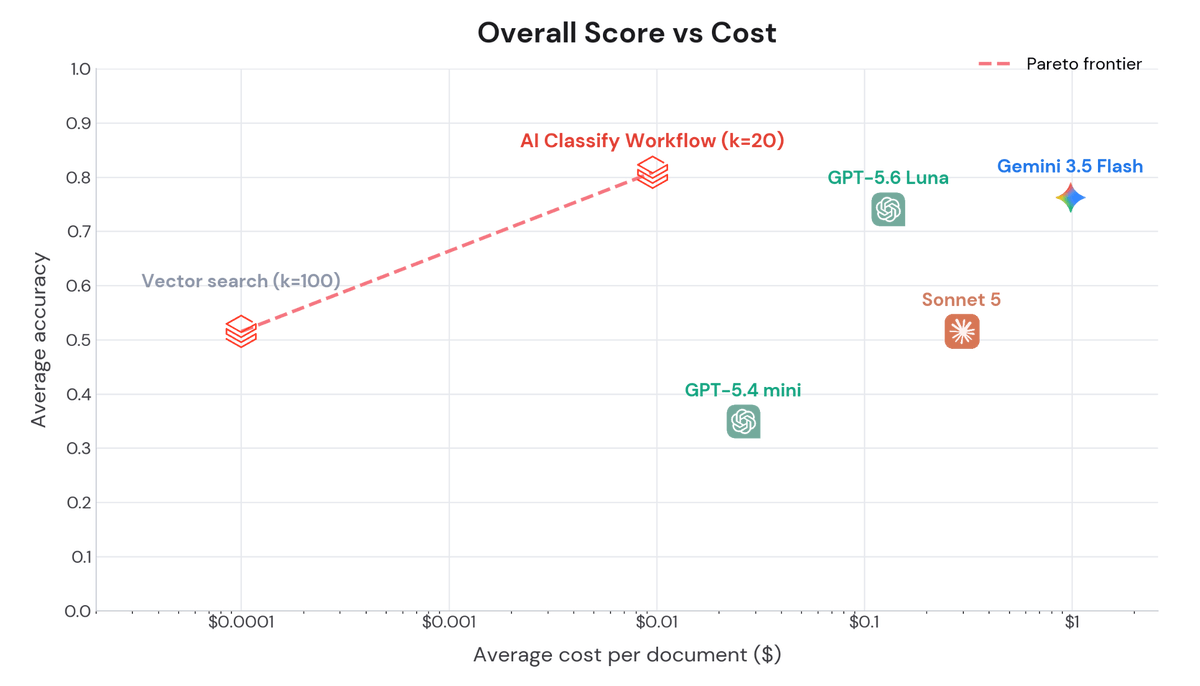
🎉 AI Classify + vector search beats frontier models on accuracy and cost!
At Databricks, we see customers with large taxonomy classification problems like vendor name normalization and biomedical entity linking. Typically they reach for regex, trained classifiers, or direct LLM calls, but these methods struggle on cost, maintenance, and context limits.
To address this, we experiment with 3 classification methods:
1. Vector search
2. AI Classify Workflow: shortlist label candidates with vector search, then classify with the Databricks AI Classify function
3. Direct frontier model calls (GPT-5.4 mini, GPT-5.6 Luna, Sonnet 5, Gemini 3.5 Flash) with prompt caching.
We find that the AI Classify workflow yields the best overall accuracy at ~100x cheaper than the next best direct frontier model.
Shoutout to my teammates @arnav_thebigman@ivanzhouyq@nihit_desai !
We're raising funding at $188 billion valuation to double down on our AI strategy focused on three priorities:
1️⃣ Unity AI Gateway - our multi-AI governance solution that helps control costs.
2️⃣ Genie - our AI coworkers that actually understand your business data.
3️⃣ Lakebase - our serverless Postgres database specifically for AI agents.
https://t.co/Bnc89qxjLG
People often ask me why we think Databricks can succeed in new areas we expand to. This is the recipe why: we build stellar teams in areas where we think we can greatly improve on the status quo. Lakehouse was one, Lakebase is next, but there's more coming, especially in AI.
@JeffDean@rtwlz If approximate NN okay, it might even make sense to compute an IVF index first? Assign each query vector to the nearest centroid and then do the sequential scan and compare only within cluster