> Kimi K3 ranks only behind Claude Fable 5 Max and GPT-5.6 Sol Max, and surpasses Claude Opus 4.8 Max's score of 1600.
I’m super excited for Kimi K3 to be open-sourced!
.@thinkymachines' first open-weights model, Inkling, is now available on Databricks through Unity AI Gateway.
As a day zero launch partner, Databricks gives enterprise teams access to a model that excels at coding and agentic reasoning and supports multimodal inputs.
Teams can customize Inkling for their business, govern it with centralized security, permissions, cost controls, and observability, and connect it to coding agents including Cursor and OpenCode.
Start building with Inkling on Databricks → https://t.co/GsK69cFGyZ
We’re excited to announce that Databricks is a Day-0 launch partner of Thinking Machines Lab (@thinkymachines), bringing its first oss model, Inkling, to the Databricks platform.
- the strongest US oss model
- 974B total parameters, 41B active MoE
- Apache 2.0 license
The Thinky team is absolutely cracked. We’ve loved working with them.
Come try Inkling on Databricks!
Today we're opening up the beta of our first 3 new products: Object Storage, Functions, and AI Gateway
Together with our database and Managed Better Auth (our auth service), they form the first version of our backend platform
Neon is evolving with three new backend functions now in beta, all branchable like the database! Object Storage, Functions and AI Gateway all ready for agents to safely work with to build the next generation of apps.
This is what the next wave of cloud infra for agentic development will look like.
As AI teams adopt more autonomous agents, one challenge becomes clear: they don't naturally work together.
Omnigent is an open-source meta-harness that sits above individual agent harnesses, routing work across multiple agents through a single orchestration layer.
Instead of managing agents in isolation, teams can compose different models and agent harnesses into unified workflows, with shared governance and collaboration built in.
Explore the project on GitHub: https://t.co/6j9MQMMYrJ
We desperately need a smart model router.
1. We’re seeing a model explosion: GPT-5.6, Grok 4.5, Muse Spark 1.1, GLM-5.2, and Fable 5 all launched within the past month.
2. Even for a single model family like GPT-5.6, there're 3 (Sol, Terra, Luna) and 5 reasoning-effort levels.
That is far too many decisions for users to make manually.
The best model should be selected automatically based on the task, latency, quality, and cost.
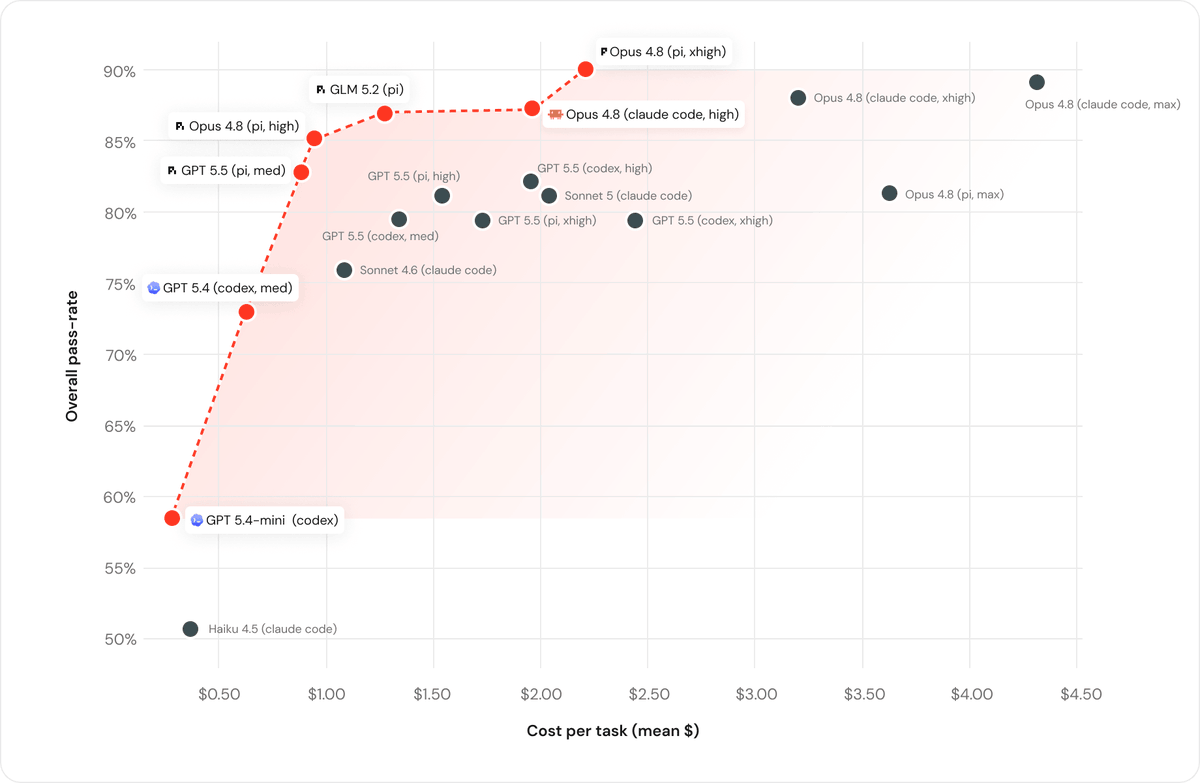
Benchmarking coding agents on our own tasks on Databricks was extremely insightful! If you're curious about how we're lowering token costs, take a look!
We benchmarked coding agents on our own internal tasks at Databricks and learned a lot!
There are many surprising opportunities to lower cost and increase quality, and many models including open source ones are truly competitive now. 🧵
One reason we built custom coding and data agent benchmarks internally at Databricks (e.g. https://t.co/SdLbEP9tye). Academic benchmarks are great and people will build better ones, but you also care about YOUR tasks, which are often different. Each company needs its own "loop".
At 11k employees, our AI costs are going up. Which model & harness should we use to lower cost but also retain great quality?
We didn't want to blindly trust public benchmarks. So we ran a comprehensive evaluation on our tasks, code base, infra. It's been produced by more than 3,000 software engineers, spans 3 hyperscalar clouds and many languages and tasks.
The results are surprising. We find that for the SAME mdoel, the choice of harness can significantly save costs (~2x). We also find that GLM 5.2 performs extremely well. We run Omnigent in front of these and can easily multiplex different harnesses and models for different tasks.
Check it out:
https://t.co/hiLtLZn1cK
2 key lessons we learned:
- agents are very good at reward hacking. We spent a lot of time preventing them from cheating the benchmark.
- multi-model, multi-agent collaboration is the future. @databricks Omnigent + AI Gateway are built for exactly this.
Kernel leaderboard: https://t.co/snI5yRUNgh
KDA: https://t.co/40cUsYrurP
Humanize: https://t.co/hPlv06186O
Omnigent: https://t.co/sqhG0y195B
Databricks ranks #1 on NVIDIA’s SOL-ExecBench kernel leaderboard, in the L1 single operation track, powered by KDA (Kernel Design Agents) 🎉
What’s crazy is: we 100% leveraged AI agents to beat the competition.
This is a sneak peek at recursive self-improvement. The core frameworks we used were KDA, Humanize, and Omnigent: Claude writes code, Codex reviews. Together, they enabled agents to run autonomously for as long as possible. The key is setting up the right framework to let the agents cook.
This work was driven by @leshenj15 at Databricks, in collaboration with NVIDIA and MIT HAN Lab’s @LigengZhu and @DongyunZou03 .
Databricks AI is like a neolab. Join us if you’re cracked!
I find the Lakebase design for serverless Postgres very elegant, so I spent some time explaining how it works in this blog.
The blog starts by explaining how databases really persist data (with a write-ahead-log and data files that are updated async), and how Lakebase separates storage and compute by externalizing those two components. It ends with how the Lakebase architecture naturally leads to LTAP, enabling OLTP and analytical workloads against a single governed copy of data.
My goal was to make it readable by anyone curious about how these systems work, not just database and storage experts. That turned out to be a lot more challenging than I first thought. Database storage is one of the most complex areas in computer science (the ARIES paper cited in blog was the hardest paper I personally ever had to read). The first draft had too little detail and I couldn't land the ideas. The second had too much and I'd lost anyone who isn't already a storage expert. This is the third draft, and I'd love feedback on whether the depth feels right.
https://t.co/icIp5niBJa
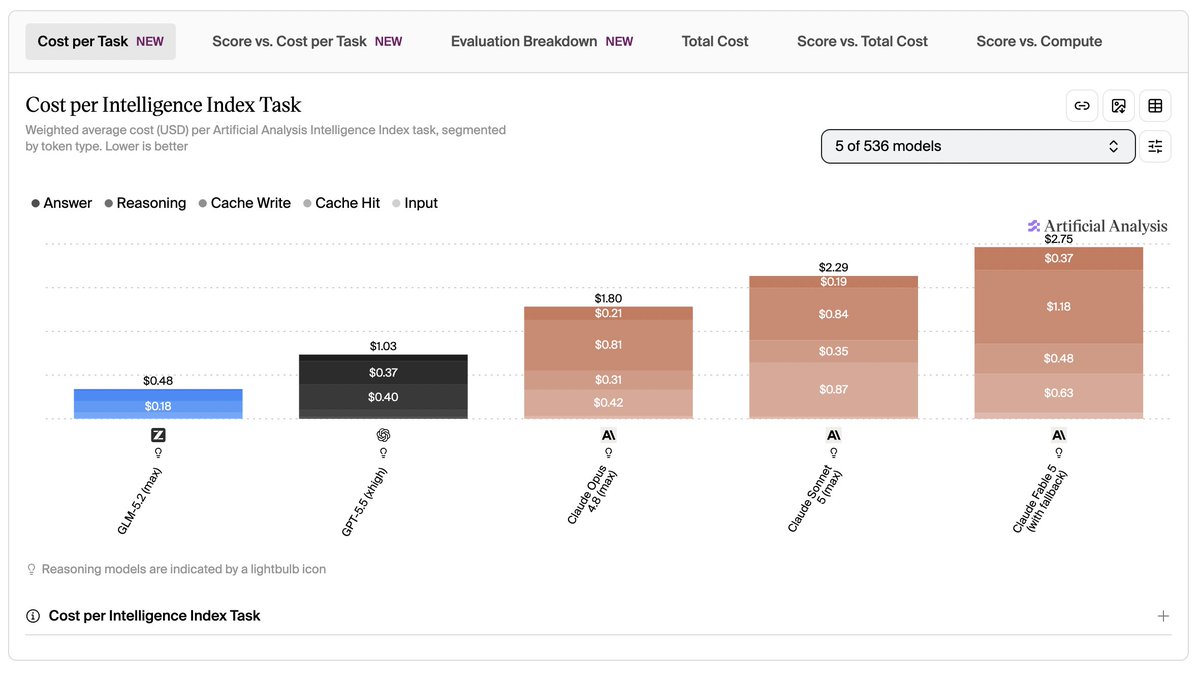
Claude Sonnet 5 costs more than Claude Opus 4.8 on the Artificial Analysis Intelligence Index task, and 4.75X more than GLM-5.2.
Token efficiency is important.