Super excited to introduce Gemma 4 12B! 💎
- Multimodal: audio, image, video, and text input
- Novel architecture: we removed the multimodal encoders for a unified, streamlined arch
- New MacOS desktop app powered by LiteRT
- MTP support
Excited to see what you build with it!
Seven new models launching at Build: let’s go!
Reasoning. Code. Image. Transcribe. Voice.
Built from scratch on a clean data lineage, designed for efficiency, working seamlessly as a family of models
Thread 🧵
#MSBuild
Today we're open sourcing https://t.co/p76KVdY7dG, a reference platform for cloud coding agents.
You've heard that companies like Stripe (Minions), Ramp (Inspect), Spotify (Honk), Block (Goose), and others are building their own "AI software factories". Why?
1️⃣ On a technical level, off-the-shelf coding agents don't perform well with huge monorepos, don't have your institutional knowledge, integrations, and custom workflows.
2️⃣ On a business level, the moat of software companies will shift from 'the code they wrote', to the 'means of production' of that code. The alpha is in your factory.
Open Agents deploys to our agentic infrastructure: Fluid for running the agent's brain, Workflow for its long-running durability, Sandbox for secure code execution, AI Gateway for multi-model tokens.
(Because of our focus on Open SDKs and runtimes, this codebase is a gem even if you're not hosting on Vercel.)
TL;DR: if you're building an internal or user-facing agentic coding platform, deploy this:
https://t.co/xdsc42nbDN
Who wants to know how Gemma 4 works?
This visual guide breaks down the new architectures and how they process text, images, and (for the smaller models) audio.
👇
Introducing the 𝗚𝗲𝗺𝗶𝗻𝗶 𝗮𝗱𝘃𝗮𝗻𝘁𝗮𝗴𝗲 in Google Marketing Platform. Our best AI for your best ROI
Experience unified inventory, accelerated performance, and ease of use. All in one place.
Some helpful updates from across Google this week, lots more to come! 🧵
@NotebookLM is introducing Cinematic Video Overviews for Ultra users in English.
Distill complex information into amazing visual deep dives - take a look 👇
For truly realistic conversational research, we must rethink fully autonomous agent design.
DialogLab, our new open-source prototyping framework, uses a human-in-the-loop control strategy to achieve realistic human-AI group simulation, offering a necessary alternative to fully autonomous agents.
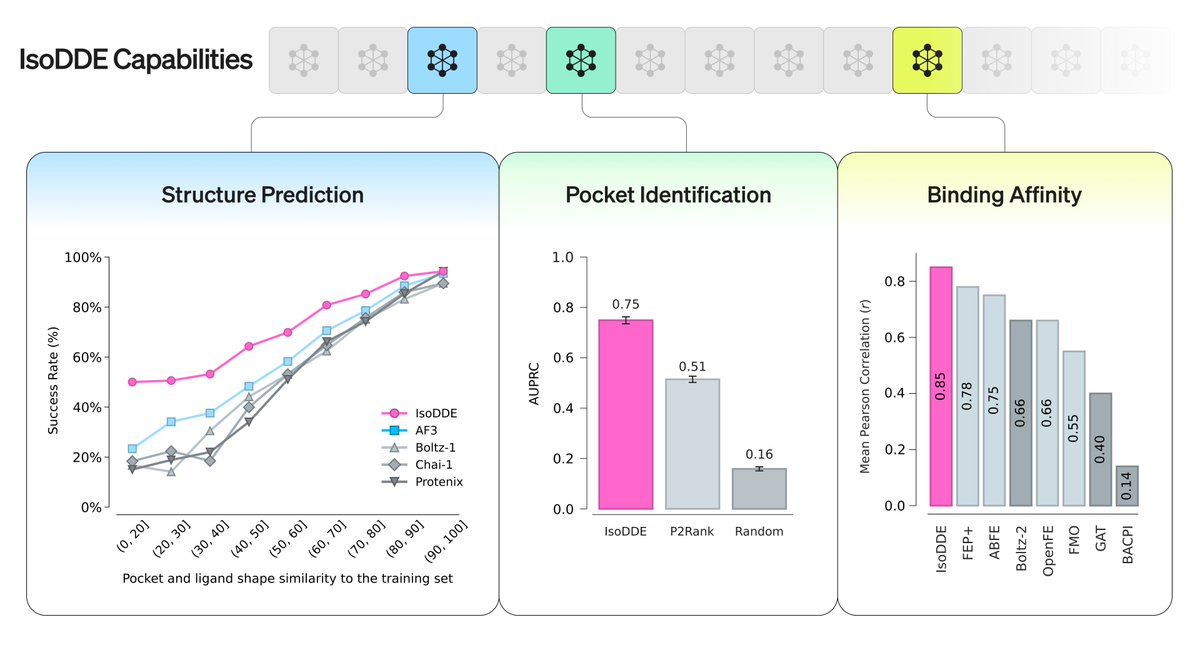
Today we share a technical report demonstrating how our drug design engine achieves a step-change in accuracy for predicting biomolecular structures, more than doubling the performance of AlphaFold 3 on key benchmarks and unlocking rational drug design even for examples it has never seen before.
Head to the comments to read our blog.
Introducing Project Genie: An experimental research prototype powered by Genie 3, our world model, that lets you prompt an interactive world into existence — and then step inside 🌎
Which AI Agent framework should you choose? LangGraph, CrewAI, AutoGen, or MetaGPT?
I created this "AI Agent Frameworks Cheatsheet" to help you decide based on your specific use case.
Here is how I see the ecosystem right now:
1️⃣ LangGraph (For the Control & Precision)
If you need a stateful, multi-agent system where you have absolute control over the flow, this is your go-to. It treats workflows as cyclic graphs.
Why I love it: It solves the "looping" problem in agentic workflows by giving you granular control over state and human-in-the-loop interactions.
Best for: Complex enterprise systems with dynamic data sharing.
2️⃣ CrewAI (For Role-Based Collaboration)
CrewAI is brilliant because it mimics a human team. You define roles (Researcher, Writer, Analyst), and the framework handles the "management" aspect.
Why I love it: It’s incredibly intuitive for process-driven tasks. It excels at collaborative workflows where one agent’s output is another’s input.
Best for: Content pipelines, market research, and multi-step business logic.
3️⃣ Microsoft Agent Framework (For Conversational Reasoning)
AutoGen (part of the Microsoft ecosystem) is the pioneer of agent-to-agent conversation. It’s highly flexible and allows agents to "talk" through problems.
Why I love it: It’s great for iterative tasks. One agent can write code, another can execute/test it, and they can keep talking until the bug is fixed.
Best for: Interactive assistants and collaborative problem-solving.
4️⃣ MetaGPT (For Software Dev Automation)
MetaGPT takes a unique approach by incorporating Standard Operating Procedures (SOPs). It’s essentially a "Startup-in-a-box."
Why I love it: It doesn't just write code; it generates the Product Requirement Document (PRD), design docs, and the full repository structure.
Best for: Product builders looking for end-to-end software automation.
The Quick Summary:
🛠 LangGraph = Control & State
👥 CrewAI = Processes & Roles
💬 Microsoft/AutoGen = Reasoning & Dialogue
🚀 MetaGPT = Software Lifecycle
I’d love to know: Which of these are you currently building with? Are there any other frameworks I should include in my next update?**👇
#AIAgents #GenerativeAI #LangGraph #CrewAI #AutoGen #MetaGPT
Follow me for more visual guides on the AI and Cloud ecosystem! ☁️✨
Find more resources at https://t.co/SnBk6yixHO
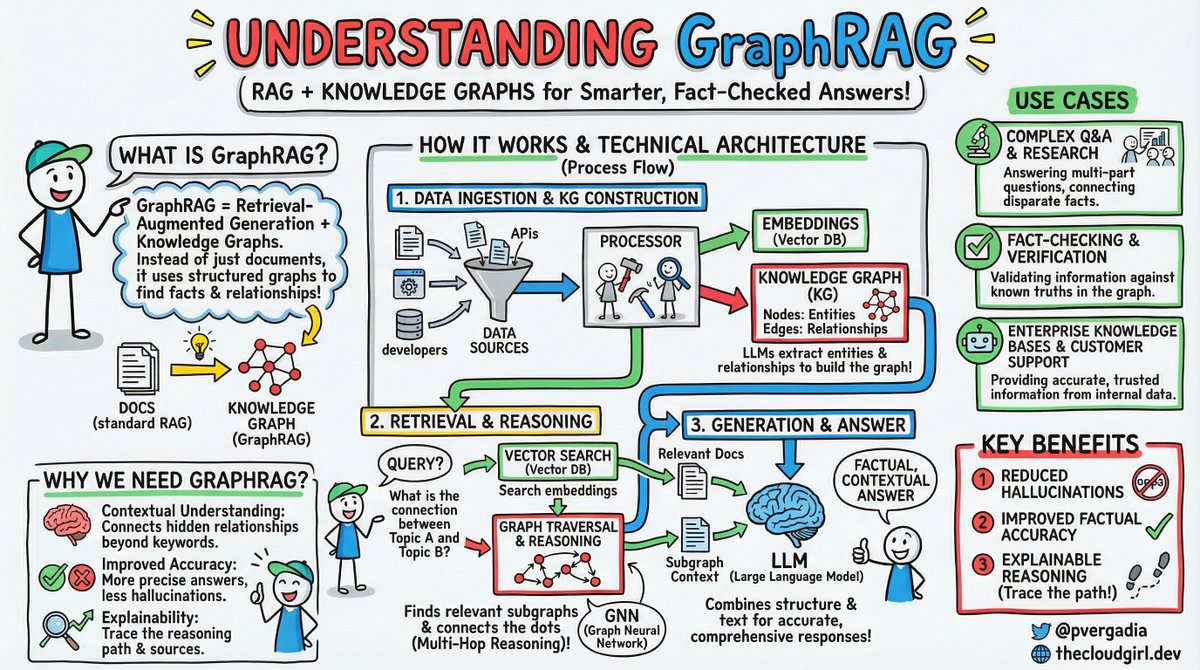
🚀 Understanding GraphRAG: Cheatsheet
Traditional RAG systems search through documents using keywords. But what relationships between concepts?
That's where GraphRAG 🧠 comes in!
What makes it different?
Instead of treating documents as isolated text chunks, GraphRAG uses Knowledge Graphs to map entities and their relationships—giving AI true contextual understanding.
📊 How It Works:
1️⃣ Data Ingestion → LLMs extract entities & relationships from your data sources to build structured knowledge graphs
2️⃣ Intelligent Retrieval → Combines vector search with graph traversal to find relevant subgraphs and connect the dots through multi-hop reasoning
3️⃣ Smart Generation → The LLM gets both the structural context AND relevant documents for comprehensive, accurate answers
💡 Key Benefits:
✅ Reduced hallucinations - Facts grounded in structured knowledge
✅ Improved accuracy - Less guesswork, more precision
✅ Explainable reasoning - Trace the path from question to answer
🎯 Perfect For:
Complex Q&A requiring multi-step reasoning
Fact-checking against verified sources
Enterprise knowledge bases where accuracy matters
Customer support with trusted, consistent answers