A founder shortlist needs evidence, not just engagement numbers.
AIsa Social's VC workflow uses public posts to find startups and founders, keep source links and prepare introduction drafts for review.
I'd try it as research only: pick one sector, shortlist five products, then open the original posts and check who is actually using each product. A popular launch isn't proof of paying customers.
The demo's $0.35 is AIsa's reported data cost, not a budget guarantee. API and model usage varies. Check coverage and costs first, and approve the recipient and words before any outreach. I haven't tested it.
Finding promising startups is hard. Reaching the right founders can be even harder.
Here’s how venture capital firms can use AIsa Social to:
> Discover early-stage startups across social platforms
> Build a shortlist with links to original posts
> Find founders and their contact details
> Draft personalized intros for review
In this example: 5 startups, 6 founders, 4 work emails, and a first intro.
AIsa data cost: $0.35 👇
Your team's best prompt shouldn't live in one person's chat.
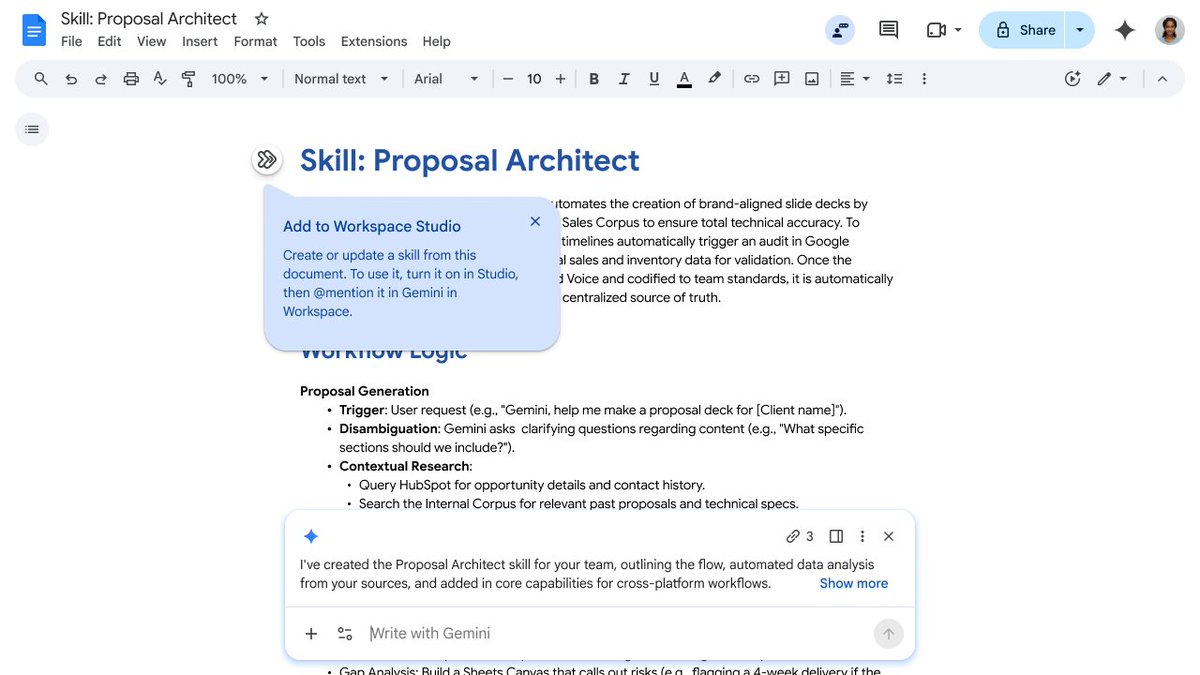
Google is rolling out Workspace skills: reusable instructions for Gemini in Gmail, Docs, Slides, Drive and Chat.
I'd start with one proposal-draft skill: approved structure, tone and reference files. Test it on a fictional brief before using it for clients.
The catch: sharing creates an independent copy, not a centrally updated policy. Referenced Drive files need separate access, and Workspace skills don't automatically sync with the Gemini app.
English only for now, on eligible plans. Rapid Release rollout began Nov 9; Scheduled Release starts Nov 30. Google's illustration below, not a workflow I tested.
Every team member brings their own expertise and know-how to work — the invoicing expert or your colleague who knows where to find every design asset.
You can now scale up that institutional knowledge with new Workspace skills, so everyone can do fewer repetitive tasks and bring best practices to their work. Read more 👉 https://t.co/XAIJMQBUwd
The edits between AI generations are worth turning into tools.
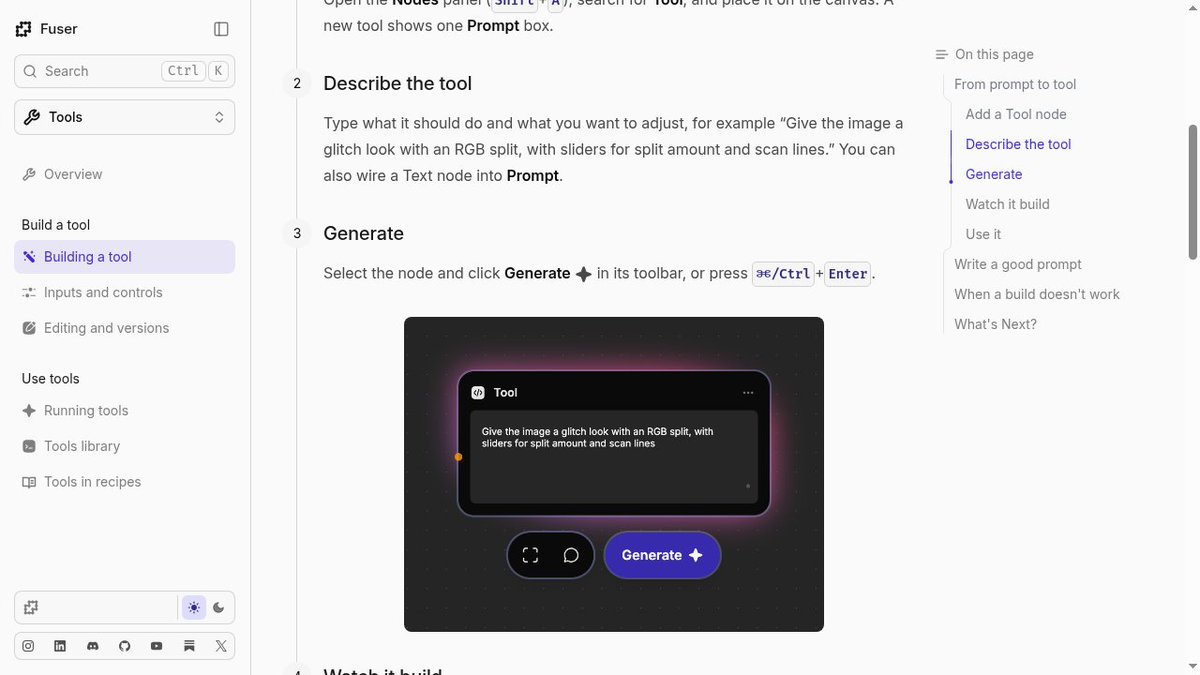
Fuser's new Tool Node turns a description into a reusable node with its own controls. Its docs show an RGB-split effect with sliders for split amount and scan lines.
I'd try that on one approved campaign image, then compare three subtle settings before reusing the tool on the next asset. Inspect the full-size export, not just the preview.
Building or editing a tool uses credits. Live tools run locally; Cloud tools use credits per run. Check usage rights before client work. Screenshot: Fuser's documentation, not a test I ran.
We spent weeks planning this launch and Jensen still found a way to make it about his tool.
Introducing Tool Node.
From lowering exposure to removing backgrounds, build every tool you need for anything you're working on... or working through.
Now available in Fuser.
Approve the story before you spend on the render.
DomoAI's new InkoAI Agent puts video and character creation into a chat. DomoAI says you can refine the work and approve each step, rather than accept a one-shot result.
I'd try a short scene with one fictional character: approve the script and storyboard, then check whether the final clip keeps the same face, clothes and story.
Check generation costs and usage terms before starting. A demo isn't proof that every scene is ready to post; I haven't tested this workflow.
Introducing InkoAI Agent, a creative assistant from DomoAI.
One sentence in. A ready-to-post video out.
Short dramas, anime videos, character designs and more: create and refine it all in one chat, and approve every step.
Try it free 👇
#DomoAI#InkoAIAgent#AIVideo
An AI-built landing page isn't finished when it looks right in a screenshot.
Modern Web Guidance 1.0 gives coding tools expert-reviewed web guides and a scanner for older code patterns. It includes browser compatibility data, with Chrome, Firefox and Edge supporting the project.
I'd start with one enquiry form on a copy of a site: ask for a modernization plan before edits, then test keyboard navigation, error messages and mobile layout. The screenshot shows a documented JavaScript-to-CSS example, not a test I ran.
The scanner only covers a limited set of patterns. A clean report isn't an accessibility certificate or proof that the page works for customers.
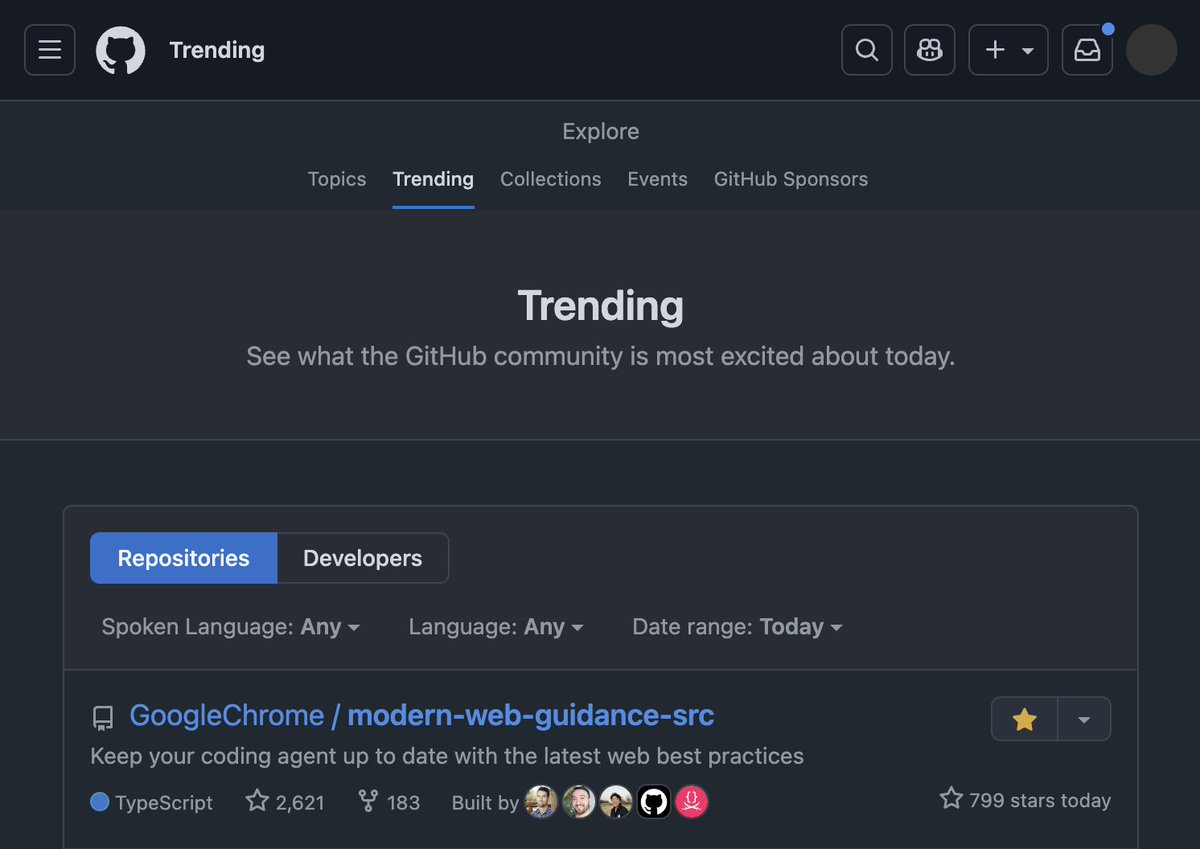
48 hours after launching 1.0, Modern Web Guidance is the #1 trending repo on GitHub 📈
Thank you to the thousands of web developers, and our partners across Firefox, MDN, Edge, and community contributors, who are helping move AI coding agents onto modern, accessible, Baseline-supported web primitives.
If you haven't tried 1.0 on your codebase yet:
Install the agent skills: 'npx modern-web-guidance@latest install'
Audit an existing codebase: 'npx modern-web-guidance@latest legacy-scan .'
Check out the repo on Github → https://t.co/TKZYQy5v0Q
The fastest search isn't always the right search.
Octen Pulse uses a model to find likely destination URLs. Its docs recommend it for official sites, docs and help pages, not fresh news. The diagram's ~10ms is Octen's server-side median, not your app's full response time.
Agency test I'd try: 20 public software names, find each official help centre, then check every returned domain and page. Useful for a checked resource directory, not an excuse to skip verification.
The released model weights and URL table are non-commercial (CC BY-NC 4.0); the inference code is Apache 2.0. Open code doesn't mean the weights are cleared for client work.
Source: https://t.co/Z4jteq5EIN
For a product film, the useful music prompt isn't just "make it cinematic." It's "leave space for this line, then hit the reveal."
Taan v1-preview is built around that kind of control: video-led scoring, timed instructions and edits to specific instruments. The preview focuses on orchestral and cinematic music.
Agency test I'd try: a 25-second mock product film, with a pause before the reveal and strings entering on the cut. Check the actual timing, the mix under dialogue and the usage terms before a client uses it. A good demo isn't a guarantee that every cue lands.
We got into @ycombinator to fix how AI makes music.
Today we're launching Taan v1-preview, the most controllable foundation music model.
Music models today make catchy tracks, but you can't steer them. Ask for "violin at exactly the 11th second" and they usually skip it. So you regenerate over and over and hope one take fits.
Taan is trained to fix this.
Hum a melody, name exact notes, or hand it an image, a MIDI file, a video or a script. Taan composes music that fits your context and follows your instructions.
v1-preview has genre support limited to orchestral and cinematic music, with more genres on the way.
live today 👇
A voice demo can sound natural and still be the wrong tool for customer support.
Haru-4B is an open-weight speech model that listens and speaks at the same time. Its code and weights use Apache 2.0. But the team calls it a research base model: it isn't a reliable source of facts and doesn't follow instructions like an assistant.
I'd test a fictional character conversation, using my own voice or one I have permission to use. Interrupt it, change topic and leave a long pause. Check conversational timing first. Don't put it in front of customers because one demo sounds human.
One wrong word shouldn't mean re-recording a whole voice-over.
Riverside Labs' Tonality lets you edit words inside an existing recording and adjust delivery word by word. Riverside says it preserves the speaker's voice and room sound. The free playground has rate limits; API access goes through sales.
Small agency test: fix a mispronounced product name in a voice-over you have permission to edit. Compare the full sentence with the original, get the speaker's approval, then replace the take. Sell a checked correction, not a promise that every edit will be invisible.
Introducing Tonality by Riverside Labs, the first voice model that edits any word in an existing recording, with full control over how it’s said.
All other voice models regenerate the whole sentence when you change one word, so you lose the original voice identity, delivery, and room acoustics.
Tonality is built for precise edits with full control over the pitch, tone, duration, pauses, energy, and pronunciation. Everything else stays exactly as recorded.
Tonality is available via API. Try it for free at https://t.co/oSgE3csGMR
A product demo can be more useful when people can turn it around, not just watch a video.
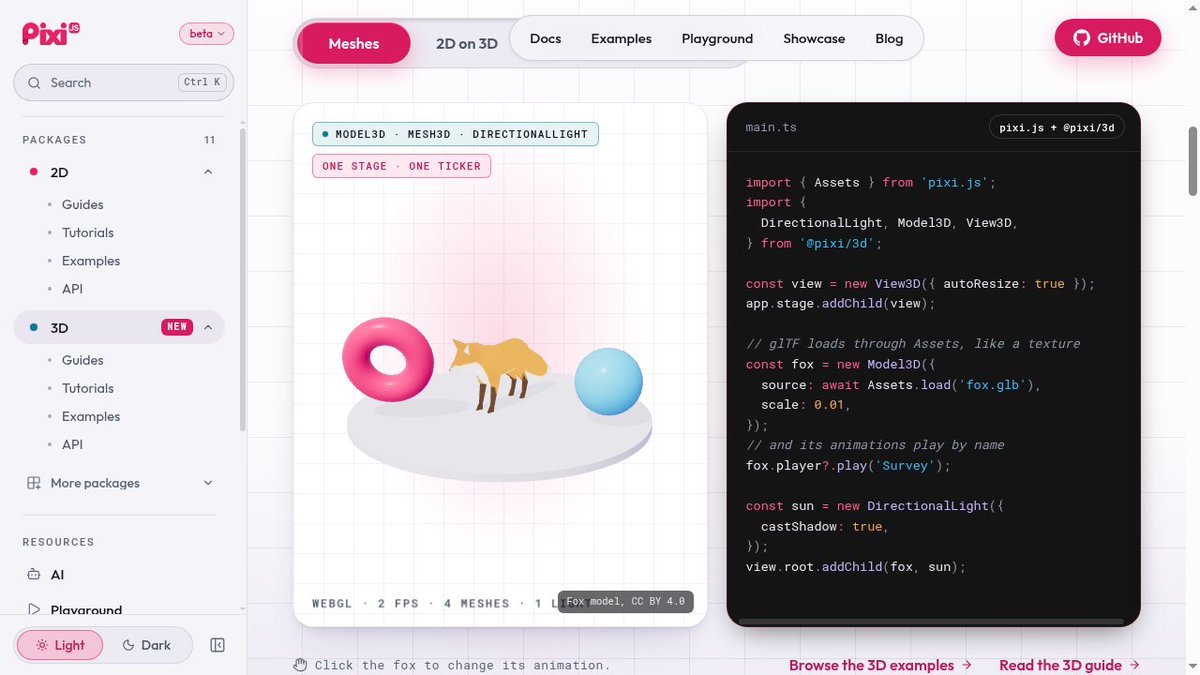
PixiJS 3D is now in open beta: 2D and 3D share one stage, with WebGPU and a WebGL2 fallback. It's MIT licensed, and the team provides skills for AI coding tools.
Small agency test: build one interactive product viewer for a mock landing page. Ask your coding tool for a starting scene, then check loading, touch controls and a fallback image on real phones. It's beta software; don't promise a production-ready result from one prompt.
A supplier shortlist is only useful if the stock and price are real.
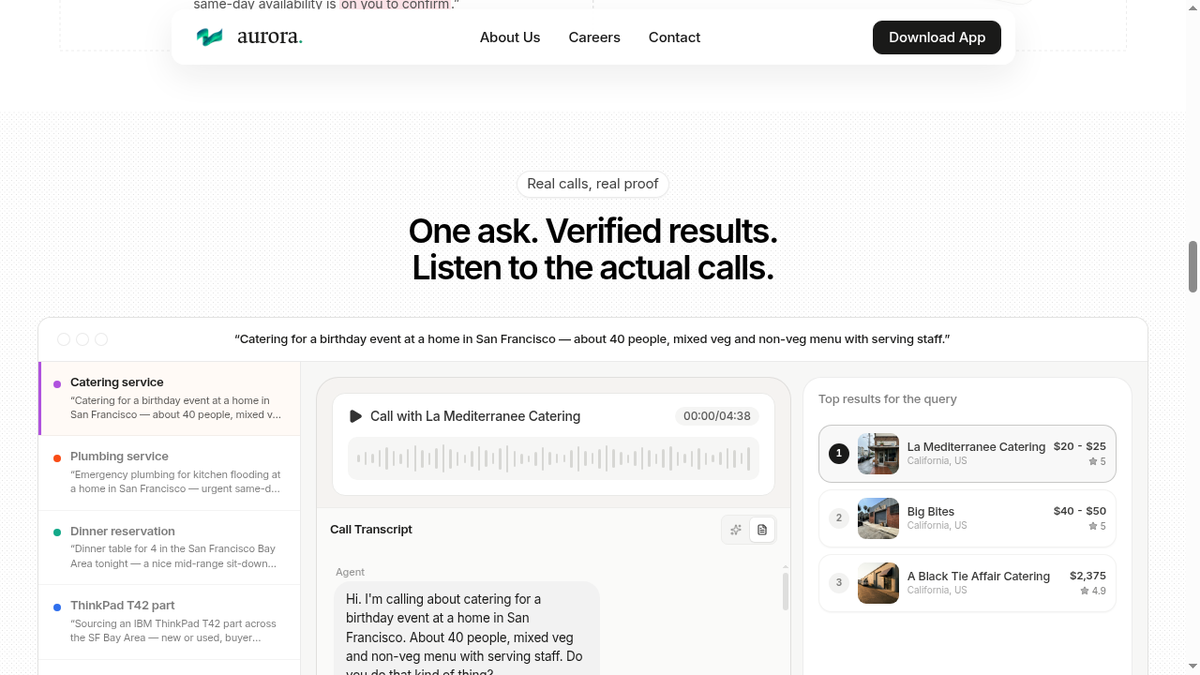
Aurora says its AI calls businesses to check availability and quotes, then returns recordings and transcripts you can review. It's in early access, with a waitlist or invite required.
Agency use case I'd try: compare AV rental quotes for one event. Check the call, delivery fees and how long each quote holds. Keep it quotes-only: no booking, no payment and no client details shared without approval.
Introducing Aurora - the Search Engine for IRL
Have you ever had to go shop-to-shop, or ask your friends and family, or spent hours browsing online for weeks, to find out - which business has what you want?
Could be anything from a renting an Apartment, to a Doctor's appointment? Maybe just your favorite shoe in your size at a store nearby?
Now - you can just Ask @aurorax_ai , and it will tell you who has it!
The voice AI business I find more interesting than another polished demo: solving one repeatable call properly.
Retell says it has passed $100M in annualized revenue run rate, up from $10M in 17 months. That's a company-reported pace, not $100M already earned over a full year.
Small agency angle: test an inbound FAQ assistant with fake customer details. Include an interruption, an unknown answer and a request for a person. Sell the checked workflow and ongoing QA, not a promise to replace everyone on the phone.
Retell just crossed $100M in revenue run rate.
$10M to $100M in 17 months. Profitable. $4.6M raised.
From day one, we’ve focused on solving the hardest parts of deploying voice AI in the product itself, so customers can build, manage, and improve their own agents without depending on us.
Our bet: the future of the contact center belongs to the teams who run it.
Proud of our team. Grateful to every customer who believed in us.
Before paying another creator, check who is already talking about your brand.
Nectar's new Creator Agent finds creators, reviews their content and brand history, and helps manage outreach and reporting. It's an add-on for Nectar customers covering Instagram and TikTok.
I'd test the shortlist first: 10 creators, one product, recent posts checked by a person. Keep outreach in draft until the brand approves the words. A good fit matters more than a big follower count.
Creators are now the biggest distribution channel a brand has.
Most creator programs still run on scrolling, spreadsheets, and one-off DMs.
Teams waste 1,000s of hours every year sifting through.
Today we're introducing Nectar Creator Agent, powered by Ren, to fix that 🍊
Sometimes you don't need AI to rewrite a document. You need it to point to the exact words.
Perplexity's Decider v1.3 adds "locate": extract matching text and its character positions from an input. This feature is text-only, not web search.
Small agency test: find the stated deliverables and deadlines in 10 sample briefs, then check every match against the original. Treat missing or wrong matches as review work, not permission to invent the answer.
We're rolling out pplx-decider-v1.3 and pplx-decider-flash-v1.3, the latest version of our open-weight decision models.
v1.3 adds locate, a new feature that extracts spans based on type or instructions.
Now available in our Decisions API, @huggingface, and @OpenRouter.
https://t.co/bsTSl2tHSo
The test for a creative AI team: does the original brief survive all the handoffs?
Krea is opening beta access to Bots: specialists for images, storyboards, motion, sound and editing that work together in chat. Access is through a waitlist.
I'd give them one fictional product brief and ask for a storyboard plus a 15-second cut. Check the product, message and brand rules at every step. Keep client files and publishing permissions out of the first test.
introducing Krea Bots, your new creative crew.
bots can take on entire creative projects and adapt to your taste as you and your team collaborate with them.
all our recent creative work has been produced with these bots, including the video below!
join the beta and get $1,000 in credits 👇
Before another client call, find the exact passage behind the last decision.
Granola MCP 2.0 adds transcript search and tools to add agendas or organise notes. Transcript search and write tools need a paid plan.
My first test: ask for the pricing objections from one past meeting, check the cited passages, then draft the next agenda. Confirm the workspace and folder audience before moving notes. Don't turn a private call into a team-wide document by accident.
Introducing Granola MCP 2.0: the most efficient and intelligent way to work with your meeting context.
🔎 Smart Search: 85% fewer tokens. Transcripts stay the source of truth.
✍️ Write Tools: Add agendas and organise notes.
🧠 Agent Brief: Keep your AI up to date on your work.
I want to meet more people building with AI.
I run an AI creative agency and make content about AI. I'd love to connect with:
- Creators making AI films, ads and stories
- Agency owners figuring out what clients actually need
- People turning small ideas into useful products
- Anyone learning AI by making things
Show me what you're working on. A video, a product, even an unfinished idea. I'd rather start a conversation around that than just swap follows.
Don't judge a coding agent only by how fast it writes the first diff.
Google's new Orchestrator in Antigravity switches between Carbon for planning and Hydrogen for edits and tests, with a hand-back when the plan needs repair. It's rolling out to Google AI Ultra subscribers.
Small test: fix one landing-page bug on a staging branch. Review the plan, diff and test results before merging. Model handoffs don't replace a review.
We’re rolling out Orchestrator in @Antigravity to Google AI Ultra subscribers, letting you run multiple models in a single session instead of routing the entire task to one model.
Orchestrator pairs a frontier model with a fast execution model: Carbon sets the plan, hands off code edits and testing to Hydrogen, and steps back in to repair the plan if it hits friction — reaching near-Carbon task success rates on Terminal-Bench 4.0 while consuming 24% less quota and completing 19% faster on average.
I'd test this on one scene before cancelling a sound library.
Mirelo generates and syncs sound effects inside Premiere and DaVinci Resolve Studio. The free version of Resolve isn't supported.
Try a 10-second product shot you own: generate footsteps, a click or room ambience, then check timing and listen under dialogue.
Client work needs commercial rights. Check the plan and training terms before uploading footage. A synced sound isn't automatically the right sound.
From today, you can cancel all your sound library subscriptions.
Mirelo now generates sound effects tailored to your footage in seconds, right in Adobe Premiere and DaVinci Resolve.
More details in thread⬇️
The useful meeting output isn't another summary. It's a brief your team can correct before the call ends.
Claude Meetings is rolling out in beta for Team and Enterprise on Google Meet. It can build docs and whiteboards during internal calls.
Small agency test: ask for a campaign brief, then check the scope, owner and deadline together. Get everyone's consent to transcription first. Start internally, not on a client call.
Introducing Claude Meetings: add Claude to your team’s video call and it builds docs, whiteboards, and other artifacts with you while you’re still talking.
Starting to roll out in beta on Team and Enterprise plans.