I’m 29, based in Berlin 🇩🇪
Moved to Berlin from India in 2021
IIT Bombay CS, founder + engineer.
Building https://t.co/htwIlHFinQ at the intersection of AI & industrial software.
Always down to meet fellow builders 🚀
@catmanyau Agreed. The tricky part is that the customer often owns the data already. If they can bring it into their own workspace, the vendor has to earn its place by making a difficult workflow work reliably. That’s a much higher bar than bundling a few agents.
Cloudflare OS(https://t.co/GS6KEZA9Dd) makes this convergence even more interesting. Having forked it and used it myself, I’m impressed by how much of this foundation is already available as open source.
Companies can deploy it in their own Cloudflare account, connect internal systems, and build their own apps and workflows on top. It’s an excellent starting point for building this kind of platform internally.
You no longer have to build the entire foundation from scratch. You can start with a working agent workspace and focus on what’s actually specific to your business.
Meanwhile, so many AI SaaS products seem to be converging on that same foundation:
Folders. Memory. Company knowledge. MCP connectors. Tool execution. An internal store for mini-apps.
Langdock, Blockbrain, OpenAI, Anthropic. Different starting points, increasingly overlapping ambitions.
That puts an uncomfortable question in front of a lot of AI SaaS companies:
If your product is this same workspace with a few industry-specific mini-apps bundled in, how much differentiation do you really have?
As agents get better at handling different inputs, using tools and building interfaces, that question only gets harder.
Deep integrations, proprietary data and reliably completing difficult workflows can still be valuable. But folders + memory + MCP + mini-apps is becoming the baseline.
Your next competitor might be your customer’s internal platform, built on an open-source foundation.
every major company is arriving at roughly the same offering:
persistent memory, email/calendar/messages, browser + computer use, background tasks, proactive notifications, voice, app/tool execution, ambient context, & some notion of a personal agent sitting above everything.
remarkable levels of convergence with very little differentiation whatsoever.
@andrewdsouza@boardyai Thanks @andrewdsouza ! Would love to meet researchers and builders at frontier labs or new AI labs, especially people working on LLMs, world models, or exploring what comes after today’s models. That’s where my curiosity is pulling me.
I’m 29, based in Berlin 🇩🇪
Moved to Berlin from India in 2021
IIT Bombay CS, founder + engineer.
Building https://t.co/htwIlHFinQ at the intersection of AI & industrial software.
Always down to meet fellow builders 🚀
Exactly what I was testing with our german supplier emails, is this a quote request, an order or an invoice dispute? That decides which workflow runs next. Jev’s confidence scores were the interesting bit for me, a way to decide what goes through automatically and what needs a person.
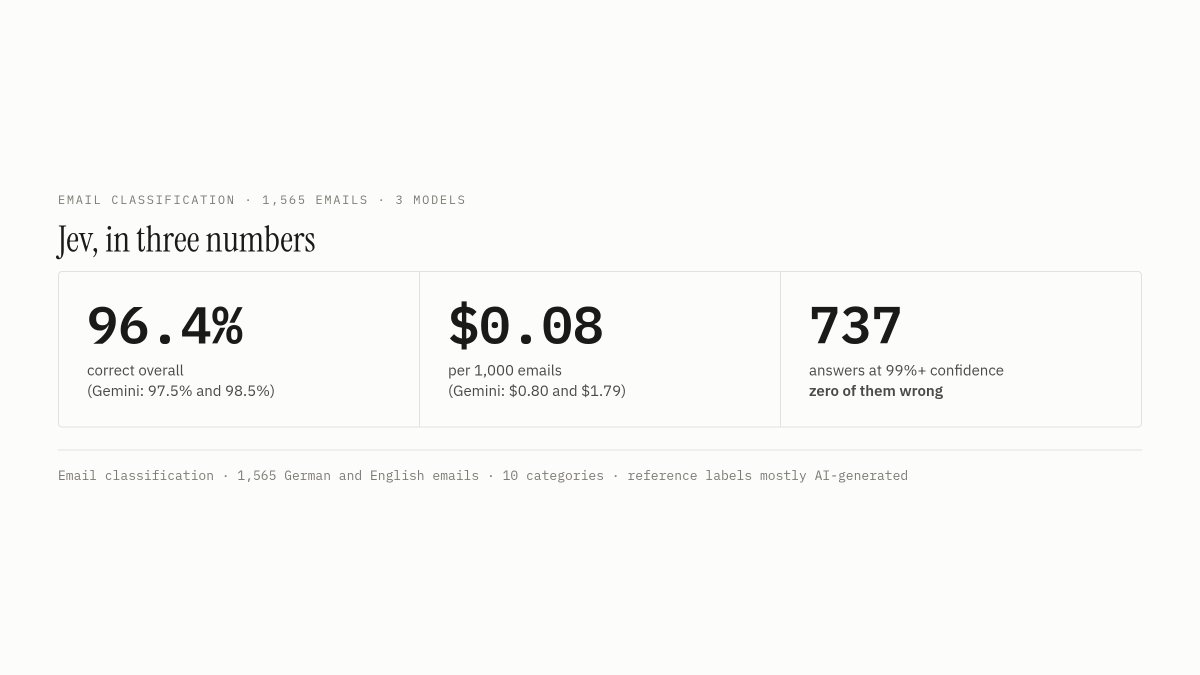
Jev lost to Gemini on our email classification benchmark.
I’m still interested in putting it into production.
We tested 1,565 German and English business emails across 10 categories from Industrial suppliers.
The interesting result wasn’t accuracy. It was where the mistakes happened. 🧵
After co-inventing ChatGPT, I kept asking myself: why have superhuman chat models not led to AGI?
I’ve spent the last 2 years in stealth building a new way to train models (RLCD), and a new type of frontier AI model that we are releasing today: Jev
• 20-200x faster
• 40-400x cheaper (w/ output tokens free)
• Frontier composable intelligence optimized for decisions
AFAICT the shortest path to AI-based economic revolution
@sirotenko_m Would love to try that! I couldn’t get logprobs back from Gemini 3.x though. Have they been disabled for those models, or am I missing something in the API config? Is there a specific model/endpoint you’d suggest?
@mrinal Haven’t tested those yet, but would love to run the same eval! Especially curious whether the confidence scores hold up too. Being able to run this locally would be a big plus.
@MiBBMa Fair point! I kept the category instructions the same because I just wanted to benchmark the models and have an apples to apples comparison. It indeed doesn’t tell us how good each model can get with tuning.
@harold_bracy Yeah, and those delays add up when an agent makes several decisions in a row. In my runs Jev’s p99 was 0.88s vs 3.14s and 16.2s for the two Gemini models. Would be curious to see tests on those tighter real-time tasks too.
@Yield_Guy Yeah, that was the most exciting part for me! You can let the confident cases go through and send the uncertain ones for review. Still want to see how well that holds up on fresh emails, but pretty promising.
@ItsCuthulhu Worth testing! My worry is a second Jev might repeat the same mistake. Same reason I’d use a different model family while using LLM as the judge: having the same model generate and grade its own answer can miss shared blind spots.
@shubhamspawn Oh nice, would love to see your results! Especially how it handles sarcasm and mixed sentiment in brand mentions. Tag me when you share, curious if you see similar patterns with the confidence scores.
@_lepach I just wanted to benchmark both the models and understand their strength and weaknesses. Now that we know, we can use them in any setup and tune it according to the usecases :)