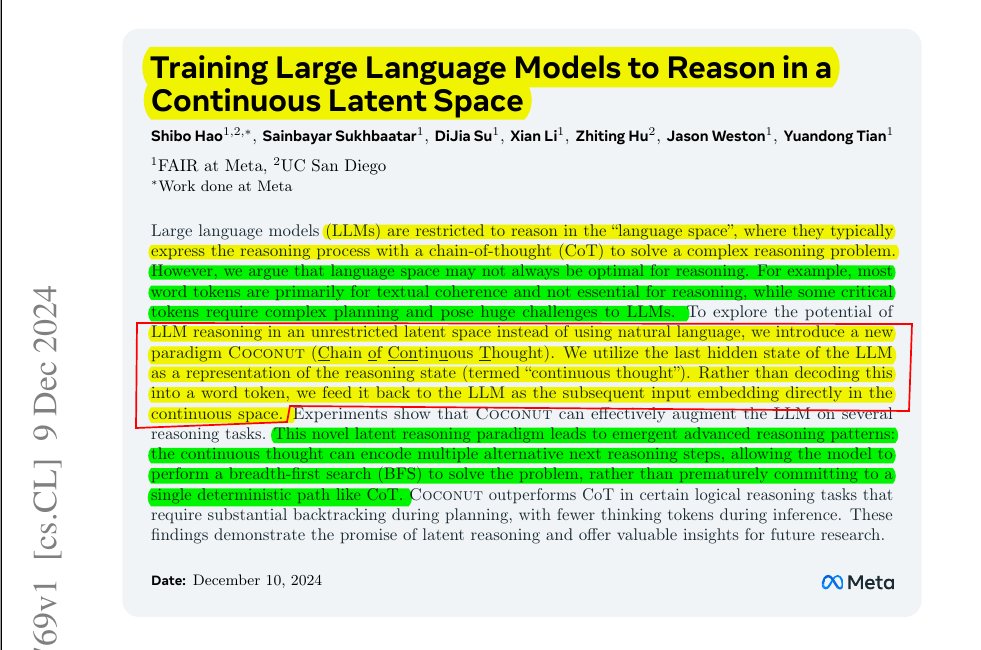
Brilliant paper from @Meta having the potential to significantly boost LLM's reasoning power.
Why force AI to explain in English when it can think directly in neural patterns?
Imagine if your brain could skip words and share thoughts directly - that's what this paper achieves for AI.
By skipping the word-generation step, LLMs can explore multiple reasoning paths simultaneously.
Introduces Coconut (Chain of Continuous Thought), enabling LLMs to reason in a continuous latent space rather than through word tokens, leading to more efficient and powerful reasoning capabilities.
🧠 The key Solution in this paper
Current LLMs are constrained by having to express their reasoning through language tokens, where most tokens serve textual coherence rather than actual reasoning.
So this paper proposes a novel solution where instead of decoding the hidden state into word tokens, it's directly fed back as the next input embedding in a continuous space.
Let me explain the mechanism simply:
In normal LLMs, when the model thinks, it has to:
1. Convert its internal neural state into actual words
2. Then convert those words back into neural patterns to continue thinking
What Coconut does instead:
It directly takes the neural patterns (hidden state) from one thinking step and feeds them into the next step - no conversion to words needed. It's like letting the model's thoughts flow directly from one step to the next in their raw neural form.
Think of it like this: Instead of having to write down your thoughts on paper and then read them back to continue thinking (like regular LLMs do), Coconut lets the model's thoughts continue flowing naturally in their original neural format. This is more efficient and lets the model explore multiple possible thought paths at once.
-----
The method uses special tokens <bot> and <eot> to mark latent reasoning segments, and employs a multi-stage training curriculum that gradually replaces language reasoning steps with continuous thoughts.
Key insights of the paper:
→ Coconut achieves 34.1% accuracy on GSM8k math problems, outperforming baseline Chain-of-Thought (30.0%)
→ The continuous space enables parallel exploration of multiple reasoning paths, similar to breadth-first search
→ Performance improves with more continuous thoughts per reasoning step, showing effective chaining capability
→ Latent reasoning excels in tasks requiring extensive planning, with 97% accuracy on logical reasoning (ProsQA)
At the height of One Million Checkboxes's popularity I thought I'd been hacked. A few hours later I was tearing up, extraordinarily proud of some brilliant teens.
A thread about my favorite story from running OMCB....
Exclusive: Meta just released Llama 3.1 405B — the first-ever open-sourced frontier AI model, beating top closed models like GPT-4o across several benchmarks.
I sat down with Mark Zuckerberg, diving into why this marks a major moment in AI history.
Timestamps:
00:00 Intro
00:38 Meta’s Llama 3.1 rundown
03:44 Real-world use cases for Llama 3.1
06:15 Educating developers on open-source AI tools
09:43 Societal implications of open-source AI
13:00 Balancing power and managing bad actors
14:40 Open source and global competition
16:59 Accelerating innovation and economic growth
20:04 Zuck on Apple and lessons from the past
24:22 Future of AI: Llama 3 and beyond
26:43 Prediction: Billions of personalized AI agents
31:32 Factors to changing anti-AI sentiment
Der er ingen grænser for, hvor ofte vi skal høre historien om, at dansk landbrug er grønnere og bedre end andre landes. Det er dog svært (læs: umuligt) at finde faktuelt afsæt for den historie.
Til gengæld findes der en anden fortælling, og den er der tilmed tal på. En 🧵
Gennem valgkampen har stort set alle partier (igen og fornuftigt) bebudet et nødvendigt opgør med bureaukratiet – og et opgør med politik lavet på baggrund af enkeltsager. Så landede TV 2’s dokumentar om omsorgssvigt på et plejehjem. Hvad skete der? Et udpluk: 1/5 #dkpol