We made LibreSSL into an XCFramework for iOS, iOS Simulator, macOS and macOS Catalyst, on both x86_64 and arm64. I wrote a bit about that: https://t.co/ynZAyk6mtj
What's new in Theo 6.0:
- Swift 6 with strict concurrency checking
- Full Swift Package Manager support (no more CocoaPods!)
- TLS/SSL encryption support
- Modern async patterns with NIO
- Works on iOS 17+ and macOS 14+
#Swift#Neo4j#GraphDatabase
Theo 6.0 is here! The Swift driver for @neo4j is fully updated for Swift 6 with strict concurrency, Swift Package Manager, and TLS support.
Connect your iOS/macOS/Linux apps to Neo4j graph databases natively.
https://t.co/YCW8PyyvLR
cc @mesirii@neo4j
Me when I'm using AI to generate code that I understand: "Nope, wrong, try again, research this, ultrathink, do this exactly, use this syntax, only change this one part of the code" [breaking it down into smaller parts, refactoring hard in between, etc]
Me when I'm using AI to generate code that I don't understand: "Wow!!! It knows EVERYTHING!!! It is able to one-shot anything I say!!" [ask it to fix things if broken, completely trust the output] 🤣
Good post from @balajis on the "verification gap".
You could see it as there being two modes in creation. Borrowing GAN terminology:
1) generation and
2) discrimination.
e.g. painting - you make a brush stroke (1) and then you look for a while to see if you improved the painting (2). these two stages are interspersed in pretty much all creative work.
Second point. Discrimination can be computationally very hard.
- images are by far the easiest. e.g. image generator teams can create giant grids of results to decide if one image is better than the other. thank you to the giant GPU in your brain built for processing images very fast.
- text is much harder. it is skimmable, but you have to read, it is semantic, discrete and precise so you also have to reason (esp in e.g. code).
- audio is maybe even harder still imo, because it force a time axis so it's not even skimmable. you're forced to spend serial compute and can't parallelize it at all.
You could say that in coding LLMs have collapsed (1) to ~instant, but have done very little to address (2). A person still has to stare at the results and discriminate if they are good. This is my major criticism of LLM coding in that they casually spit out *way* too much code per query at arbitrary complexity, pretending there is no stage 2. Getting that much code is bad and scary. Instead, the LLM has to actively work with you to break down problems into little incremental steps, each more easily verifiable. It has to anticipate the computational work of (2) and reduce it as much as possible. It has to really care.
This leads me to probably the biggest misunderstanding non-coders have about coding. They think that coding is about writing the code (1). It's not. It's about staring at the code (2). Loading it all into your working memory. Pacing back and forth. Thinking through all the edge cases. If you catch me at a random point while I'm "programming", I'm probably just staring at the screen and, if interrupted, really mad because it is so computationally strenuous. If we only get much faster 1, but we don't also reduce 2 (which is most of the time!), then clearly the overall speed of coding won't improve (see Amdahl's law).
The more I use GenAI coding tools, the more I am convinced keeping to "traditional" software engineering practices is what works most productive here. As in 10x more productive. E.g.
- Small changes
- Test that the change works before moving on
- (unit) tests wherever you can
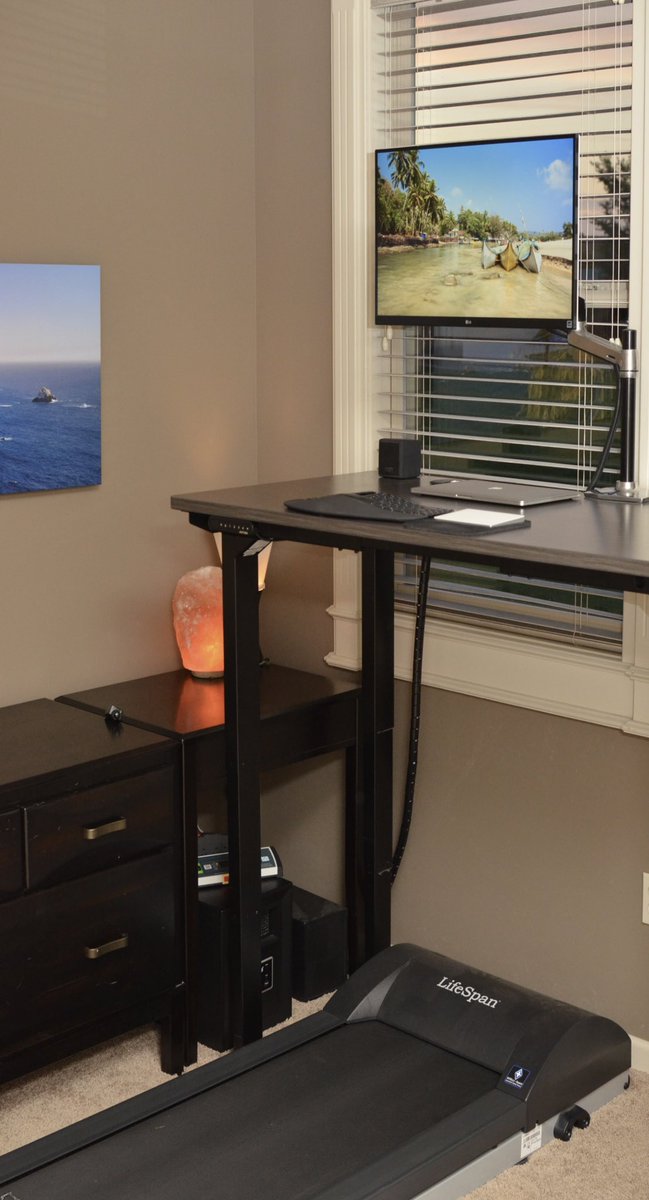
I’ve used a treadmill under my standing desk for the last 8 years. I love it, and I believe it’s a competitive advantage.
Here’s why:
1. 10k steps a day is generally recommended for good health. I easily hit that goal by walking 2 mph for part of the day while I’m working.
2. Walking reduces my stress and improves my mood.
3. If I sit too long I get restless and groggy. When I walk, I feel more alert.
4. Studies show it aids memory retention and creativity.
5. I’m in my 40s and weigh the same as I did in school. I think the treadmill played a role.
6. “I’m too busy to exercise” isn’t an excuse anymore. I walk and work.
@julianfdezme @PHuenermund @CBScph And yet it is, in your words, optimal for your daily life in the city. Danish is, in a very large part, a language of things not said. The rest is slurred and garbled ;-) #goNorwegian
@adamlyttleapps You new? Anyway, there’s the looking forward to the new and (possibly) revoltuionary, and then the how is our daily work going to change, and how can we take advantage of that. That last part is usually the most actual exciting :-) But the first one may be it this year
Jeg leser om personer i middelklassen som investerer formuer for å bli førtidspensjonister og slippe å jobbe.
Så leser jeg om uføre som gjerne ville jobbet hvis de var friske og fikk jobb.
Har jeg forstått det riktig at det bare er sistnevnte gruppe som oppfattes som late?