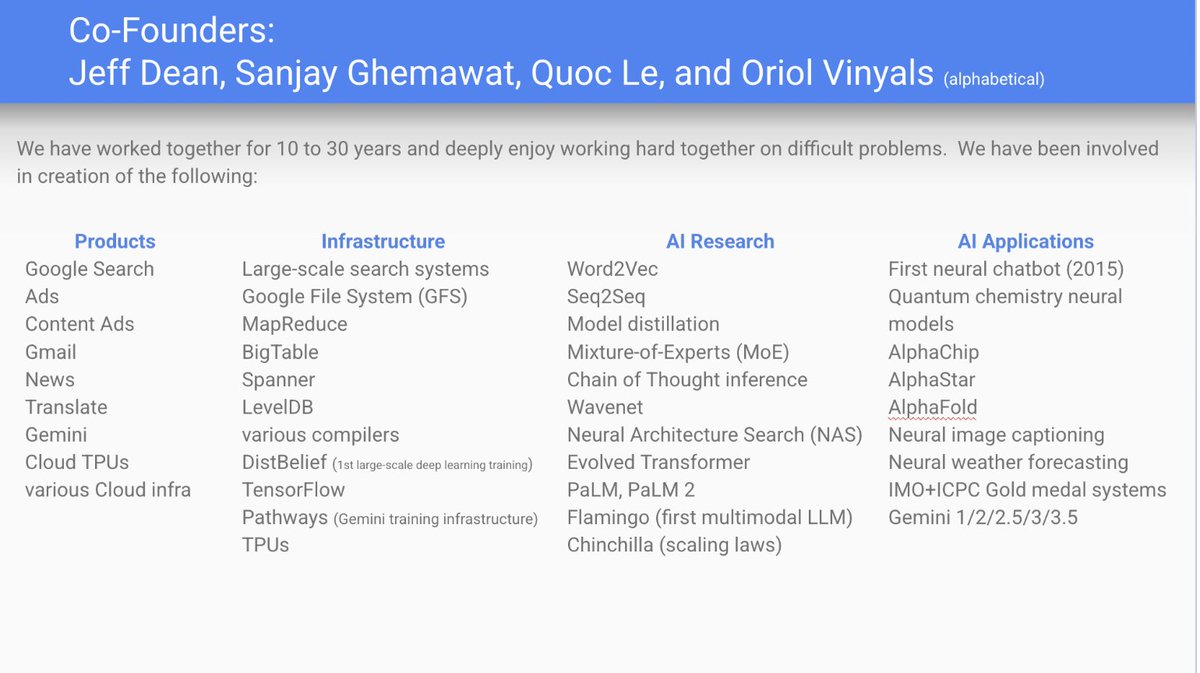
We created a pitch deck to tell a handful of VC firms about us and what we were up to (a fun experience!). Here’s a few slides about our background and some of the things we’ve worked on from the pitch deck (it was fun putting together the list of people in our teams who have gone on to found a whole range of exciting companies). We are delighted to have selected @radicalvcfund
and @khoslaventures to lead our initial funding round, along with participation from @lightspeedvp, @kleinerperkins, Doerr Capital (@johndoerr), and Alphabet (@Google). We’ll be working with them to close our seed round over the next few weeks.
Fun to think about distributed system design for @Starlink. Possible to replace leader election with a deterministic schedule governed by orbital mechanics?
To think that things get more predictable if you just move all your routers fast enough...
If finding security flaws is fully automated with frontier models à la Mythos, then GitHub should have a metric, like stars, showing how much compute is spent securing/hardening an open-source package. Example:
📦 linus/linux
⭐️ 200k 🦾 $239M
Only way OSS can be trusted.
@richardartoul Right... Still a little surprising considering how thoroughly they seem to have mastered bash. Could be that there is too much "friction loss" from unlearning read/write/edit on-the-fly.
@LauraRuis@MinqiJiang Agreed. A lot of work is only "better" or "worse" because a human judges it so, based on their value system. While that is the case, there is always an opportunity for humans to better leverage and align the available raw intelligence.
We're not off the hook yet, Laura!
Security may be what ends up rebalancing the scales in favour of software reuse and OSS. Sure, anyone can spend the tokens to recreate functionality. But are you willing to spend the tokens needed to find all possible exploits? Attackers only need to find a single one.
Blog post: On the Coming Industrialisation of Exploit Generation with LLMs https://t.co/aK4pysY1wD
TL;DR: I ran an experiment with GPT-5.2 and Opus 4.5 based agents to generate exploits for a zeroday QuickJS bug. They're pretty good at it.
Code: https://t.co/47xHRObhRy
Seems like future operating systems for the era of Claude Code need to work more like databases. Strong isolation and the ability to validate integrity constraints on the before and after state of the entire system before committing to a change (or rolling back).