AI engineer. CO-founder @hyperank_ai, helping brands get cited by ChatGPT, Perplexity and Google AI. Daily breakdowns of open-source AI tools worth your time.
Texting agents beats keeping a remote session open. I run a lot of Claude Code agents daily, and the part I want most is a short ping only when one is stuck, not a stream of updates.
Right now my favorite way to talk with my agents is through iMessage.
Claude code, Hermes, codex -----> all setup to talk via text.
It's so simple and doesn't rely on me having a remote session or anything. I'll often talk to my agents via a terminal app on my iPhone but there is this one dead zone on my morning walks that kills the connection. iMessage just works.
Setting it up is relatively easy.
- Use photon
- Hermes has a built in way to connect
- Claude Code and other terminal-based harnesses will need a bridge that you can have your agent put together pretty quick.
/impeccable is now a skill inside Computer. It’s an open-source skill built by @pbakaus to let you build interfaces that don’t look like AI-generated slop. We’re offering 5000 credits per user to get started with the skill.
@TheCoolestCool@ahrefs The long tail point is the one I'd bet on. Engines split one buyer question into follow-ups, and the brand with a page for each gets named. The free query fan-out generator at @hyperank_ai turns one keyword into ~20 related queries, handy for spotting missing niche pages.
The unbranded number is the one worth checking, since buyers rarely type your name first. We built a free checker at @hyperank_ai that asks AI five neutral buying questions without your brand and shows who gets named instead.
Fun fact:
When a buyer asks ChatGPT about your brand BY NAME, your website gets cited 77.6% of the time.
When a buyer asks "who is the best in this category," your site gets cited 2.2% of the time.
Here is how to close that 14x gap.
Oh, and if you want to see where your site stands across Google, ChatGPT, Claude and broader AI search, start here (it's free):
https://t.co/Evw8cXXicl
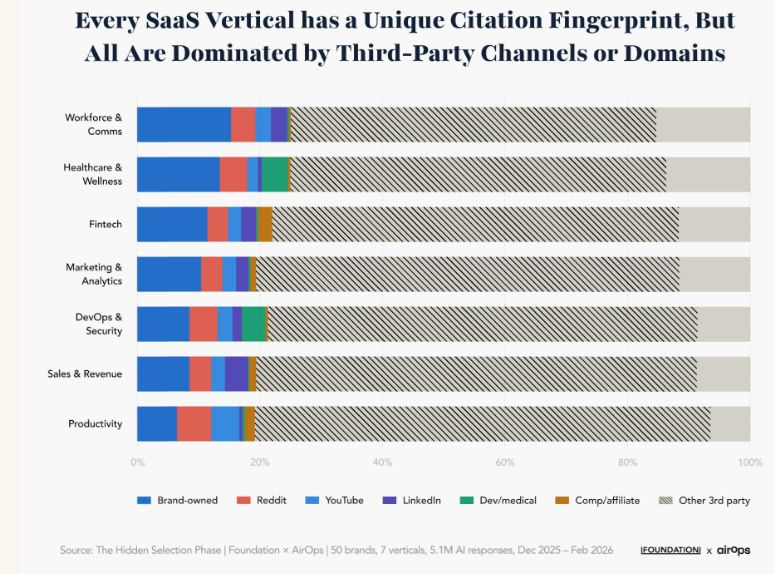
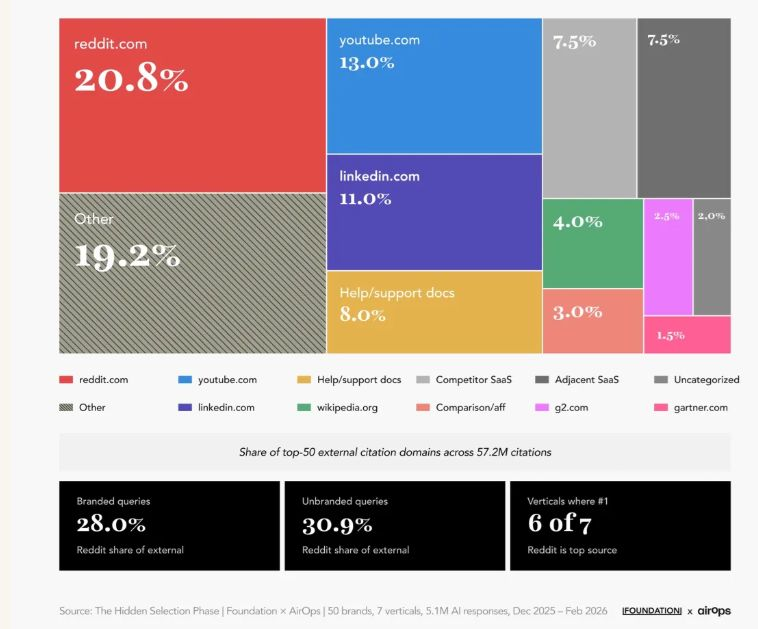
According to Foundation Marketing and AirOps's April 2026 study of 57.2 million AI citations across 50 brands in 7 B2B verticals, branded queries generate 14x more citations for brand-owned websites than unbranded discovery queries.
The brands that do appear in unbranded AI recommendations share a fairly consistent profile: deep expert content on their own site that establishes category authority, combined with editorial coverage from trusted industry publications that puts their brand name in front of the AI's retrieval system across multiple authoritative sources.
Basically, when a buyer asks AI about your brand by name, the AI searches specifically for your website and your content, so of course it finds you.
But then when a buyer asks "best CRM for mid-market companies" or "top cybersecurity platforms for healthcare," the AI is looking for the most authoritative, comprehensive answer it can assemble from every source in the category.
Every industry has a different set of sources that AI draws from for these unbranded queries.
The brands that close the 14x gap are the ones that show up across both their own site and the editorial sources AI trusts in their vertical.
That takes two things working together - both of which SEO Stuff (https://t.co/wKpf0EILTx) has been helping customers with all year.
Expert content on your own website that demonstrates deep category authority: this is what gives AI platforms a reason to include your brand when it finds you.
And editorial backlinks + mentions (authority) from trusted publications in your vertical: this is what puts your brand name across multiple authoritative sources so the AI encounters your brand repeatedly when searching for the best answer to a category query.
Again, if you want to see how your brand performs on branded versus unbranded AI queries and where the 14x gap is in your category, start here (it's free):
https://t.co/Evw8cXXicl
The expert content is doing two things simultaneously.
First, it creates a comprehensive resource that AI can cite directly when it finds the brand during category searches: the more sub-questions your content answers, the more entry points AI has to discover and recommend your brand.
Second, it creates something that editorial publications want to cover and link to: original data, expert frameworks, and comprehensive buyer guides are what industry publications write about.
Every editorial placement where a trusted publication mentions your brand and links to your site creates another source the AI can encounter during unbranded category queries.
A brand that has been covered by 10 or 15 editorial publications in its vertical gives the AI multiple authoritative references to draw from.
Reddit alone accounts for 20.8% of all external AI citations, but editorial publications, review sites, and industry sources collectively represent a massive portion of the citation landscape that brands can actively build presence on through expert content and earned editorial coverage.
This is the system SEO Stuff (https://t.co/wKpf0EILTx) was built around.
The done-for-you package:
https://t.co/Evw8cXXicl
Expert-attributed content backed by DR50+ backlinks: the content builds category authority on your site that AI cites directly, and the backlinks put your brand across the editorial sources AI draws from during unbranded discovery, closing the 14x gap
The content package:
https://t.co/5osvnSaiGB
60 pages of expert-attributed content covering every question buyers ask in your category: the content depth that gives AI a reason to cite your brand and gives editorial publications something worth covering
The authority building package:
https://t.co/BMl9QCGGn3
Editorial placements on trusted publications that put your brand name across the authoritative sources AI searches during unbranded category queries, turning your brand into a recommendation for buyers who have never heard of you
And if you want to see where your site stands across Google, ChatGPT, Claude and broader AI search, start here (it's free):
https://t.co/Evw8cXXicl
@BuildToCite Answer-first sentence also helps on the AI side, since engines tend to quote one self-contained passage. Do you check those same high-impression questions in ChatGPT too, to see if the page that ranks is also the one it pulls from?
@0xMafiaBod@RooliHQ 1,000 reach-outs and mostly no is useful data. Did the no's pile up around one reason, or was it all over the place? Curious if the few yeses looked like the same kind of buyer.
@kuroshiro01 ewriting titles to match what people type is the right first fix. Next I'd ask ChatGPT for the best claude code mods and see if your directory shows up. It can pick different sources than Google, so GSC won't show it. Does the daily job also write a short description per mod?
@om_patel5 Blocking by user agent only holds against bots that tell the truth, agreed. Still worth knowing what your robots.txt says to each of the 14 AI crawlers before you lean on it. We built a free checker for that at @hyperank_ai, shows allowed or blocked per bot.
@iamwadeed@Marie_Haynes Low volume but high intent makes sense, someone asking ChatGPT for a tool is already past browsing. One catch: the 0.62% is only what analytics can label, a lot of AI clicks land in direct. Does her data split that out?
SEO gets the page indexed.
AEO gets the page chosen as the answer.
Same content. Different job.
If AI Overviews show up on most brand searches, rankings without citations are a vanity metric.
Write the first two lines like the answer.
Then let Google rank the rest.
@saminyesser Real sales call questions is the right source. One thing I'd add: write each answer so it still makes sense on its own, since AI usually pulls one passage, not the whole FAQ. Do you ever ask ChatGPT those same questions to see who it names?
@YCInsight "Where users come from" is getting harder now. A growing chunk of signups say direct because the real source was a ChatGPT or Perplexity answer. Asking "how did you hear about us" on the signup form catches a lot of it.
@alexgroberman The 91% own-site number is the bit I'd pin. When all four engines agree, it's usually because the business's own page states plainly what it does and where. Did the study say if the site content mattered more than the reviews?
Most people think SEO is just "content". Boy, are they wrong.
Here's the 2026 truth...
Content is the part you can see.
It's maybe 20% of what actually ranks you.
The other 80% sits under the waterline.
Here's what SEO really is now:
1. Technical Foundation
↳ Google can't rank what it can't crawl.
↳ Indexing, Core Web Vitals, mobile UX.
↳ Site architecture and internal links that point somewhere on purpose.
2. Authority
↳ Who else vouches for you.
↳ Backlinks and digital PR, still.
↳ Plus Reddit threads, reviews and "Best X" lists. Roughly 85% of AI citations come from third-party sites, not yours.
3. AI Search (GEO)
↳ Getting cited, not just ranked.
↳ AI Overviews, ChatGPT, Perplexity.
↳ Clear entities, schema, answer-first pages, and coverage of every way people phrase the question.
4. Revenue
↳ The only layer your CFO cares about.
↳ CRO on the pages that rank.
↳ Track leads and revenue per page in GSC and GA4. Not just traffic.
Publishing 10 blogs a month fixes none of this.
I've watched founders do it for a year and wonder why nothing moved.
EcomBalance hit #1 for "ecommerce bookkeeping" because all four layers worked together.
Content was the easy part.
Which layer is your SEO weakest on?
♻️ Repost if someone on your team still thinks SEO = blogging.
P.S. Follow me for more posts like this daily.
@SEOKeval Nice jump. Collection pages like that often feed ChatGPT's shortlist for best nail polish questions too. Do you check if the brand gets named there now? The free ChatGPT visibility checker at @hyperank_ai asks 5 buying questions and shows how often a brand appears.
@ConnorGillivan That 85% from third-party sites is why layers 2 and 3 are really one job. I'd start by looking at which domains sit behind the answers for your category, then pick the lists and threads worth being on. Do you check the sources first or the answer itself?
@0x_scientist Cultural relevance reads as how much the web already says about you, and agents lean on that. Reviews, mentions, people talking about you in the places they check. Personal brands same thing. Do you think it shows up first in name searches or in third-party mentions?
@Wuebbe Quotable on purpose is a good way to put it. The catch is you can rank first and still not be in the answer, so I'd check what ChatGPT actually says about the brand before rewriting anything. We have a free ChatGPT visibility checker at @hyperank_ai for that.
@jeremy3102 Picking one buyer is the part people skip. What I'd add: write down the exact question that buyer would ask ChatGPT, then check if you show up in the answer. Tells you fast if your niche is clear.
@TebeauGroup Booked jobs is the only slide I'd trust. Ask ChatGPT who it recommends for your service in your city, that's the new first page for a lot of local buyers.