The brain may compare its predictions to actual sensory input by having different brainwave frequencies interact with each other (fast waves nested in slow waves). It acts like a built-in error-detector.
https://t.co/YAsM4Jog9s
#neuroscience
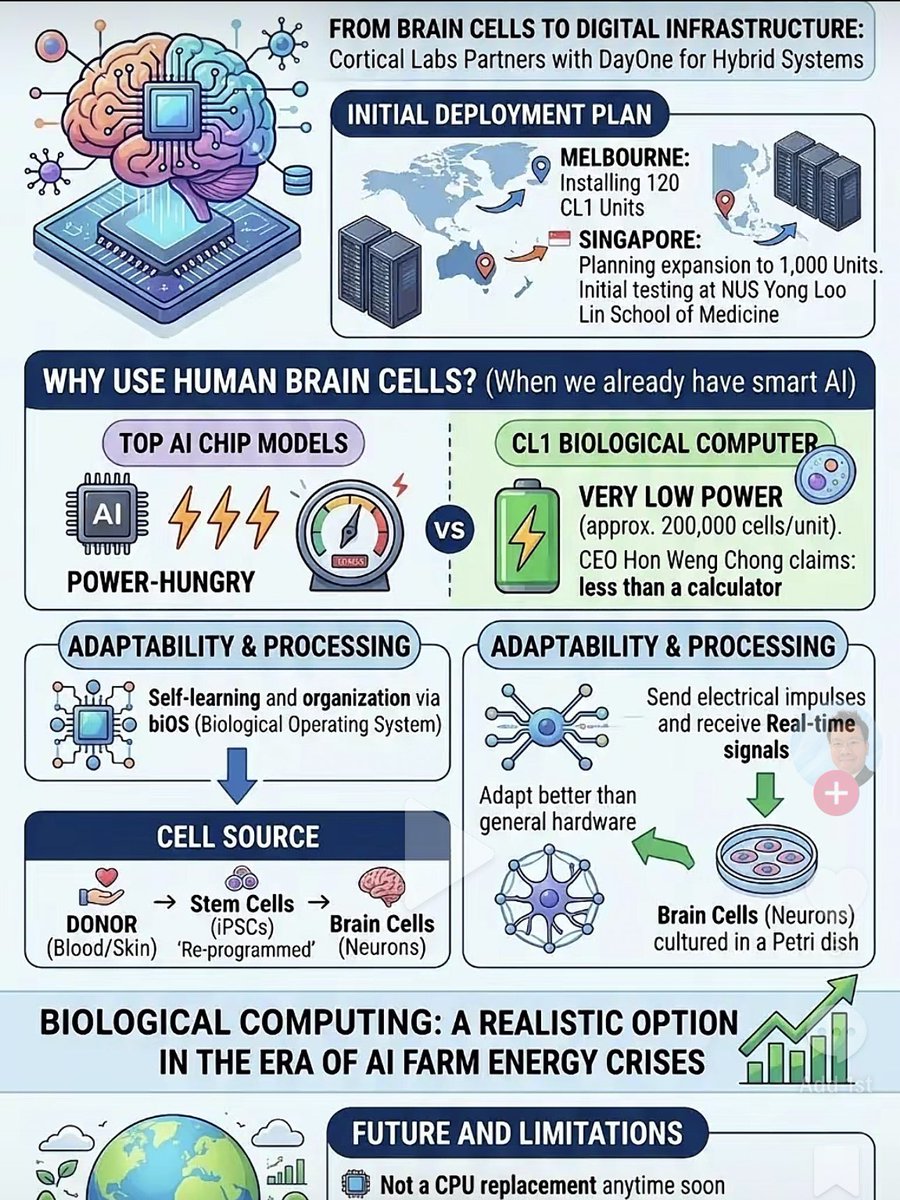
Cortical Labs partners with DayOne to create Synthetic Biological Intelligence / Wetware), growing living human brain cells on top of silicon microelectrode arrays to perform computation!!
The moment-to-moment speed of alpha and beta brain waves sculps perception via predictive coding.
Alpha and Beta Frequency Modulations in Motion Prediction Reveal Mechanisms of Predictive Coding in Perception.
https://t.co/ePfGXvyAnu
#neuroscience
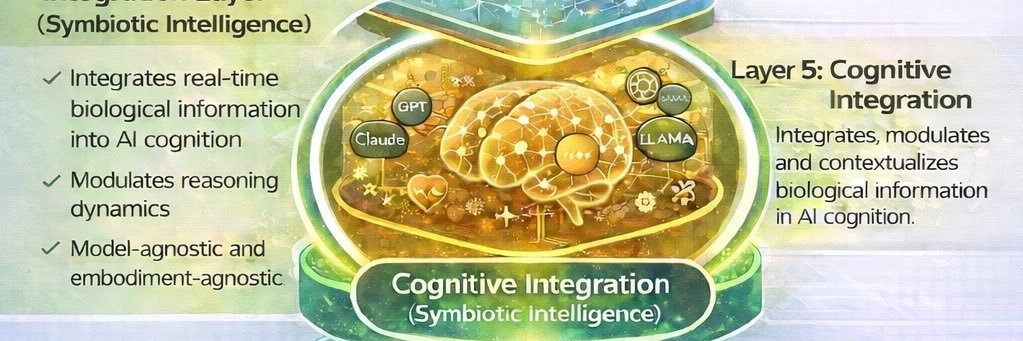
Symbiotic intelligence is about establishing a true bidirectional closed feedback loop between biological and artificial neural networks. The human biology has spent millions of years optimizing compute efficiency, operating on roughly 20 watts of power https://t.co/kuQSyy8qb0
Interplay between fast and slow brainwave rhythms may be a core mechanism the brain uses for predictive coding.
Cross-Frequency Coupling as a Neural Substrate for Prediction Error Evaluation: A Laminar Neural Mass Modeling Approach
https://t.co/YAsM4Jog9s
#neuroscience
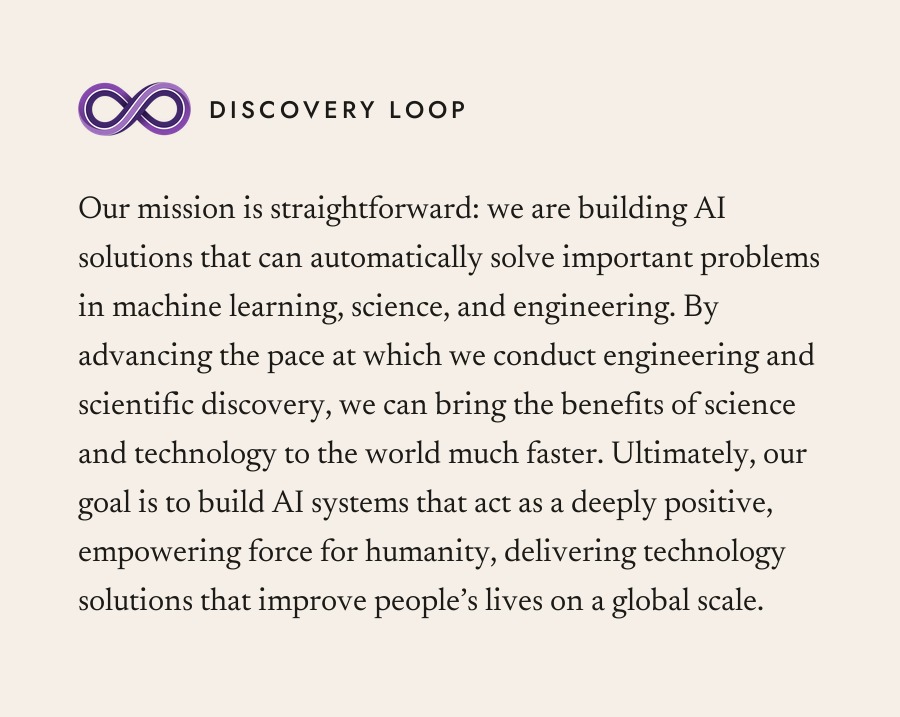
Discovery Loop:Rather than using AI as a tool for researchers,their goal is to automate scientific methods,building autonomous agents to run the entire experimental loop in parallel, proposing new hypotheses,iterating thousands of times over at speed humans scientists can't match
Introducing Discovery Loop ♾. We’re building AI to run experiments at unprecedented scale and to solve the biggest bottlenecks in science and engineering.
Our founders @JeffDean, @Sanjay_Ghemawat, @quocleix, @OriolVinyalsML helped build the AI infrastructure and models that scaled the modern world. Now, we are scaling discovery itself.
The future can't wait.
Learn more at: https://t.co/6Fr8dX5dDB
Today's AI systems learn mostly by passively absorbing data, but the brain builds intelligence in the reverse order.
Grounded world models in biological organisms and future embodied AI
https://t.co/jIj7bfeoN7
#neuroscience
Neurons don't just fire more for important sounds, their activity becomes more precisely timed and rhythmic
Representations of spatial saliency in auditory cortex are selectively organized through temporal coordination
https://t.co/3gv0Mogazd
#neuroscience
Considering adding it as a specialized tool:
The current open weight model setup (like Llama)is great for general reasoning, broad world knowledge,chats.But Inkling-Small seems to be great for autonomous agent tasks, multifile code editing,native multimodal work #thinkingmachines
Are brain rhythms a steady hum or a brief buzz? Both. Alpha/beta is relatively sustained, helping maintain ongoing brain state, supporting its role in top-down control.
Universal rhythmic architecture uncovers two modes of neural dynamics
https://t.co/NzGXRrbJDb
#neuroscience
Amazing News! MNE-RT for neural oscillation research. It brings real-time closed-loop pipelines (artifact cleaning, TFRs, decoding) directly into the MNE-Python ecosystem via LSL.
Works on everything from research rigs to an older Emotiv EPOC in JupyterLab
https://t.co/Wm7KiCevSo
Alternatively, especially if you’re a researcher, you can open-source frameworks (like CrewAI or LangGraph) on your own machine to run these exact same agentic loops completely free and with zero limits, not to mention having IP and data privacy #nvidia#research#science
Thank you to the 7M active users who are now using Codex and ChatGPT Work.
We have added a banked reset to everyone's account to celebrate the milestone. You can apply the reset in the desktop app or on web and it will replenish the weekly usage for you.
Have fun out there.
In honor of the holiday weekend commemorating 250 years of independence, here are 10 free MIT courses to spark your curiosity about the origins of the American Revolution. https://t.co/WNoSKUAEul
What we felt and knew all along 😞 😢
Recent study published in the journal Science highlights how socioeconomic opportunity leaves the deepest physical imprint on our developing brain. https://t.co/U8m3ifJA8X
Like a stadium full of sports fans doing the wave, neurons coordinate their electrical signals in rhythmic patterns that sweep across the cortex, the brain’s outermost layer.
Recent studies in humans and animals have shown these patterns, called traveling waves, can take on complex shapes, among them a rotating spiral that has been observed during deep sleep, memory retrieval, and other brain processes.
A new study has now captured the fast-spinning waves spanning whole brains, offering clues to how they’re organized and what they might do.
Learn more: https://t.co/gAK0mjsUyL
Speedy, spiraling electrical waves may be key to brain’s information flow
Rotating neuronal waves are built into brain anatomy and help coordinate far-flung regions, mouse imaging study suggests
https://t.co/YL2gPYdKbF
#neuroscience