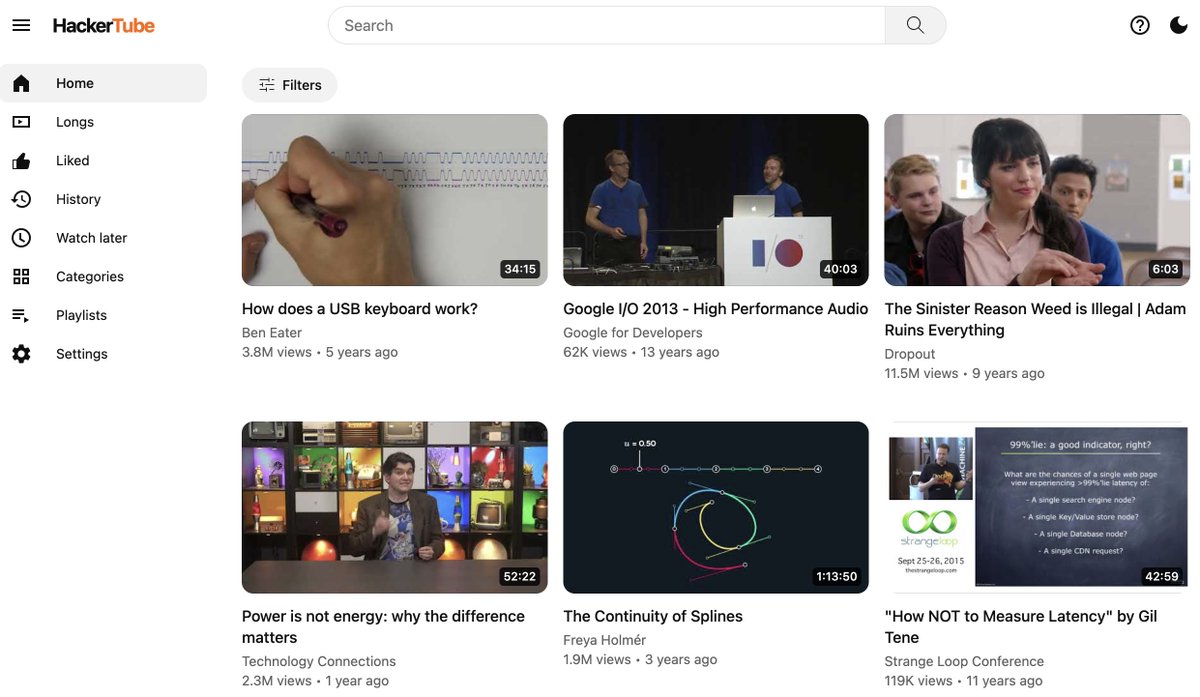
Weekend hack: HackerTube. I was annoyed with YouTube's recommendations so I had Claude filter down 43M comments over 20 years of HN to 6,454 videos that keep being recommended. *Significantly* better viewing experience, ~2 hours with Opus 5.5:
https://t.co/JIhXN7OSh1
- Excellent recs without any logins (state is kept in local browser session)
- Thumbnail is a representative frame from middle of the video instead of the super duper A/B test hyper-optimized user uploads
- Underlying data from the comment analysis as one zip file, point your Claude at it and ask for your own version
- HackerTube Longs ✊
A bit more on the process:
I use Claude Code (desktop app for Mac), Opus 5.5 on Medium effort as my default. I only talk to Claude and have it do everything, the only "manual work" I helped with in tandem was in the browser (reminiscent of MenuGen): 1) I had to create some kind of API key from Google Cloud UI to query YouTube for video metadata, 2) I booted up a VPS box for serving and 3) I bought the domain name. Once the box was up I gave Claude the IP and told it update, secure, harden, deploy and optimize the code, and it did the whole thing.
Many awesome projects that would have normally taken weeks/months even can now be few-shotted for breakfast. What else are we not thinking of.
Registered for the HCLTech × Naukri Campus Young Turks 2026 hiring challenge to learn the process. Despite academic pressure and no specific preparation, scored in the 93.11 percentile. I know I can do better next time!
#HCLTech#YoungTurks2026#NaukriCampus#HiringChallenge
Hey guys!
I built a startup finder to help you discover startups to apply to, especially as a fresher
check it out: https://t.co/hgQG1QU3xA
what features would make this more useful for you? drop your suggestions below
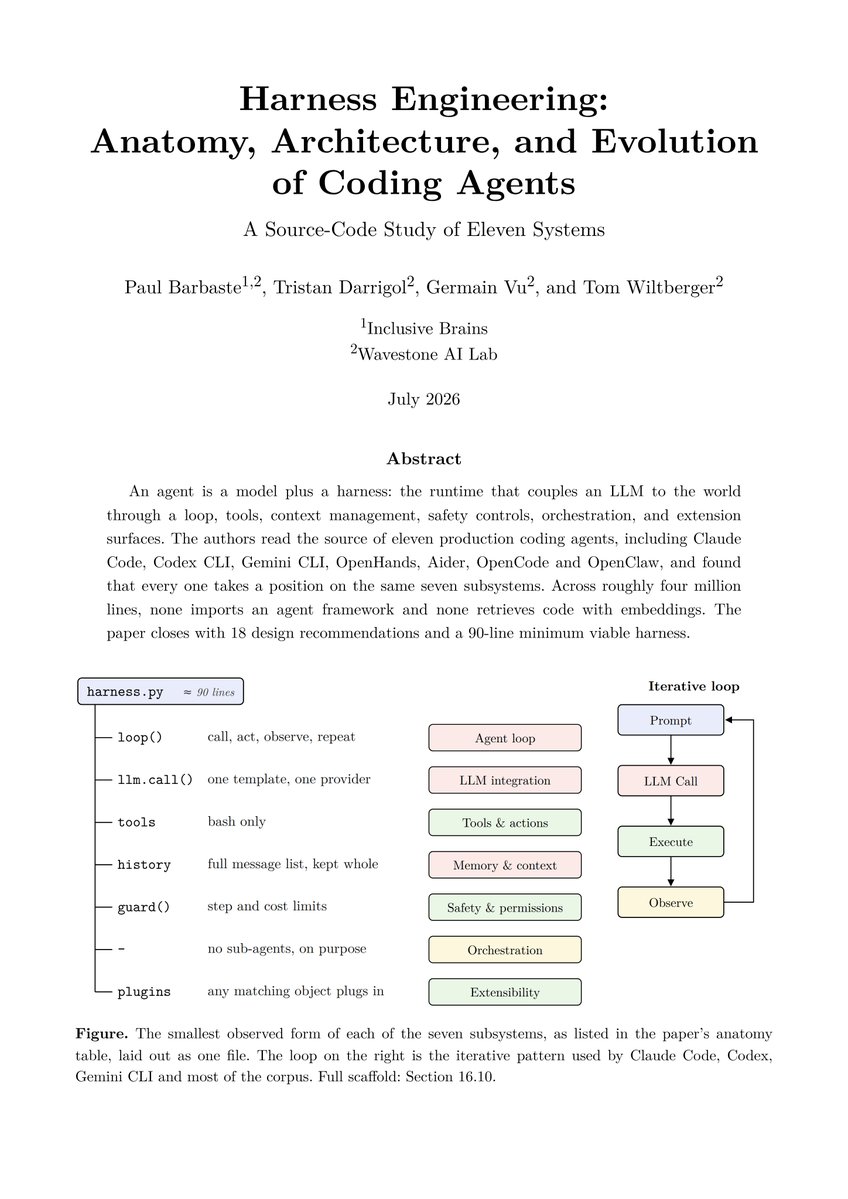
This might be the most useful paper on AI agents this year.
A team at Wavestone AI Lab took apart Claude Code, Codex and 9 more and found the 7-part blueprint every good agent is built on.
Their definition: an agent is a model plus a harness. All 11 agents build the harness from the same 7 parts. Only the size changes.
> Loop: Mini-SWE-Agent is a plain while loop. OpenHands logs every event so a run can be replayed
> LLM layer: one prompt template on one side, 29 provider profiles on the other
> Tools: some agents only have bash, the biggest has 43 typed tools loaded on demand
> Memory: from keep-the-whole-history to notes the agent maintains across sessions
> Safety: from a simple step limit to policy rules plus a reviewer model plus an OS sandbox
> Orchestration: Aider skips sub-agents on purpose, others fork them with their own context
> Extensions: hooks, skills and MCP. SKILL.md is in 9 of 11, MCP in 8
The paper ends with a 90-line harness covering all 7 parts, a solid starting point for your own.
Key pages:
> p.4: the 7-part map
> p.12: the 3 loop types, with Claude Code and Codex as examples
> p.53: why none of them use frameworks or embeddings
> p.67: 18 design recommendations
> p.71: the 90-line harness you can copy
Andrej Karpathy just dropped a 1-hour Stanford lecture on AI engineering from scratch:
"You can basically delete everything… delete everything, keep Graph"
Here are the core ideas:
10% → LLM: "I treat GPT like a general-purpose computer that can be reprogrammed at runtime"
30% → Prompt: "I give that computer a program written in natural language"
50% → Agent: "I wrap the model with a goal, context, memory, and tools that turn prediction into action"
70% → Loop: "I separate the inner loop, where the model learns from context, from the outer loop, where training updates the weights"
100% → Graph: "I organize communication as data-dependent message passing across directed graphs"
This 1-hour Stanford lecture will teach you more about AI engineering than most 100 random YouTube tutorials combined
"Just chop everything up and throw it into the mix"
Bookmark it and watch later
Then read the full article below ↓
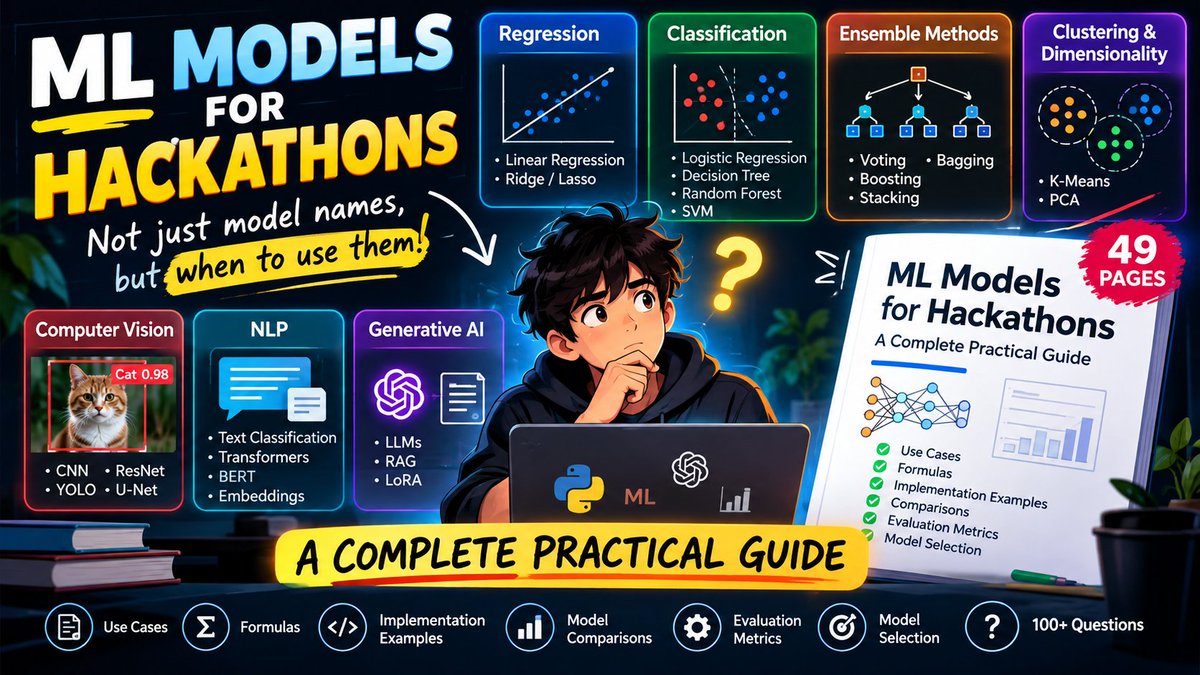
One common problem in ML hackathons: knowing many model names but not knowing when to use them.
I made a practical guide covering models, use cases, metrics, ensembles, comparisons and implementation examples.
Link: https://t.co/52SRepmlIY
Spoke at the PyData Global Impact Scholarship Program 2025, a PyData Global virtual conference initiative. I presented my session on implementing GraphRAG within the Allycat open-source project, focusing on improving retrieval and reasoning for complex, context-heavy queries.
The talk covered the GraphRAG pipeline: building knowledge graphs from web data, integrating graph traversal and reasoning into query processing, and benchmarking against traditional vector-only RAG systems. Results showed measurable gains in response quality and grounding.
What if your AI tutor could:
draw a red box on the exact wrong step
prove answers via Python, not vibes
understand a lecture from visuals + audio only
That’s what SmartHomework does with Gemini 3 Pro + an agentic React stack.
Black box → glass box.
#Gemini3#EdTech#AI
Are you interested to join @GoogleDeepMind as a student researcher (PhD students)?
I am hiring for a fun project on reward modeling for world models!
If you are interested on video understanding/generation and reward models/critiquing, get in touch and apply below! 👇
Hah! Another workshop accepted at #QConSF 😃
"Allycat - chat with your website with LLMs"
https://t.co/XoQbEy34Ul
In this hands-on workshop, I will show how to crawl a website, index the data and query it using natural language (not just keywords) with LLMs.
Tech-stack:
- Web crawl
- Docking for sanitizing and extracting data from downloaded data (HTML / PDF ..etc)
- Index and store in vector database
- llama-index as the framework
- open source LLMs like (Qwen3, GLM, GPT-OSS, Deepseek) powered by Nebius AI Studio
You will walk away with working code you can build on.
Little backstory:
@davenielsen and I started Allycat (https://t.co/PnLnXvCKrT) as a demo project at @thealliance_ai . Since then it has been adopted by many and getting contributions from others. This is how open source works.
@QCon #Docling @nebiusaistudio@nebiusai #QConSF