Friday fun! 🎨🤖
I built Doodle Derby - where 3 vision models compete to recognize doodles as they're being drawn in real time!
@MiniMax_AI M3.1-Flash
@deepseek_ai V4.1-Flash-1017
@NVIDIAAI Nemotron-3.5-Super-VL
All running on @nebiustf 🚀
Who won? And what were the models thinking? 👀
Watch 👇
(Inspired by Google's Quick, Draw!)
@MiniMax_AI@deepseek_ai@NVIDIAAI@nebiustf 🎨 Your turn!
BYOK (Bring Your Own Key) and play Doodle Derby:
https://t.co/9GoGIFU6jb
🔑 Keyless version coming soon!
💻 Source: https://t.co/CeczujizIZ
Give it a try! Feedback and suggestions welcome! 🙌
Friday fun! 🎨🤖
I built Doodle Derby - where 3 vision models compete to recognize doodles as they're being drawn in real time!
@MiniMax_AI M3.1-Flash
@deepseek_ai V4.1-Flash-1017
@NVIDIAAI Nemotron-3.5-Super-VL
All running on @nebiustf 🚀
Who won? And what were the models thinking? 👀
Watch 👇
(Inspired by Google's Quick, Draw!)
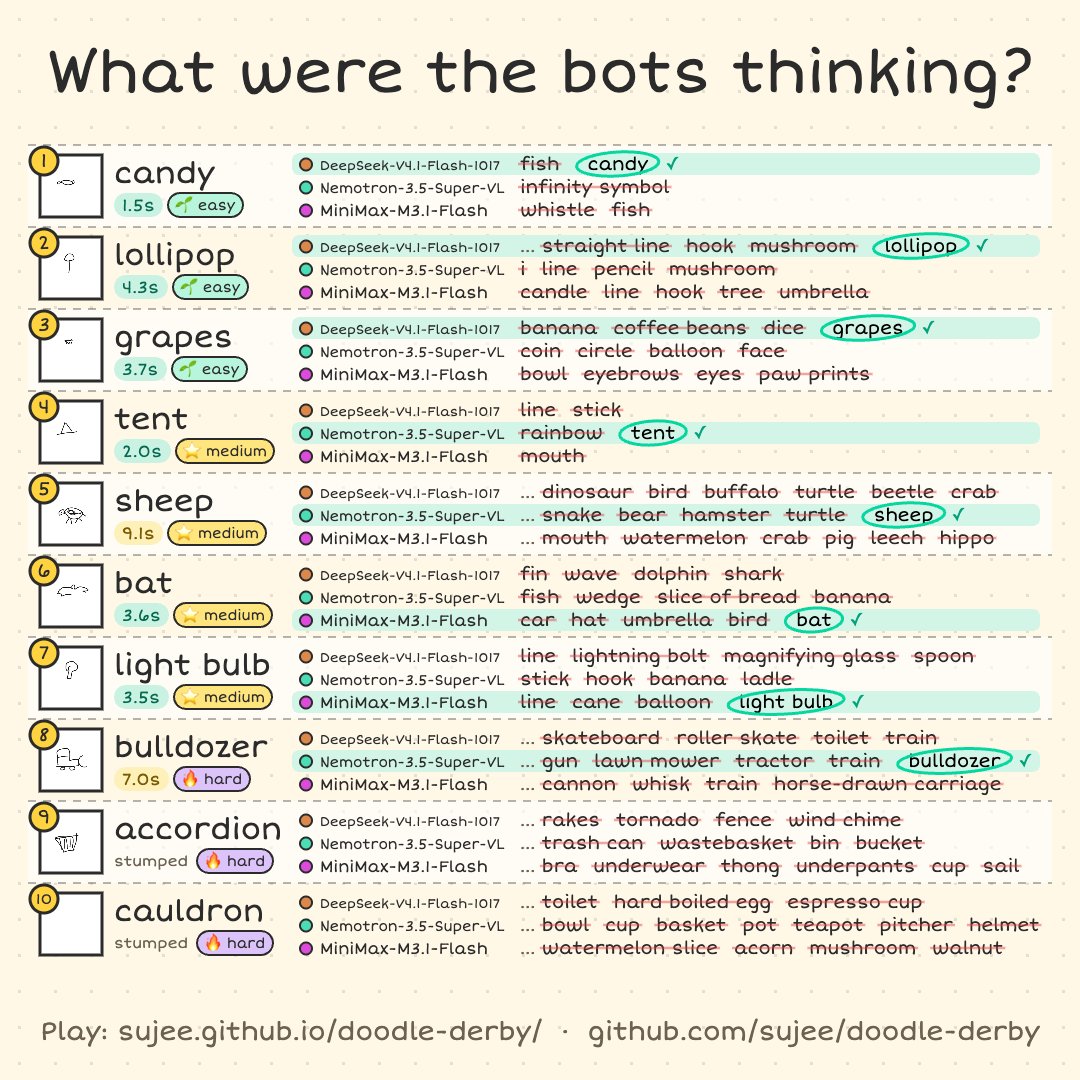
@MiniMax_AI@deepseek_ai@NVIDIAAI@nebiustf And the results are in! 🏆
It's a tie! 🎉
The second image is my favorite - a peek into what the models were guessing along the way.
Some of those guesses are hilarious 😂
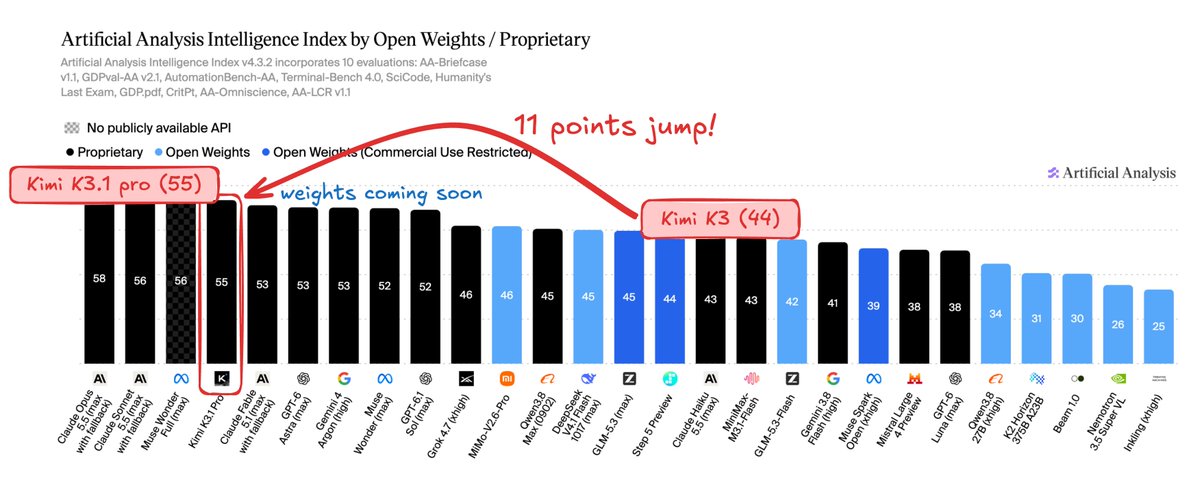
🚀 @Kimi_Moonshot 's progress in just 3 months is impressive!
Kimi K3 (July): AA Intelligence Index 44
Kimi K3.1 Pro (Oct): AA Intelligence Index 55
That's an 11-point jump! 📈
Even more interesting: both have the same 2.8T total / 104B active parameters. More intelligence, without a bigger model 👏
Introducing Kimi K3.1 Pro: our most capable 3T-class open-weight model.
🔹 1M-token context, 2.8T total / 104B active params (MoE), Multimodal.
🔹 Full-project coding: games in Unreal, Unity & Godot.
🔹 Excels at parametric 3D modeling in Blender & CAD.
🔹 More reliable at finance work: Accurate modeling with hallucination down by 65%.
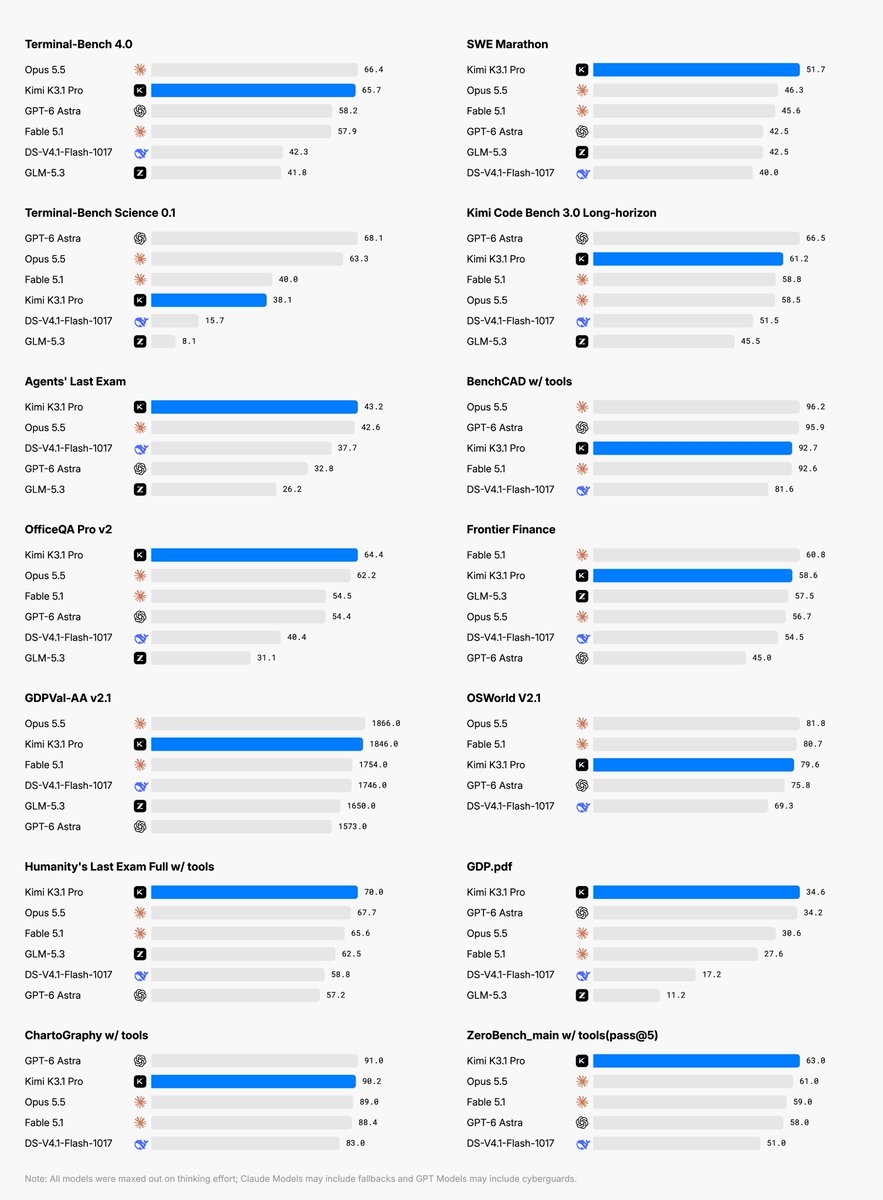
🔹 Matching the strongest proprietary models across coding, agentic and knowledge benchmarks.
Kimi K3.1 Pro and K3.1 Pro Highspeed (2–3× faster) are now live on https://t.co/85jA71X9gw, Kimi Work, Kimi Code, and the Kimi API.
Open weights by Nov 4, 2026.
🔗 API: https://t.co/XCrgjXAqMw
🔗 Tech blog: https://t.co/5iPP0MBej6
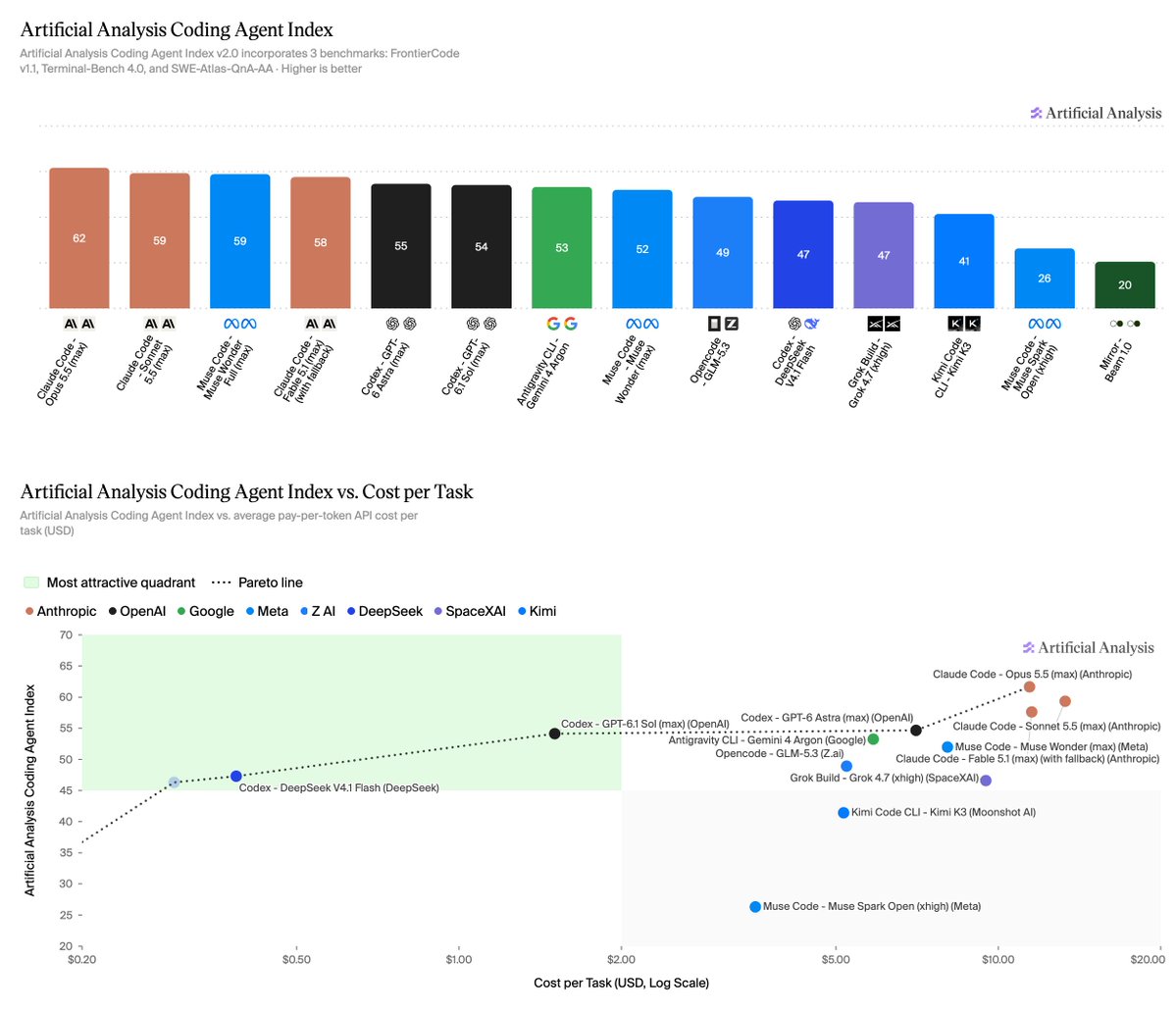
A few interesting takeaways from this @ArtificialAnlys coding benchmark 👇
1 - Coding performance isn't just about the model. The coding harness matters too. That's why comparing harness + model combinations makes sense.
2 - Impressive to see Muse Code + Muse Wonder climb the rankings so quickly!
3 - My current open-model coding workhorse: @opencode paired with GLM 5.3 or DeepSeek 4.1 Flash.
I explored this in my talk, "Coding with Open Models":
https://t.co/utgUT1nkkE
Announcing Artificial Analysis Coding Agent Index v2.0: FrontierCode v1.1 from Cognition replaces DeepSWE, SWE-Atlas-QnA grading is revised, and Claude Opus 5.5 in Claude Code leads at 61.7
Today we are launching v2.0 of the Coding Agent Index. The Index evaluates models together with their agent harnesses, now across 290 tasks covering software engineering, terminal use, and repository Q&A, with the three benchmarks weighted equally.
Changelog (Index v1.5 → Index v2.0):
→ FrontierCode v1.1 replaces DeepSWE v1.1. FrontierCode is a benchmark from @cognition with a private test set: 100 software engineering tasks on real open-source repositories, graded on whether a maintainer would merge the change. An attempt that fails a blocking check scores zero, and one that passes them all scores between 70% and 100% depending on the non-blocking checks it meets. We also scan each trajectory with a modified version of Cognition's rule-based scanner, and any attempt flagged for accessing solution material scores zero.
→ Revised SWE-Atlas-QnA grading, now SWE-Atlas-QnA-AA. Scale AI's 124 repository Q&A tasks are unchanged. We reworded 127 of the 1,306 rubric criteria for more consistent verdicts and moved to GPT-6 Luna (xhigh) as the judge, with five votes per criterion. The dataset and judge configuration are published on Hugging Face.
Key results:
➤ Claude Opus 5.5 leads the Index: Claude Code with Claude Opus 5.5 (max) scores 61.7, followed by Claude Code with Claude Sonnet 5.5 (max) at 59.3, Muse Code with Muse Wonder Full (max) at 58.9 and Claude Code with Claude Fable 5.1 (max with fallback) at 57.6.
➤ FrontierCode v1.1 is where Opus 5.5 pulls ahead: Opus 5.5 scores 56.0% on FrontierCode, ahead of Codex with DeepSeek V4.1 Flash (max) at 52.6%, Codex with GPT-6.1 Sol (max) at 49.4% and Codex with GPT-6 Astra (max) at 49.3%. Below the top, FrontierCode scores are tightly packed: 15 of the 24 configurations on the Index score between 43% and 49%.
➤ SWE-Atlas-QnA-AA grading is stricter and more consistent: across the 21 configurations evaluated on both Index versions, the mean score falls 1.7 points, from 58.8% to 57.1%, with 14 of 21 moving down. Individual configurations move by up to 7 points: Muse Code with Muse Spark Open (xhigh) falls 7.0, Kimi K3 in Kimi Code CLI and Codex with GPT-6 Luna (max) 6.2, and Muse Code with Muse Wonder (max) 5.6, while Codex with GPT-6.1 Sol (max) gains 2.1.
➤ Four configurations sit on the cost frontier: Codex with DeepSeek V4.1 Flash (max) scores 47.3 at $0.39 per task, Codex with GPT-6.1 Sol (max) 54.1 at $1.50, Codex with GPT-6 Astra (max) 54.7 at $7.04 and Claude Code with Claude Opus 5.5 (max) 61.7 at $11.42. Costs are pay-per-token API costs, not subscription prices.
We will keep updating the Coding Agent Index incrementally, with more evaluations and agents to come.
What actually happens when you send a request to an LLM?
Gateway → tokenizer → router → queue → prefill → decode → streamed back to you, one token at a time.
I'm tracing the whole trip tomorrow at Hacktoberfest 2026. ⚡
Thu, Oct 22 online @ 10am PT / 1pm ET
link below 👇
What actually happens when you send a request to an LLM?
Gateway → tokenizer → router → queue → prefill → decode → streamed back to you, one token at a time.
I'm tracing the whole trip tomorrow at Hacktoberfest 2026. ⚡
Thu, Oct 22 online @ 10am PT / 1pm ET
link below 👇
Friday fun 🎉
The Nemotron family (Super, Lightning, Ultra) went to the carnival… and raced horses 🎪🏇
One of them is a total sprinter. Guess who? 👀
Link below 👇
@nutlope@togethercompute this is brilliant @nutlope and @YoussefUiUx !
I am building something similar :-)
what is the best stack to
- limit sessions for built in key
- prevent bots .etc