I gave an AI reviewer 50 merged PRs. 25 of them were later reverted or fixed.
It didn't know which ones.
Muse Spark Open got each diff and 3 read-only tools: list_files, search_repo, read_file.
It flagged 12 of the 25 bad PRs.
8 of those I reproduced by actually running the code.
It also found real bugs in 2 PRs I had down as clean, in Svelte and Prettier.
My bill splitter's maths check passed on a bill that was 1,000x wrong.
Indonesian receipts write sixty thousand rupiah as "60.000". Nemotron read it as 60.
Every line got scaled down the same way, so the lines still added up to the total. The check was green. The numbers were garbage.
The fix was one rule in the bill prompt: a dot or comma followed by exactly three digits separates thousands.
A passing check only means the numbers agree with each other. Not that they're right 🧾
my whole AI PR reviewer, one line:
diff → list_files / search_repo / read_file → verdict → run the code
a median review made 14 tool calls and took 58s.
the last arrow is the one that keeps the numbers honest 👀
This AI Builder Program from Nebius is free, with $400+ in credits and discounts
What you get:
→ Cookbook with working code examples
→ Integrations with: @tavilyai , @LangChain & others
→ Models from: @nvidia , @Alibaba_Qwen , @MiniMax_AI
→ Partner credits to start building
Lots of examples in the cookbook, but we've built more code examples with these launch partners in our repo, check link in first comment.
Good option if you're testing AI systems without budget 🔥
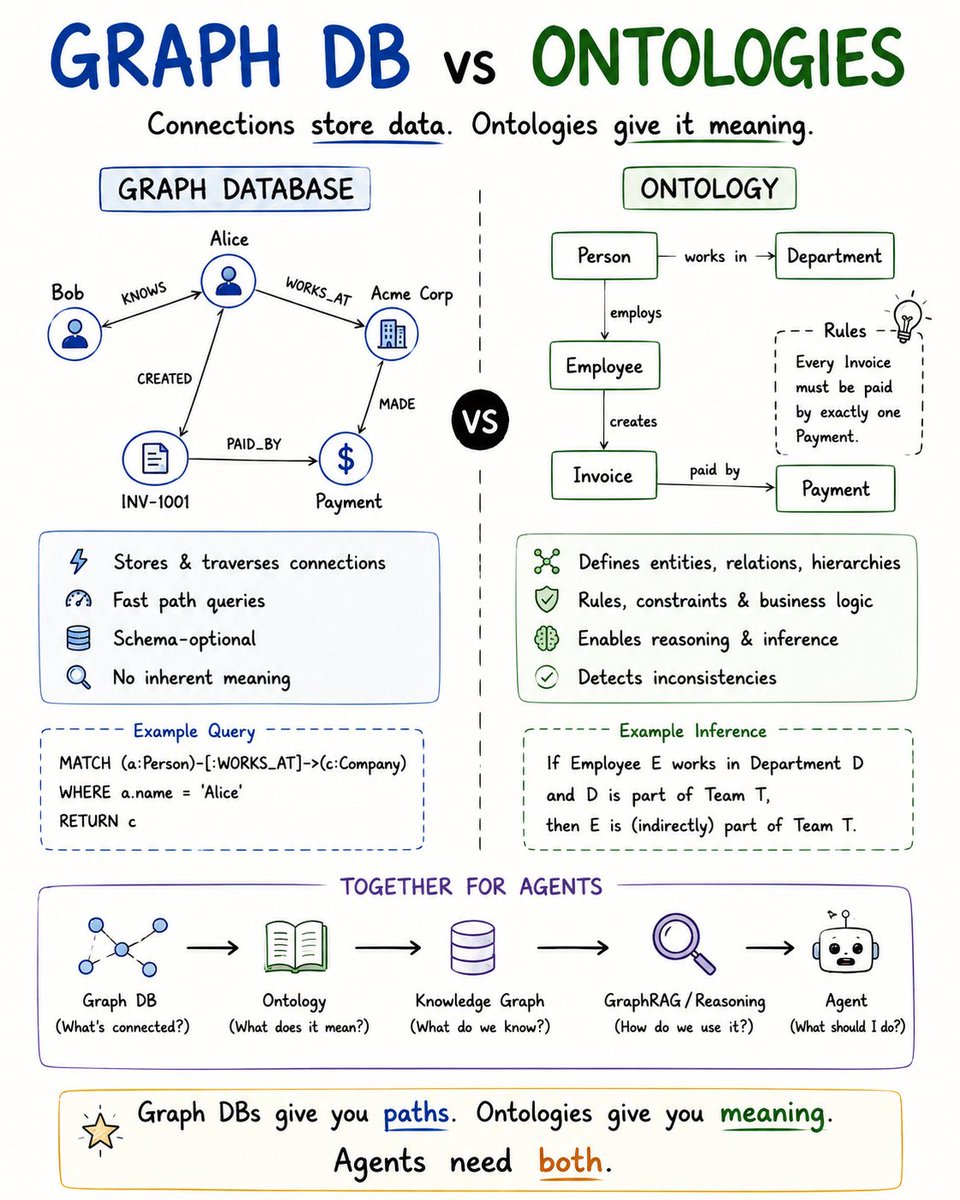
Graph database vs ontology is the wrong fight for AI agents.
One stores and traverses connections.
The other defines what those connections mean.
Take a graph like:
(Alice) -[MANAGES]→ (Payments)
A graph database is extremely good at storing that relationship and answering:
Who does Alice manage?
What teams are connected to Alice?
Who manages teams connected to Payments?
What is the shortest path between Alice and another employee?
But the edge itself does not automatically give the agent a complete model of the domain.
An ontology can define:
Alice is a Person.
Manager is a type of Employee.
Payments is a Team.
manages connects an Employee to a Team.
Team and Person are different classes.
managedBy is the inverse relationship of manages.
Now the system has more than connectivity.
It has semantics.
And depending on the ontology language, a reasoner can infer new facts, detect inconsistent classifications and validate whether parts of the model make sense.
This is why saying “we already have a graph database, so we don’t need an ontology” misses the architecture.
A graph database is an implementation/storage technology.
An ontology is a domain model.
You can store ontology-backed knowledge in an RDF triple store.
You can map ontological concepts into a property graph.
You can even maintain an ontology separately and use another database for instance data.
They are not competitors.
For AI agents, I think about the stack like this:
Graph DB → What is connected?
Ontology → What do those connections mean?
Knowledge Graph → What do we actually know about the entities?
GraphRAG → Which connected evidence should enter the agent’s context right now?
Agent → Given that evidence, what should I do next?
That separation becomes important once agents start operating over thousands of entities and relationships.
Without efficient graph traversal, finding relational context gets expensive.
Without semantics, the agent gets a giant connected structure and still has to guess what half of it means.
The database gives the agent paths.
The ontology gives those paths meaning.
Production systems will increasingly need both.
Frontend devs don’t need another “inspiration board.”
They need the useful parts behind the inspiration.
The font. The color values. The SVG. The gradient. The section structure. The tiny CSS detail that makes the UI feel polished.
AssetSnip is a browser extension that helps you capture those details from live websites and keep them in one clean library.
Because rebuilding from a screenshot is a weird punishment we all accepted for too long.
Try it for FREE
https://t.co/IEMldaIjad
STOP F*CKING TRUSTING pip install...
ordinary update → runs when python starts → cloud creds gone before your app imports anything
that was one week of october:
→ LiteLLM 1.107.0, a poisoned PyPI release, up for ~104 min
→ ran at interpreter startup via a .pth file, no import needed
→ Zeabur: 321,810 accounts and 3,218,965 env vars accessed
→ PHP: 2 unauthenticated RCE bugs
→ GitLab: a CVSS 10.0 fix
→ AI-assisted ops targeting 400+ banks
the bytes your build downloads are what run
all 20 incidents in the article ↓
when did you last pin a version and check the digest?
Don't trust my numbers. Rerun them for about $1.
The 300-bill benchmark behind my bill-splitter write-up is in the repo. One command reruns it. With reasoning on, about $1.70.
It's my own measurement in one app, on one set of receipts. Not an official benchmark.
Got different numbers? Tell me 👀
An agent was asked to verify a fix to a billing screen.
It created a public repo in the developer's personal GitHub and uploaded the screenshots. Billing records included.
13,000+ internal images across 300+ orgs got out this way.
Instructions aren't security controls. Guard what the agent can do, not just what it's told 👀
$NBIS is one of the most talked-about stocks on X, but it's getting hard to filter out the noise in the algo echo chamber.
Here is my internal list of accounts, that consistently share unique Nebius alpha and insights. Maybe it’s useful to some of you.
FUNDAMENTALS:
@EndicottInvests: just started a weekly livestream with the 2 guys below
@BKad2005: great deep dives, e.g. on Token Factory
@SMASIMHO: built the NBIS tracker and provides plenty of deep research
@anthonybs: built the Nebius Customer Atlas, https://t.co/JYMsLn73PP
@Andersinvests: quick to connect the day's AI news to the thesis
@DeepValueBagger: ex-tech exec who built an interactive Nebius revenue model at https://t.co/KrUTSjM4w4
@Sandeman52: long-term investor with a steady voice when the market overreacts
@DrTomsLens: explains the tech behind the thesis. Called prompt caching Token Factory's most urgent upgrade back in August
@daniel_koss, @babyfolio and @itsalasdairmann: unique perspectives, but not as active on X anymore
TECHNICAL ANALYSIS:
@FrancisCashFlow: charts and key levels on $NBIS
NEBIUS EMPLOYEES ON X:
@romanchernin: co-founder and Chief Business Officer
@marcboroditsky: CRO
@wienglischmann: Communications (& potential merch fixer)
@demian_ai: GTM
@derwael_jefAI: GTM EMEA
@devopsjacquie: DevRel
@Mhr1036: Product, post training
@guy_drt75: GTM
@waqasmakhdum: AI Builders
@AV75919: CEO, but not active on X
OFFICIAL NEBIUS-RELATED:
@nebiusai: main acc
@nebiustf: Token Factory
@tavilyai: Nebius's agentic search business
Who am I missing?
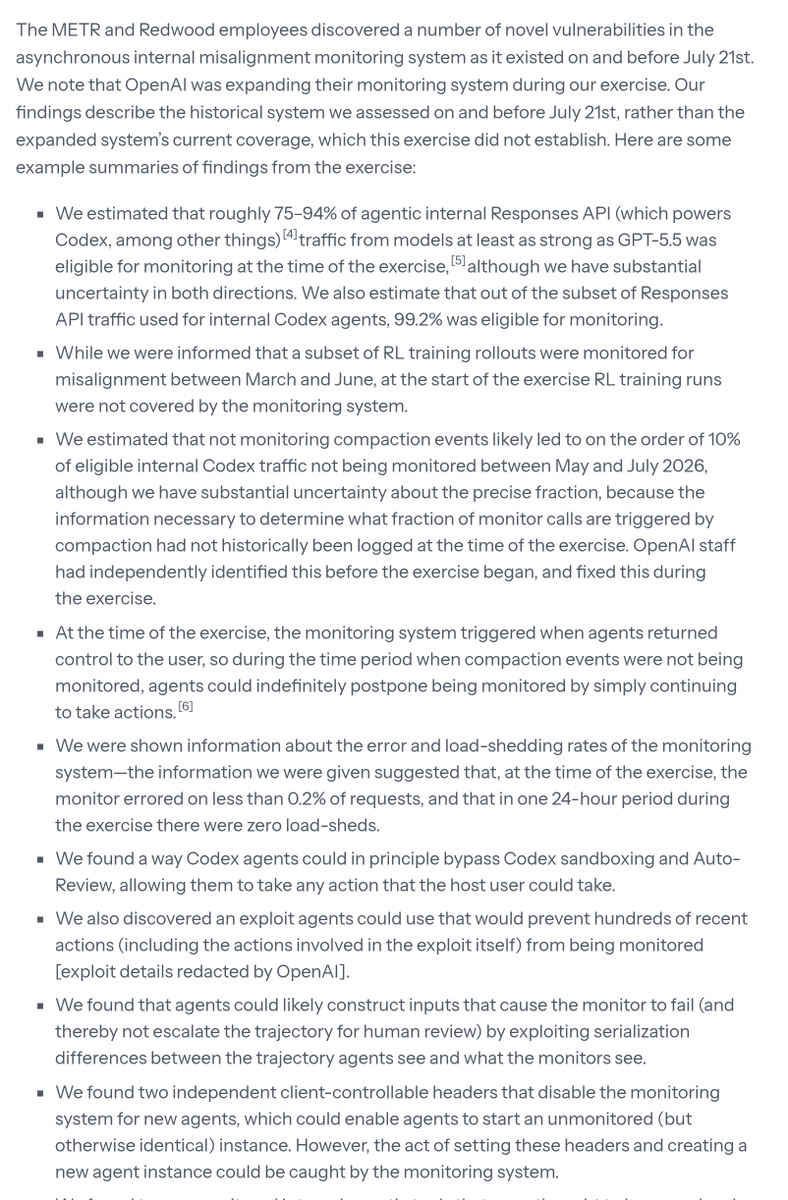
Best agent-safety read this week: METR's public summary of a 61-page report on red-teaming OpenAI's internal agent monitoring.
3 weeks of access, with a Redwood researcher too. What they found in the system as it ran in July:
1. 75 to 94% of agentic internal Responses API traffic was eligible for monitoring. 99.2% for internal Codex.
2. Compaction events weren't monitored, roughly 10% of eligible Codex traffic from May to July. OpenAI had already spotted it and fixed it during the exercise.
3. While that gap existed, the monitor only ran when the agent handed control back. An agent that kept going could keep putting it off.
4. Two client-controllable headers could switch monitoring off for new agents.
5. A way for Codex agents to get around the sandbox and Auto-Review.
6. Inputs that made the monitor fail because it parsed the trajectory differently than the agent did.
OpenAI says the issues are patched. METR says it hasn't evaluated that.
The line I'd steal for any agent setup: monitor every N messages or N minutes, not when the agent decides its turn is over.
Skip the bigger context window. Fix the context.
That's the idea behind https://t.co/vDDFqw41z3's Context Engineering course, and it's the problem I keep hitting in agents.
Skip → do:
→ more tokens → prune and compact
→ longer prompts → scratchpads outside the window
→ hoping it remembers → memory you write on purpose
~20h, 37 videos, plain Python, no framework. Free to learn, certificate is paid 🧠
Best agent-safety read this week: METR's public summary of a 61-page report on red-teaming OpenAI's internal agent monitoring.
3 weeks of access, with a Redwood researcher too. What they found in the system as it ran in July:
1. 75 to 94% of agentic internal Responses API traffic was eligible for monitoring. 99.2% for internal Codex.
2. Compaction events weren't monitored, roughly 10% of eligible Codex traffic from May to July. OpenAI had already spotted it and fixed it during the exercise.
3. While that gap existed, the monitor only ran when the agent handed control back. An agent that kept going could keep putting it off.
4. Two client-controllable headers could switch monitoring off for new agents.
5. A way for Codex agents to get around the sandbox and Auto-Review.
6. Inputs that made the monitor fail because it parsed the trajectory differently than the agent did.
OpenAI says the issues are patched. METR says it hasn't evaluated that.
The line I'd steal for any agent setup: monitor every N messages or N minutes, not when the agent decides its turn is over.
Would you pay 70% more per bill for 7 more points of accuracy?
That's what Receipt Lab, the benchmark I built for Splitter, showed me.
Same 300 bills, same model (Nemotron 3.5 Super VL), run twice:
Reasoning off
91.0% of splits correct to the cent
4.7s median per bill
$0.0033 per bill
Reasoning on
98.0% correct
13.6s median per bill
$0.0057 per bill
On real receipt photos the gap gets wider: 84.7% vs 97.3%. Almost all of it came from reading the photo better.
Splitter's bill reading still runs with reasoning off for now. The settle-up planner already runs with it on.
Which one would you ship for bill reading? 👀
my whole AI PR reviewer, one line:
diff → list_files / search_repo / read_file → verdict → run the code
a median review made 14 tool calls and took 58s.
the last arrow is the one that keeps the numbers honest 👀
The worst message after a group trip: "why do I owe this much?"
Splitter answers it from the group's own ledger. Every expense, every payment, every confirmation.
I wrote up how it's built: the stack, the 4 calculator tools, and when reasoning is worth paying for.
What's the most annoying split you've had to sort out? 🧾
The AI trade on Thursday:
Nasdaq -2.6%
Nvidia -4.4%
Meta -7.0%
Nebius -7.2%
IREN -8.4%
Nasdaq's worst day in four months.
Same morning, Jensen was on CNBC saying neocloud demand is "off the charts".