Schumpeter (1939) writing on the years immediately following the Great Depression.
Still as relevant as ever, this piece could be published again today and fundamentally still hold true for much of business cycle theory.
https://t.co/CfvZgH8TS0
Responding to some of the comments here: Of course banks borrow short and lend long, but properly managed and supervised banks limit duration mismatch between liabilities and assets so their capital position is not gravely compromised by rising long-term interest rates.
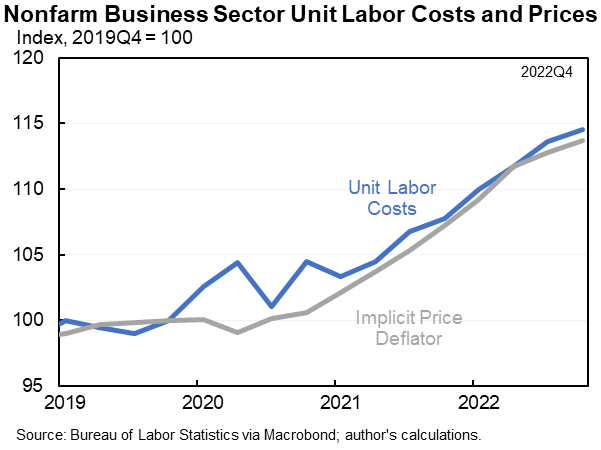
Based on today's revised productivity data unit labor costs (which is compensation growth minus productivity growth) is running basically at--or a smidge ahead of--price growth.
In other words prices, if anything, have not caught up with labor costs.
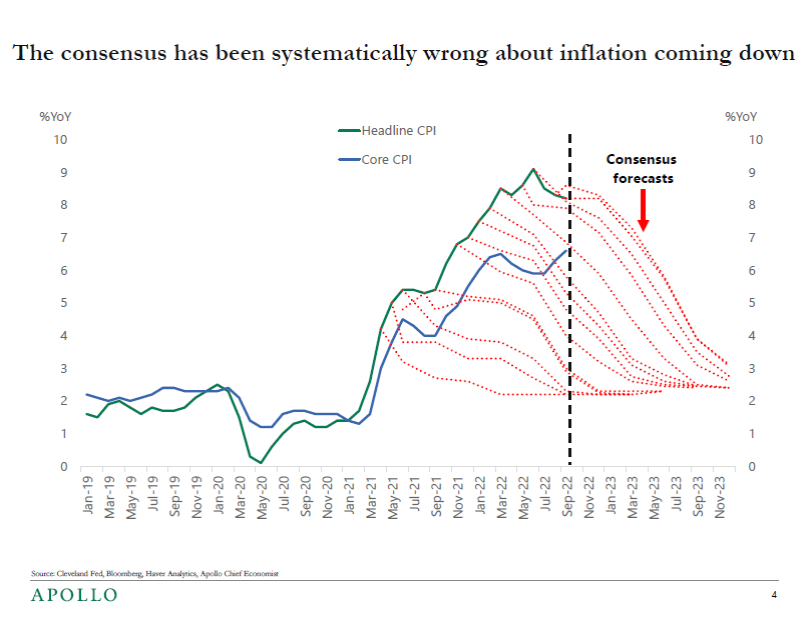
I’m encouraged by yesterday’s CPI numbers. While the decline in inflation can be explained in terms of special factors, explaining away decreases as transitory has same problems as explaining away increases. These numbers should, at the margin, influence the @federalreserve.
Today’s JOLTS report shows a labor market that is cooling very slowly and will likely continue to be extraordinarily tight for some months to come. Job openings declined by only 350K last month, meaning we would need 9 more months at this rate just to get back to 2019 levels.
While some argued two months ago that job openings can fall without increases in unemployment, the evidence so far suggests the opposite. To the extent that job openings have started to fall, unemployment has ticked up. Based on the historical data, this pattern should continue.
The unemployment rate that is consistent w/ today’s vacancies and quits rate is probably in the 2% range. I don’t think there is any Phillips curve specification that would suggest that inflation can fall substantially with a labor market as tight as the one we currently have.
Encouraging CPI number. This is comparable on the low side to some of the earlier surprises on the high side. Cannot make judgements on a single monthly number, but this is not one that can be dismissed.
The terminal rate, according to Fed funds futures, has just risen above 5. This is a kind of milestone. I think it is more likely than not to rise more. But the increase already of more than 400bps in 18 month is surely most of the increase we will see in this cycle.
Inflation hurts:
A sobering chart from the @WSJ; and a reminder that ...
Despite higher nominal wage #growth, the purchasing power of earnings has been hit hard by #inflation; and
It is the most vulnerable segments of our society that get hit the hardest.
#economy#equity
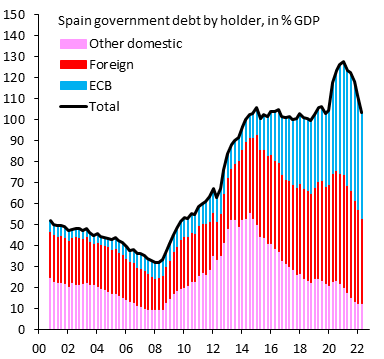
Spanish government debt is back down to pre-COVID levels. Markets reward this with lower and less volatile spreads and - increasingly - differentiate on the Euro periphery. Spain is not in the same basket as Italy and hasn't been in that basket for a very long time.
I was very pessimistic about the consequences of utterly irresponsible UK policy on Friday. But, I did not expect markets to get so bad so fast.
A strong tendency for long rates to go up as the currency goes down is a hallmark of situations where credibility has been lost.
The UK government continues to put added pressure on consumers with expansionist policy. Truss attempts to make her mark with Thatcher style policies at a time when inflation is far beyond acceptable. Irresponsible.
#inflation#macroeconomics
Powell's message today is that rates are heading higher and poised to stay at a restrictive level for "some time". Says a soft landing will be "very challenging" and that failure to restore price stability is not an option https://t.co/AWUwR62zEt @FinancialTimes