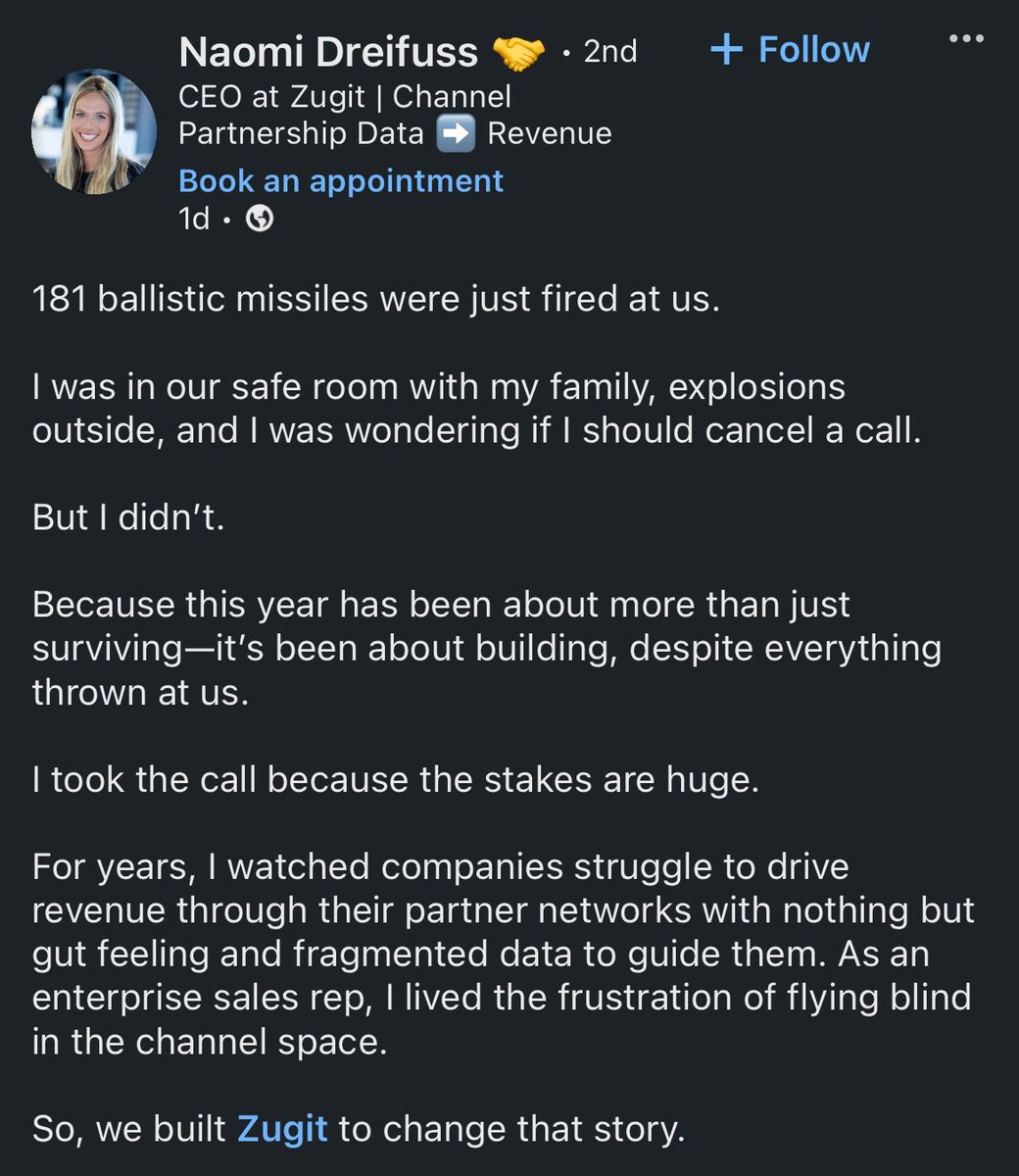
Lord, give me the confidence of the VC Analyst who cold emails you asking for your pitch deck so they can learn about your business and explore investment possibilities!
Crazy! Reminds me of a founder who has this habit of calling out every executive exit as "I fired him, he didn't leave". Whatever the reasons, life is too short to waste on opportunities that don't excite you.
We are terminating Chris Degnan for unethical conduct involving Cognition.
The last few months have seen incredible progress in AI capabilities. San Francisco has flourished as new companies that solve new, more ambitious problems are finding great success. Generally, it is a wonderful time to be building.
We at @FactoryAI have seen overwhelming interest in our model-agnostic coding agents and our software factory product. Our team has 10x’d in size, while our revenue has 100x’d year over year. This momentum has been unprecedented.
A much larger competitor, Cognition (makers of Devin) has fallen behind us on the capabilities that matter most to customers: cost, quality, and security. Instead of competing in the market, Cognition engineers feigned interviews with us to pry information about our product. Not finding what they were looking for, Cognition has decided to throw their weight and money at people with direct knowledge of our most confidential plans.
It feels as though ethics is being thrown out of the window in the AI era. People are willing to do anything, including exploiting privileged information and violating ethical boundaries. I think this is unique to our time, and I don’t think it’s right. Integrity still matters.
Yesterday, I made the decision to immediately terminate Christopher Degnan’s roles as a Board Observer and Advisor to Factory, after over a year of service.
Prior to this decision, Chris told me he had a casual conversation with an executive at Cognition AI. When I questioned his intentions, he reassured me that ethics aside, he had “made too much money” and was “too lazy to go work for Cognition,” which I trusted and believed.
On Monday, Chris spent time advising the Factory team on a handful of confidential board-level matters. That evening, he called me to say that the conversation that was initially described as casual and one-off was actually formal and recurring. For weeks, while he sat in our board meetings and advised our leadership team, he was also confiding with executives of our largest competitor. Chris was subject to confidentiality obligations in connection with his work with Factory. We do not know the extent of the information he shared, but it puts his timely questions about our product roadmap and what the parity gap involves into a new light.
It is sad to sever a relationship with someone who has been a trusted advisor - and even a close friend - for over a year. But Chris’s conduct is unacceptable to me. Trust in Board Membership is one of the sacred bonds in the Silicon Valley, one that helps the startup ecosystem thrive. With it comes an enormous responsibility. That trust was violated.
Competition is good. I respect and in many cases admire our competitors. San Francisco is a beautiful, singular place where the bold and ambitious go to defy the norms and precedents of the past. But certain principles that must remain. Violating ethics to seek advantage turns what should be positive-sum into zero-sum.
We all love technology. And we all love to compete. But we must hold ourselves to a higher standard. The future of software engineering comes with abundance that will impact every person on Earth. Building that future comes with immense responsibility. We must build and compete with integrity.
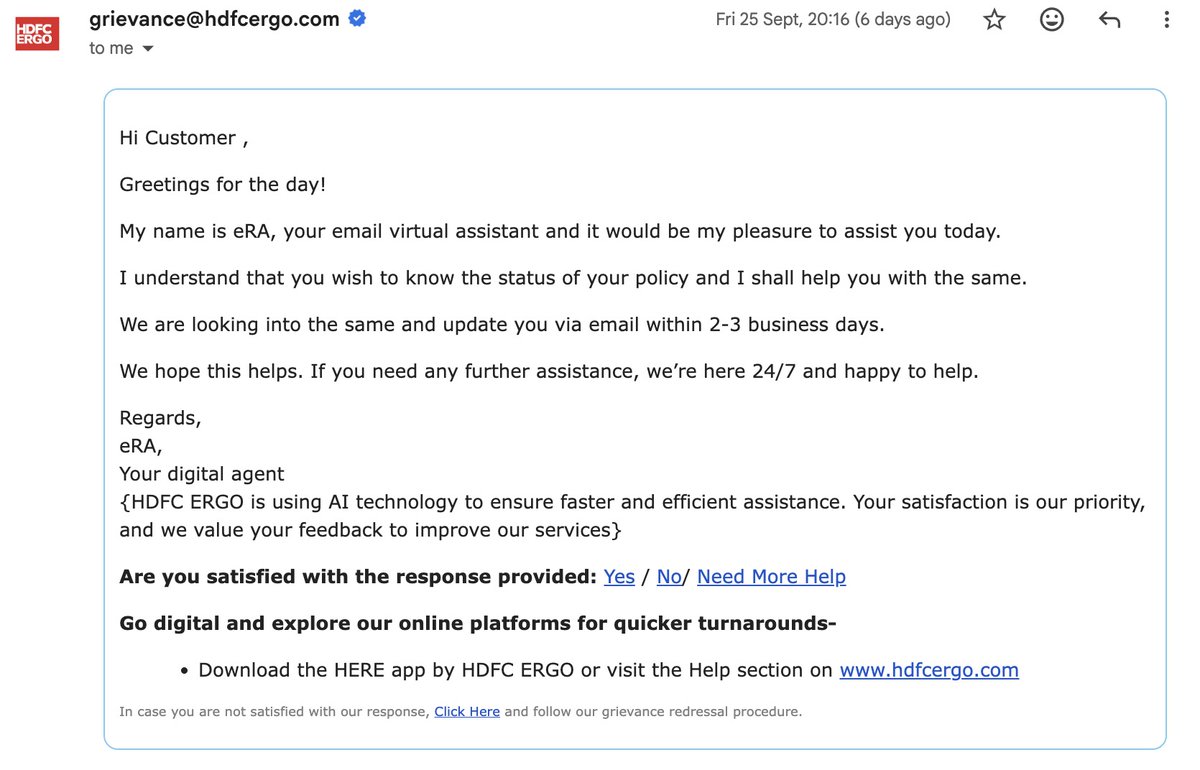
Hey @HDFCERGOGIC , allow me to point out what is wrong with your support:
1. you are using a really dumb system - I need to update the policy members and for some reason you think I need to know the status. Someone has sold you a poor software with the label of AI
2. When your AI confirms 6 days ago that they will respond in 2-3 days, make sure this happens.
3. There is no support channel where I can talk to a human - time to make clear guidelines on this @irdaindia
@HDFCERGOGIC , please stop using your voice AI agent for service calls - it is thoroughly useless. When we call for a service call, we want the problems solved and not go through ridiculous hoops.
I had a ‘nice’ CTO who cribbed about one of the EMs on the team for a year. Every time I would bring this up, the dude just ranted about his intention to let him go. The EM couldn’t get anything shipped - the PMs on the pod got frustrated and eventually left. The company was all ops, customers didn’t care much about the product and they coasted for a year - thanks to being ‘nice’.
Janagraha used to organize civics education and know your rights sessions - I remember traveling to BLR from BOM for one such in 2010. I even started a portal called Samuday to help communities know what their local issues are. It was such a stellar experience knowing them and their work - however briefly!
In 2010 or earlier, Bengaluru based NGO Janagraha had launched a widely successful crowdsourcing platform called “I Paid A Bribe”. It grew fast, won a lot of acclaim and press coverage including from BBC and New York Times. I know this because we won a tech-impact award alongside them.
India’s NGOs do a lot of impactful work that goes unnoticed because we prefer to hear and say stories of technology capitalism. This initiative was a crowdsourcing platform in 2010 and it is the same even today. Tells you how much impact and “change” depend on technology innovation vs people’s willpower to incite change.
People may not realise how long @RajanAnandan has been backing the Indian startup community. In 2011, I was at the NASSCOM Product Conclave presenting our EdTech startup. Rajan's immediate response after he heard was that he couldn't invest because he has already invested in a potential competitor. Instead of being upset, I was amazed at how Rajan spotted this rather early idea so ahead of the times. More power to you!
@bhavintu had a very good ask from all hiring managers - they must write a JRD (Job Responsibilities Description). No big talk - but the list of things you think the person would do on a daily, weekly, monthly, yearly scale. This brings lot of clarity to what the interview should focus on. Worked pretty well and kept the hiring in check when every leader felt they needed to hire more.
This is becoming true for even junior roles now. The way role definitions are changing by the day, and _what you should be looking for_ is evolving, the clarity of “what to look for” is becoming a huge bottleneck.
What questions to ask someone is a higher order problem stemming from do you even know what you are hiring for.
After decades, the conversation is about education and reforms. It will be a travesty if this stops with the resignation of a minister. Families spend 20% of their income educating their children. But once in government, the same people cannot find even 4% for education. Education is a priority when the child is ours—and expendable when the child is someone else’s.
Look at where we have fallen in the last decade:
1. Between 2004–05 and 2013–14, India’s education budget rose from ₹13,098 crore to ₹71,059 crore, recording a CAGR of 21%. In contrast, between 2014–15 and 2023–24, it increased from ₹68,874 crore to ₹1,23,357 crore, but at a much slower CAGR of just 7%. School education growth fell sharply from 22% to 5%, while higher education growth declined from 19% to 10%.
2. Between 2004–14 and 2014–24, total revenue expenditure—excluding interest and grants—rose from ₹57.95 lakh crore to ₹155.57 lakh crore. However, education expenditure increased from only ₹4.05 lakh crore to ₹8.38 lakh crore, causing education’s share of revenue expenditure to fall from 6.98% to 5.39%.
3. Between 2014 and 2024, government colleges grew from 7885 to 7994, a growth of just 1%. In the same period, private colleges went up from 21,750 to 32,513, a growth of 49%. Including the Private aided colleges (which grew at 24%), the total growth has been 35%. Sadly, the growth of government colleges has been by accident and not by design.
4. Similarly, enrolment also took a turn for the worse. Students enrolling in a public institution grew by 21% (134 lacs to 163 Lacs) while those into private grew by 42% (182 lacs t0 357 Lacs).
5. We are closing 25 schools a day. Between 2014 and 2023, India’s population grew by over 12 crore, or 9.3%. Yet, during roughly the same period, the number of government schools declined by 89,441, or 8%.
6. School education is effectively killed and replaced by an entrance exam or a competitive exam. For Ex: CUET is the most useless exam that has been imposed on students in Delhi. Even a topper from Delhi cannot get a seat to study in any college in Delhi unless the student appears for CUET. And every entrance exam is against equity as only those who can afford coaching or have access to coaching succeed. The public schools are death a death blow.
7. Between 2014 and 2026, IIT tuition increased by 122%, At IIM Ahmedabad, the two-year programme fee rose by about 66%, NID and NLU fees also rose substantially by two to three times.
8. While India is seeking its Indian origin scientists working abroad to return back to India, our own research fellowships have been disbanded. The KVPY gave way to INSPIRE Scholarships. In the current year, there are no budgetary allocations for INSPIRE fellowships too.
9. The fees in Private colleges has grown beyond means of most Indians. NEET as an exam is a competition for just about 30,000 Government Medical College seats in the open category! The other 70,000 private seats are a ‘reservation for the rich’ where just about 1% of India can afford to pay the 1.25 Crores fees. All Private colleges cost about 5X to 10X of public institutions.
10. While the Government announced an additional 9911 seats for the current year with much fanfare, only 2400 are in public institutions. 78% of them are in private space and outside the reach of the common man.
11. As per Economic Survey 2025-26 report,
a. 56.2% of professor posts in central universities and other HEIs remain vacant (as on 31-01-2025)
b. 75% of HEIs lack industry readiness
c. About 2 crore adolescents (14-18 years) are out of school.
12. While we have a GER target that is much touted, what we have done is to reduce GER at secondary stage, which is at 68.5% (against NEP target of 100% by 2030). Nearly one third of children are outside the education system, the stage (class 9 to 12) that determines employability and higher education participation.
This conversation took decades coming. I do hope that we don’t stop with the resignation of a minister and demand bigger reforms. This is an opportunity that India cannot let go. This is important to every student, every parent, every young person and to our nation, INDIA.
Software horror: litellm PyPI supply chain attack.
Simple `pip install litellm` was enough to exfiltrate SSH keys, AWS/GCP/Azure creds, Kubernetes configs, git credentials, env vars (all your API keys), shell history, crypto wallets, SSL private keys, CI/CD secrets, database passwords.
LiteLLM itself has 97 million downloads per month which is already terrible, but much worse, the contagion spreads to any project that depends on litellm. For example, if you did `pip install dspy` (which depended on litellm>=1.64.0), you'd also be pwnd. Same for any other large project that depended on litellm.
Afaict the poisoned version was up for only less than ~1 hour. The attack had a bug which led to its discovery - Callum McMahon was using an MCP plugin inside Cursor that pulled in litellm as a transitive dependency. When litellm 1.82.8 installed, their machine ran out of RAM and crashed. So if the attacker didn't vibe code this attack it could have been undetected for many days or weeks.
Supply chain attacks like this are basically the scariest thing imaginable in modern software. Every time you install any depedency you could be pulling in a poisoned package anywhere deep inside its entire depedency tree. This is especially risky with large projects that might have lots and lots of dependencies. The credentials that do get stolen in each attack can then be used to take over more accounts and compromise more packages.
Classical software engineering would have you believe that dependencies are good (we're building pyramids from bricks), but imo this has to be re-evaluated, and it's why I've been so growingly averse to them, preferring to use LLMs to "yoink" functionality when it's simple enough and possible.