Sworn enemy to meaningless jargon, unnecessary complexity and a stifling status quo. Marketing @atriumhq @DunBradstreet @Lattice_Engines @yammer @marketo.
CONAN AT HARVARD: “No university in our nation has produced more Nobel laureates or white collar criminals… so whether you choose good or evil, know that you are among the very best.”
Jack Dorsey is the most misunderstood CEO in Tech
I wrote about Block 40% layoffs as part of a deeper dive into what @bhalligan is calling Dorsey Mode - Jack's bold approach to managing in the AI Era
Link below
High-agency people genuinely believe that reality is negotiable in a "there are always more levers to pull" way. It's about having this bone-deep conviction that if you keep poking at something from different angles, eventually something will give.
I’m going to tell you how much worse it was at the start of the PC Revolution for white collar workers trying to adapt, vs today with AI
Today, presumably every white collar worker has access to a smart phone and/or a PC/laptop.
Back then, a PC cost $4,995 , an off brand was $3,995. 5k in 1984 is about $16k today. It was really expensive.
The only reason I could learn how to code and support software is because my job let me take home a PC to learn. By reading the software manual. Literally. RTFM. Or pay to go to training. Classes that started at hundreds of dollars then. It was expensive. It absolutely limited who could get ahead.
Today, ANYONE can go to their browser, to the AI LLM website of their choice, and type in the words “I’m a novice with zero computer background, teach me how to create an agent that reads my email and …”
That concept applies to LEARNING ANYTHING
Think about what this means. Any employee of any company can say “ I need to learn how to xyz for my job , which is to do the following: Tell me what more information do you need to help me be more efficient, productive and promotable”. Or “ what new skills can you teach me that will help me reduce my chances of getting laid off “. Or “what suggestions do you have for me to communicate to my boss, who I barely know, to help my chances of staying employed “
These aren’t great prompts. But they are a start that anyone can take.
Think about how incredible that is.
Back in the day was so much harder for white collar workers. It was harder for new grads because unless they took comp sci, they probably had never used a PC.
Big Companies are going to cut jobs. No question about it. Small companies is are going to need more and more AI literate thinkers who can help them compete or get an edge
What I tell every entrepreneur, and it’s more crucial today. “ when you run with the elephants there are the quick and the dead. Adopt tech quickly , you can out maneuver big companies. “
Over the last 12 years, I've worked with 4 Private Equity funds at ZoomInfo. Here’s my 12-step playbook for working with PE Owners.
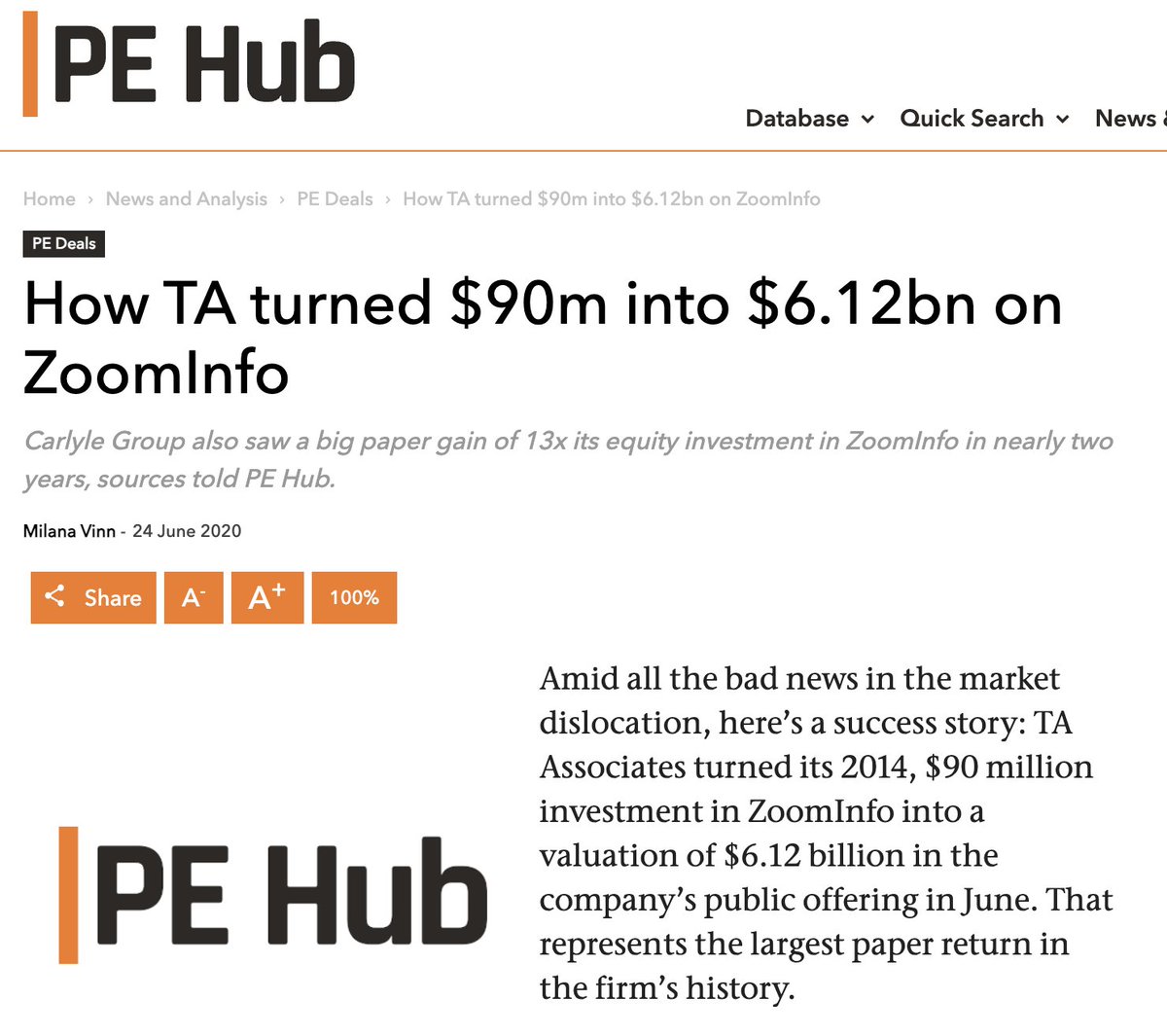
In 2014, I took on my first PE investors (TA Associates and 22C Capital).
In 2018, we brought on Carlyle and CPPIB.
Private Equity is in the headlines everywhere now - buying businesses like Smartsheet, Zuora, SolarWinds, Avalara…
Here are lessons I learned on how to make working with them a LOT easier.
1. Get aligned from Day 1
Ask them what they underwrote the deal to. That’s a fancy way of asking:
“What did you tell your investment committee this business would be worth in 4–5 years in the base case?”
Then ask about the upside case.
If you want real alignment, ask for the memo. If they get squirrely, just say:
“I assume there might be some misgivings about me in there - can we talk about those so I’m aware?”
There is no faster way to get aligned than seeing exactly how they described the investment.
2. Understand the clock
If you want to invest in growth and bring down margins to do it, do it early. As you approach exit, EBITDA becomes a sacred cow.
Want to launch a new product? Great. Show what sales is committing to it and when. If you can’t do that, don’t even bother asking.
3. You don’t have to do everything they tell you
After my second board meeting I went to D. Randall Winn (my PE board member and CEO of S&P Capital IQ) and said, “Randy, just tell me what you want me to do and I’ll go do it.”
He laughed and said: “Whoa whoa, that's not how it works - no one here knows your business as well as you do. We’re going to give you advice and pattern match. Your job is to listen and decide.”
That said, you MUST listen to their advice and explain your choice. This doesn't have to happen immediately.
Try phrases like this: “I hadn’t thought about that - it’s a good point, I want to take some time to think it through and get back to you.”
Then actually follow-up.
4. You NEED a strong CFO and FP&A team
Most of your private equity investors’ interactions are with your CFO. A strong CFO and FP&A team build trust. They help you craft strategy around data AND they're endlessly valuable to your PE partners because they can build models and get them the data they need to understand what’s happening in the biz.
This makes life easier for you and them.
5. Response time matters
PE employees work all hours. One of the associates on our deal told me that she was sleeping in her car outside their office for ~2 hours and then starting to work again cause she didn’t want to waste 30 mins driving home.
When they email asking for clarification or making a suggestion, respond fast - even if it’s just to say you’ll follow up.
6. Send them swag
This one might sound dumb, but you want them to FEEL like they are on your team. When you get new swag, put it in an envelope and send it with a nice note - you want them to feel the same level of pride you feel in your company.
7. Expect pressure to do M&A
I remember being at a PE conference where they flashed a slide showing that portfolio companies that did M&A far outperformed the ones that didn’t.
Every firm had the same slide, they all believe it and you should expect pressure here.
8. Be prepared to offshore
They believe deeply in offshoring because labor offshore can be equally talented at 1/2 to 1/3 the cost. There is an organizational tax that comes with this, you can’t negotiate it away. You just have to prepare the company to manage it.
9. When a metric goes sideways, don’t show up like a macho man
If you show up with a confident solution, you’re begging for a fight.
Instead: present the metric, share POTENTIAL hypotheses, explain what you’re testing and ask what they think you might be missing
Make them partners in solving, otherwise you’ll quickly turn them into adversaries poking holes.
10. Cutting costs is easier than driving growth
This is just objectively true.
If your strategy increases costs in the hope of faster growth, you need to answer two questions:
- What metrics and checkpoints will tell us this is working - and when do we kill it if it’s not?
- Does the additional growth actually change the multiple and valuation of your business?
If you go from 15% to 20% growth in an EBITDA-dilutive way, you may have made the business worth less, not more. Your PE partners will care a lot about this.
11. They LOVE pedigree.
Hiring someone from Stanford or Salesforce is almost never questioned. But take a risk on a state school or a non A-plus company hire and you’ll be defending that person even in good times - your job is to build the best team you can so the price of doing that is owning those hiring decisions at the board level.
12. Relationships matter
There were a handful of times where I knew that I got on the wrong side of one of my PE board members. So I would tell my wife, “hey listen, I’m flying to San Francisco or New York on Sunday and I’m going to have breakfast with them and then fly home.” Then I’d call them and just say “Hey, do you have time for breakfast on Sunday? Maybe a workout before.” They always said yes and it gave me 4 hours of time, some relationship building and then we got right into the reasons we were misaligned and what I could do better.
These were super valuable - don’t EVER underestimate the power of getting in person with your partners - same rule applies to your team.
The thing I loved about working with Private Equity is that there is no singing kumbaya pretending we are some happy family. It’s a 4-5 year relationship and the expectations are very clear.
I really appreciated that.