Can someone please tell me what happened with Arctic Wolf, Millennium throwing money at people and they still couldn’t last a year. Who’s got the scoop?
🚨NEW EPISODE🚨
Jeff Currie @CommodMkt pounds the table on owning hard assets - now & long term - in an incredibly convincing way.
- Bessent intervention = financial repression
- OWN GOLD - $10k target
- Energy > tech
- Global recession risks under-priced - watch diesel & ag
Timestamps:
0:00 Intro
2:23 Yields rising
4:00 Bessent intervention is financial repression
7:36 OWN GOLD
13:08 Not worried about gold pullback
18:36 Energy over Tech
23:30 Watch Diesel
27:02 China buying crude again
29:23 Crude reserves low
30:19 Recession risk underpriced
34:53 “Munificent 7”
36:53 Ag commods exploding
41:22 Buy any commod pullback
44:20 Recession risk to commods?
47:00 History suggests still early for commods
49:10 Iran hugely boosts commods bull case
52:43 Bearish Bitcoin
55:28 Post Goldman - Real Macro
56:50 Conclusion - Own all commodities
Greece has an interesting model, aiming to attract people exactly like Chris:
- Non doms can pay €100,000 a year flat tax on non-Greek income
- Greece requires a 'small' amount of investment in addition (€500K)
- Theoretically that means the millions of tax they'd pay elsewhere instead stay with them, but the bet is that they'll also spend or invest some of that locally, above and beyond the threshold they have to
So the UK loses hundreds of future millions in tax, Greece gets a guaranteed €100k a year, plus a one-off minimum €500k investment, plus the likelihood that Chris will hire local people, invest locally, spend his money locally
HERE'S ANTHROPIC NET ARR: Anthropic Gross ARR reported to be $65B in July '26 and at $10B net new ARR / month you get $85B Q3'26 and $115B Q4'26.
If you remove:
- Meta ($5B ARR)
- Payout to AWS Bedrock / GCP (20-25% API volume assume 20% take rate
- 2% of all API volume is Chinese labd distilling.
You get to:
$62B Net ARR Q3'26
$82B Net ARR Q4'26.
At 20x EV/ARR that implies $1.3T Q3'26 numbers and $1.6T Q4'26.
Makes the pre-IPO price of $1.4T on @prestocks make sense.
One of the most interesting blog posts we've released: details on internal research acceleration at @OpenAI. I expect these trends to continue.
We also share some details on how we've paced model development to prioritize monitoring, alignment, and security.
Warning: Once you see this monk's 3-minute demonstration on "how to stop thinking," you can't unsee it.
Ajahn Brahm says:
"Your mind never actually stops. It just fills every gap you fail to notice."
His demonstration works because he exploits something neuroscience has quietly confirmed for years that "the thinking mind cannot generate thought and pay full attention at the same time."
Attention and cognition compete for the same neural real estate. When one runs at full volume, the other goes quiet.
Most people never experience mental silence because they've never once given attention *anything* to fully occupy it with.
What Brahm does in those 3 minutes is deceptively simple.
He asks you to listen to the *gaps between his words*.
The silence between syllables. The pause between sentences. And the moment you shift your attention to those gaps, your internal narrator goes quiet.
The reason is you directed your awareness with such precision that it fully engaged your attention and left no room for extra commentary.
Meditation traditions have circled this insight for 2,500 years.
The Pali term for mental chatter is *prapañca.*
Transaltion: Conceptual proliferation.
One thought spawns another, which spawns three more, and within seconds you're rehearsing an argument from 2014.
Brahm's technique interrupts the mechanism at its source. You cannot proliferate thought while genuinely tracking silence, because silence has no content for the mind to grab onto and multiply.
This is why most meditation instruction fails people. They're told to "clear the mind," which is like being told not to think of a polar bear. The very act of trying activates the machinery it's supposed to silence. Brahm inverts the entire approach.
Instead of asking you to stop, he asks to divert your attention somewhere so refined to rest that stopping happens on its own, as a side effect.
There's a deeper reason this demonstration hits so hard.
Modern life has trained our nervous systems to treat silence as a threat that must be filled with a podcast, a scroll, a snack, a plan.
We've forgotten that silence is the medium consciousness actually rests in. Sound is the interruption. It's not the other way around.
Once you experience even 5 seconds of genuine internal quiet, your relationship with your own thoughts permanently shifts. You stop believing every mental voice is *you*. You start noticing there's a witness underneath the chatter that was never anxious to begin with.
Please throw in your thoughts on this.
No libido = cortisol.
Puffy face = cortisol.
3am urge to pee = cortisol.
Belly fat that won't budge = cortisol.
Here are 7 hacks to rebalance your cortisol, according to science:
1. Stop working out after 7pm
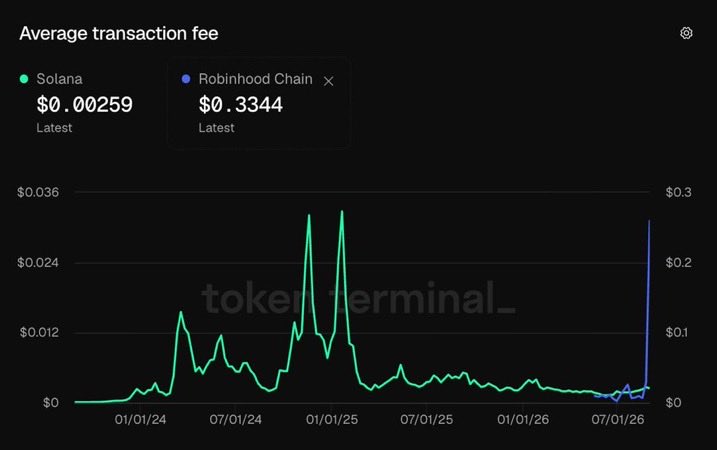
$HOOD Chain was a great moment for crypto, and a revealing one.
When the largest retail broker in the world chose where to put 24/7 stocks, yield and DeFi for 120+ countries, it didn’t choose the chain that spent five years optimizing for the cheapest transaction.
It chose Ethereum, via Arbitrum. That decision tells you what consumers, and the institutions building for them, actually optimize for.
Two chains made two different bets.
Solana bet that fees were the product.
It got there by concentrating validator infrastructure, and the bill came on Aug 12: one data-center routing fault knocked 102 of 699 validators offline, 29% of stake, 33 minutes, 4.5pts from losing finality.
One provider hosts 27% of stake, above the Foundation’s own 25% cap. The status page never logged it and still reads “100% uptime.”
The economics were built the same way: 95% of H1 2025 revenue was priority fees and Jito tips, i.e. memecoin flow. That flow left, and network revenue fell 87% YoY in H1 2026. Solana still owns spot memecoin volume, but it was monetizing speculation and not finance.
Ethereum bet that settlement was the product and let execution move to chains you can own.
That is exactly what Robinhood bought: 100ms blocks (vs ~400ms on Solana), 10M+ daily transactions two weeks after mainnet, tokenized US equities 24/7, Uniswap and Chainlink on day one, ETH as gas, its own sequencer and its own economics, all settling back to Ethereum.
Look at where the new DeFi is actually being built and the pattern is the same. Perp CLOBs, tokenized equities, prediction markets and RWAs are now the volume; perp DEXs alone clear $1T+ a month.
Hyperliquid built its own chain.
Lighter is a zk-rollup on Arbitrum.
Polymarket sits on an ETH L2.
Ethereum holds ~48% of all RWA value.
None of it lives on a shared L1, because these products want their own execution layer and someone else’s settlement.
You can’t spin up your own Solana.
Ethereum sells precisely that.
And the settlement layer is getting faster and cheaper on its own: Glamsterdam this quarter brings ePBS and parallel execution via block-level access lists, a gas-limit floor of 200M (from 60M), mainnet transfers already sub-cent, then Hegotá with FOCIL. Part of those changes will allow the L1 to perceive more value from the current revenue split/burn from L2s as well.
Layer that on the deepest liquidity and stablecoin base in crypto.
So $SOL is squeezed from both sides: losing the institutional and RWA layer to $ETH’s L2 stack, and losing the trading layer to purpose-built venues like $HYPE and now $HOOD Chain.
What the consumer wanted was new products, yield, good UX, small fees, 24/7 markets and security.
Right now that lives in the $ETH ecosystem, and builders know it: organisations like @ethlabs_org are making it easier to onboard and are shifting $ETH’s already dominant position by listening to the users and builders.