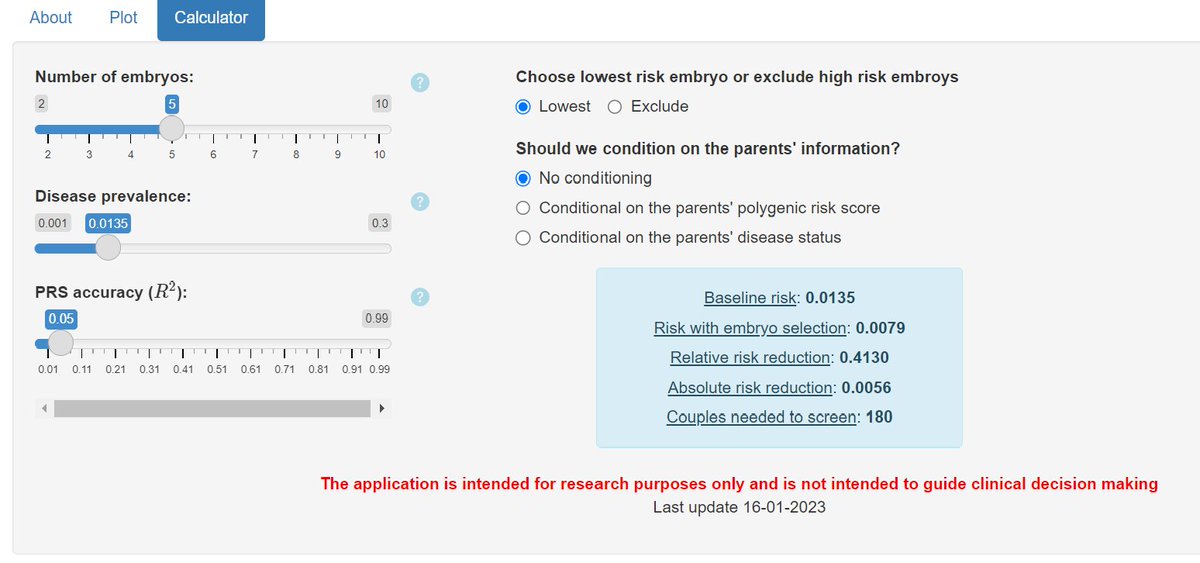
Are you a clinician/researcher interested in the pros and cons of screening IVF embryos for polygenic diseases (PGT-P)?
Check out our new online risk reduction calculator.
https://t.co/Y36lLHtEbf
An interesting new preprint on how to combine PRS and family history to improve disease risk prediction. By Alkes Price and colleagues.
Bottom line: adding disease status of family members as indicators to logistic regression works well.
Thread ->
1/14
https://t.co/in3e8A3XPz
I'll elaborate on this a little bit, since I feel it isn't just enough to say someone is my hero without explaining why. Daphne Koller (who I have never met in person) has had a disproportionately large impact on my life. Thread below (1)
@Farzad_MD@atulbutte@KennethBaer@chiragjp And that map... when ~200 people in the sample are from 94022 (Los Altos & Los Altos Hills, probably the richest zip code in the county), it seems hard to write "targeting a representative sample of the county" with a straight face?
@ewanbirney@matthewherper@skathire@jcbarret@SCSanderson Probably most important difference is disease frequency (e.g., figure 2 of https://t.co/5rMPLTzRgL) -- family history works well in practice only for quite common diseases (and this was with 7-year-ago "PRS")
@GENES_PK@anshulkundaje@FiveThirtyEight Yeah, I’ve never written it out but it seems true. Re @anshulkundaje q about small differences in AUC, the most natural metric isn’t clear, but at least increasing one will increase others. It’s the nice part about small effect sizes in GWAS :)
@anshulkundaje@GENES_PK@FiveThirtyEight Under the assumption of small effects sizes (for a fixed disease prevalence), the risk distribution is ~normal and there is just one parameter that all metrics can be derived from, so it doesn't really matter what metric we talk about. E.g., https://t.co/dt6V1M7IRF
Intense hunt by biotech (i.e. Calico) & billionaires to promote lifespan (healthy aging).
Here, a genetic study reveals the secret: avoid a heart attack!
Most gene variants identified for lifespan are just common alleles *protective* for heart attack.
https://t.co/K3KDtX420S
Our Health R&D team is looking for a scientist to create novel health products. Background in epidemiology & machine learning a plus 📈👩🔬 #jobs#hiring#ASHGtrainee https://t.co/AYUAVxPduh
Fireside Chat with Daphne Koller (ICLR 2018). The best ICLR session IMO, discussing ML & computational biology, online free education, and women in science https://t.co/U3aBicgAyS
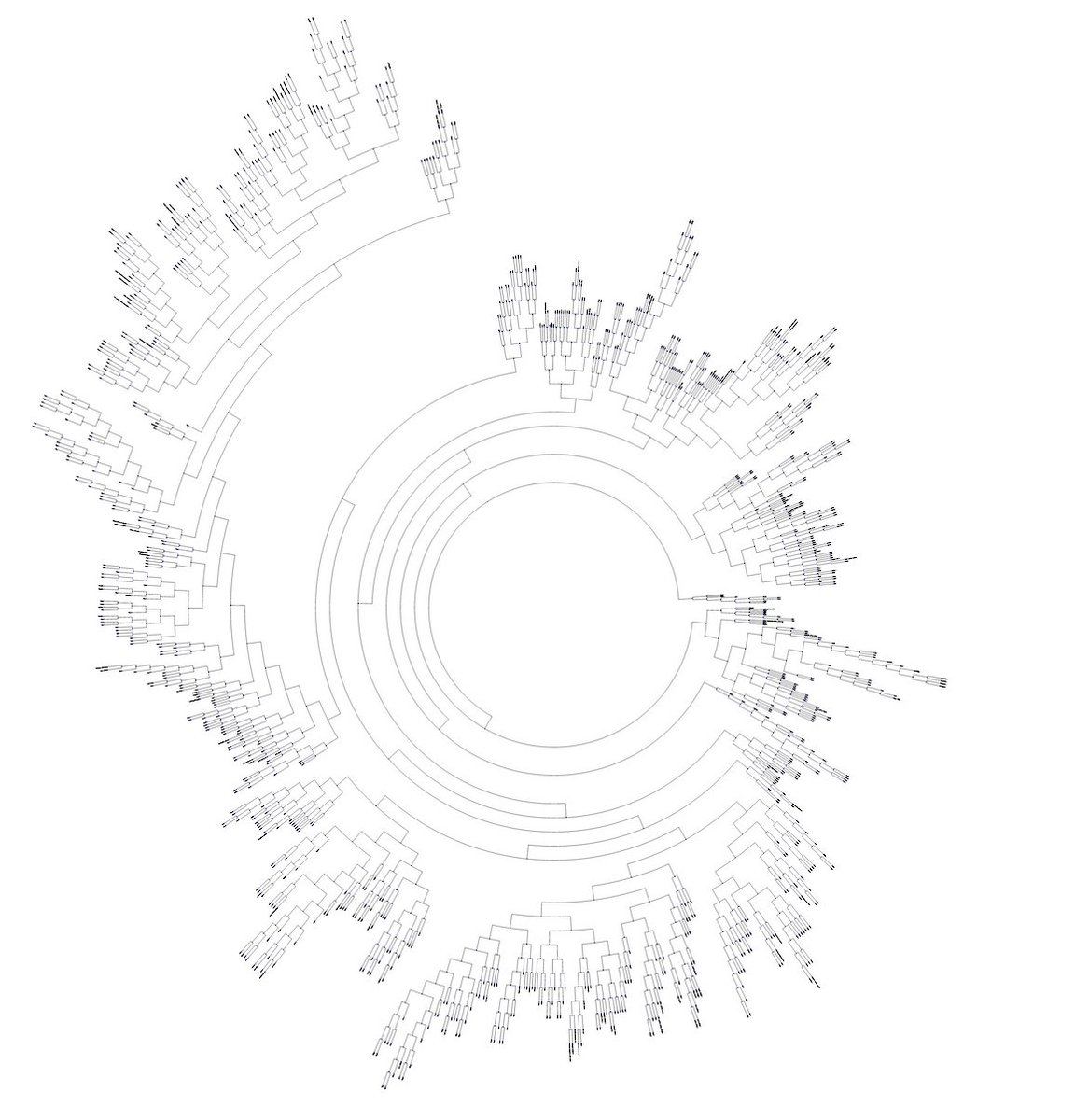
Deep learning, min hashing, assemblies oh my! If you're interested in such topics, join us @hexagonbio and start adding leaf nodes to this fungal tree!
My latest work w/ @23andMeResearch@predictPD on the Parkinson's disease phenome! Associations between PD and 840 survey-based phenotypes. Replicated 32 known associations and highlighted some potential risk factors (migraine, OCD, allergies, anemia). https://t.co/o6iejxgcBt
Congrats to Bernd Sturmfels, past ICERM scientific board member, who will receive the 2018 George David Birkhoff Prize in Applied Math from the AMS. #appliedmathematics#appliedalgebraicgeometry https://t.co/HO2ngfH8Qc