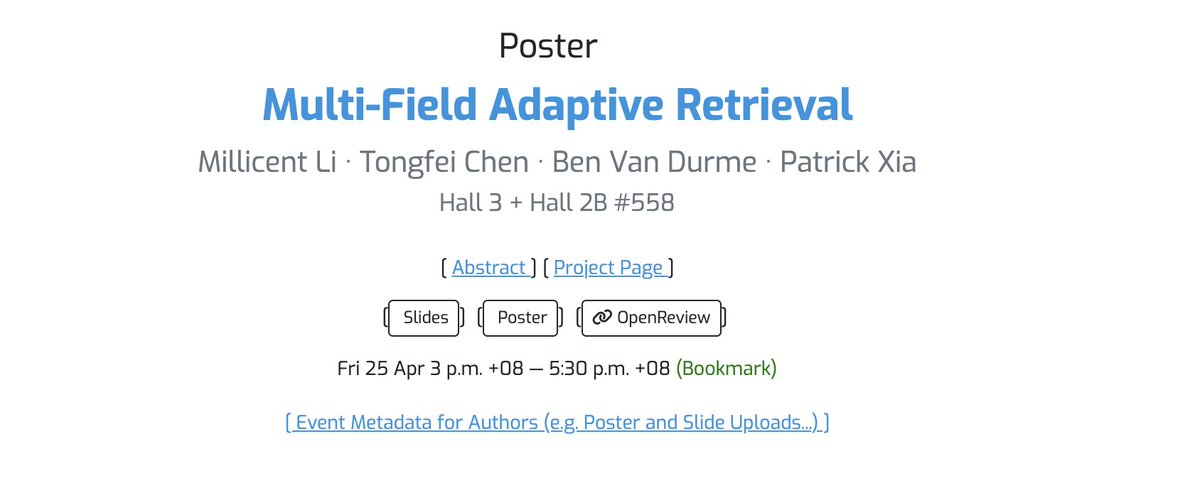
I'll be at #ICLR25 to present our spotlight poster (w/ @nlpaxia@ctongfei@ben_vandurme) on Multi-Field Adaptive Retrieval on Friday at 3 PM (Hall 3 + Hall2B)!
DM me to chat about this work, interpretability, science of AI, or just to generally chat and eat good food!
cool work on improving structured retrieval (with some interp/controllability too), especially as rag is now everywhere - see 🧵 for details and paper
it was a privilege to host you over the summer @millicent_li!!
Documents 📃 on the internet 🌎 contain structure, such as 'author' and 'biography' fields from Wikipedia pages.
Can we improve document ranking based on the field name and its associated text?
Our answer: yes we can! 🧵
arxiv link: https://t.co/qy2L8PjbL3
Thrilled to (finally) be able to share our paper:
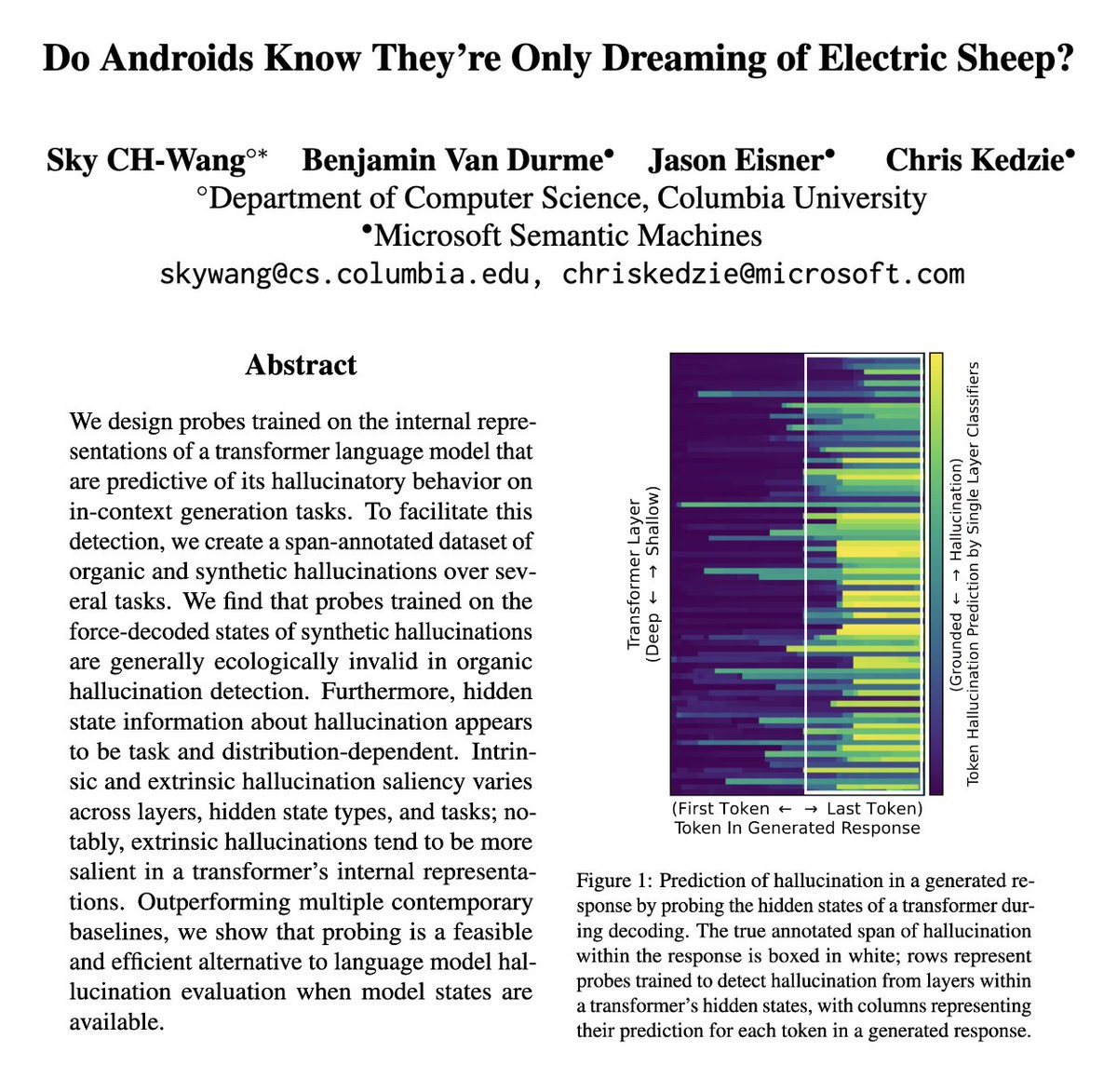
🐑 Do language models know when they're hallucinating? TL;DR answer: yes!
🔗: https://t.co/Q8x7abTROh, and a🧵
w/ Semantic Machines @MSFTResearch: @ben_vandurme & @adveisner & Chris Kedzie
📢 New Paper Announcement:
We present SCREWS, a reasoning with revision framework that allows exploration of various reasoning chains to find the most suitable one for a given task.
Paper: https://t.co/oPBvHZelMA
Is your Coref model struggling with: Multiparty dialogues? Non-English languages? Expensive annotation? Look no further! Check out our new #TACL paper at #ACL2023 on July 12th, 11:00-11:15(Pier2&3) !
https://t.co/B7076rnQsu (w @nlpaxia, Mahsa Yarmohammadi, @ben_vandurme) @jhuclsp
PhD students in NLP/ML/AI: apply for an in-person summer 2023 internship at Microsoft Semantic Machines! Intelligent agents helping humans, via grounded natural language dialogue and more. Read more at https://t.co/Oo0sIkOQ3G . #NLProc#ML#AI
I will present at today’s poster session, Machine Learning for NLP at 2p (Dublin time).
Will also present at tomorrow’s virtual poster session 2 and oral session on Friday (Machine Learning for NLP 5).
So happy to be at @aclmeeting and excited to meet people!
How can your model quickly learn that "owner of Twitter" and "Tesla's CEO" refer to the same person?
Check out "Adapting Coreference Resolution Models through Active Learning", accepted at ACL 2022 main conference.
Paper: https://t.co/eU6PFfmDSb
Video: https://t.co/yobPqOc6NW
JHU CS is recruiting in various topics, including NLP, Machine Reasoning and Grounded Language. Come join CLSP and the broader AI space at Hopkins. https://t.co/OcW4OkT3wi
Some of the findings: skip paying for OntoNotes, small dev sets are OK, zero/few-shot cross-lingual coref is pretty neat, finetune fewer layers w/ continued training, new scores, ...
"Moving on from OntoNotes: Coreference Resolution Model Transfer"
https://t.co/VEXzQZccur (2/2)
Come check out our (with @ben_vandurme) #EMNLP2021 paper at the virtual poster session (IE track) in 11.5 hours (11:30am EST)!
We investigated the effectiveness of continued training of coreference resolution models for domain and language adaptation to 11 coref datasets (1/2)
Which *BERT (and how can we improve *BERT-science)? Come to the Zoom QA session 13 at 11am-12 EST. See thread for a tl;dr: https://t.co/RsFTyX4do4
And chat about constant memory coreference resolution at Gather session 5, tomorrow 1-3pm EST: https://t.co/FHdwiCNbn4
#EMNLP2020
Which *BERT should you use? We (with @EzraWu and @ben_vandurme) surveyed as many of them as we could in this #EMNLP2020 paper https://t.co/fgLraDcevz. Takeaways: 1) Encoders can be expensive to use and may not be worth it if they only get you +0.2% ... (1/3)
… 4) Do good science by building off other, released models when possible.
We’re excited to share this survey w/ everyone (including those completely new to BERT). Let us know of specific topics/questions you’d want to hear about in our talk! (or if we missed your work) (3/3)
Which *BERT should you use? We (with @EzraWu and @ben_vandurme) surveyed as many of them as we could in this #EMNLP2020 paper https://t.co/fgLraDcevz. Takeaways: 1) Encoders can be expensive to use and may not be worth it if they only get you +0.2% ... (1/3)
… 2) Focus on your task and your data: encoders trained on unknown web-scraped text won’t always be applicable on real problems. 3) The language(s) of your task matters. Multilingual encoders are an easy solution but may not account for language-specific phenomena… (2/3)