@alz_zyd_ from a former math major who was fairly serious about math but didn’t come from this background: you are absolutely right. the olympiad kids imported their weird toxic culture and really ruined a lot of the fun for the rest of us. very happy to be in econ/finance now.
@alz_zyd_ even if beneficial for everyone, there would be a coordination problem. should we think about this as a one-shot prisoners dilemma, in which case the answer is clear, or a repeated game, possibly w things like reputation & folk theorem?
@SamPassey3 One theory is that as frontier models get better, their weight in the paper production function, relative to human intelligence, will increase. If one’s goal is to produce a signal as to his/her type, it could make sense to try to produce type-relevant output now.
Could AI investment start a global sovereign debt crisis?
If you look at the SpaceX-Google deal, it is already the case that the entire capex for the data center can be paid off by leasing it out for roughly 1 year.
As we get closer to AGI, the returns on compute will be massive and obvious, many-fold the principal within a few years. And as AIs get more capable, the demand for the compute to serve them will be as large as the demand for white collar labor - aka 10s of trillions of dollars a year.
In this world, why would anyone invest in anything but datacenters/ semiconductors/ energy/ robotics, which will have astronomical returns?
There may be many upsides to this world, but one of the downsides would be many sovereign debt crises around the world
In 1980, Fed Chair Paul Volcker raised interest rates about 10 pp in order to fight inflation - and this drove some 40 odd countries, mostly in Latin America, to default. A similar thing might happen again - what @BasilHalperin calls the second Volcker shock.
To put it in very plain terms, investors would say, "Hey, why am I going to lend Egypt money at 5% when I could just buy relatively safer investment-grade hyperscaler debt in America at 10%?" It’s even worse, because the investor also correctly notices that rising rates make Egypt more likely to default, so they demand even higher rates to account for the risk. This makes it even harder for Egypt to continue servicing their debt, which accelerates the default.
Most equities would get pummeled too. Anything valued for stable cash flows craters in price as the discount rate increases, resulting in a barbell of market equity returns. The market overall may be up because of AI stocks, but almost every other stock will be down.
The U.S. fiscal situation may also be troubling because short-duration U.S. debt would get refurbished to the new interest rate just as the main source of federal revenue (labor) is decreasing in relative share.
At the end of the day, I think the U.S. government will be mostly fine, because the data centers are on American soil, and Congress can always invent new taxes to capture some of the token revenue, or, less efficiently, the investment itself.
All this being said, if the economy is growing tens of percent a year, this would also be a world of great abundance!
I think this is a bunch of nerd speak for the very basic fact that in a world with explosive growth as a result of AI, there's just a lot of opportunities to invest and grow money. The higher interest rate reflects the fact that the opportunity cost for government spending just shoots up extremely high. You're paying a ton of opportunity cost to give people pensions now rather than building a new datacenter.
And yet, net-net, most people might still be significantly better off.
kind of the most insane shit ever. even if one buys the argument about reducing administrative hassle, it is hard to rationalize deleting the data that has already been collected..
Today, @FinCENnews issued a final rule that permanently removes the requirement for U.S. companies and U.S. persons to report beneficial ownership information. FinCEN today also announced that it will delete previously reported information by U.S. persons from the beneficial ownership information database.
My argument in this piece is simple: Beijing is pressing foreign leaders to describe Taiwan in China’s language, while also keeping Taiwan’s own leaders from being heard on the world stage. The result is a dangerous distortion: Taiwan’s desire to preserve its democratic way of life is treated as a provocation, while China’s military and diplomatic coercion is treated as normal. But peace cannot be built on a narrative that blames the threatened for the threat.
Set against the unsparing examination of President Biden’s cognitive health, the media’s failure to apply comparable scrutiny to Trump’s increasingly erratic conduct is nothing less than journalistic malpractice.
@DeepDishEnjoyer@kwertytwo wait sorry im dumb and confused. i understand that even if the “mid” price equals the fair value, retail is losing because they have to cross the spread
is this also about being dumb and moving the price away from fair?
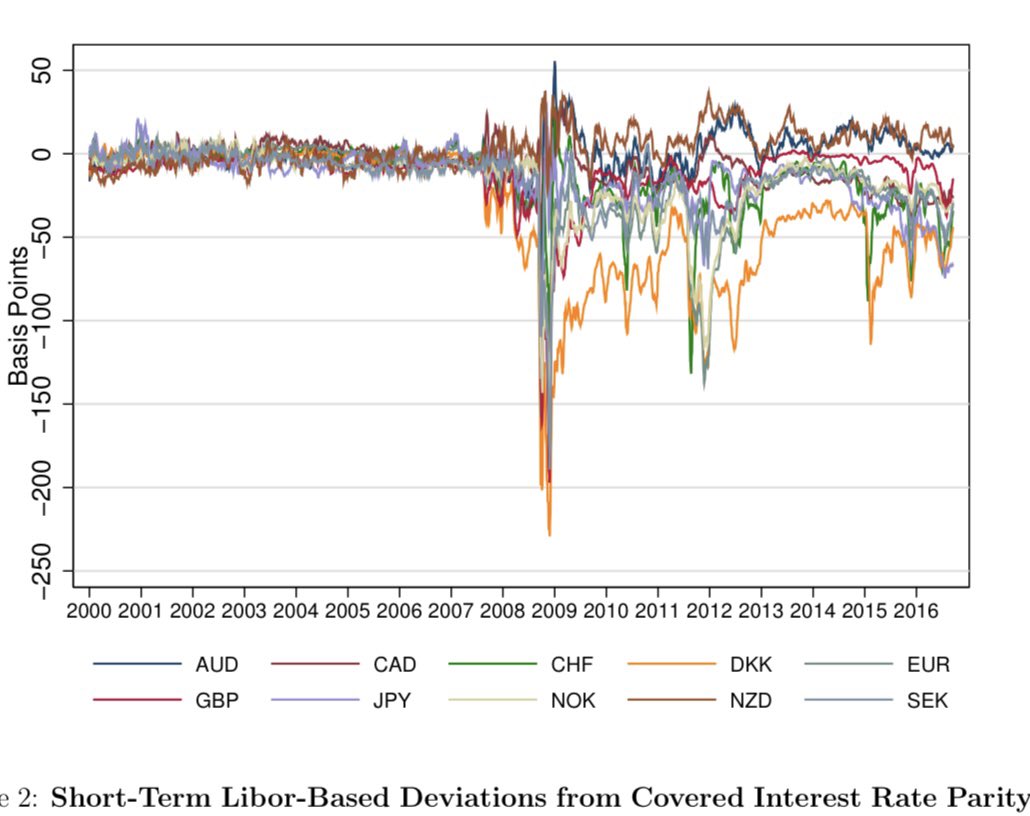
really striking figure. Deviations from CIP as measured by three-month cross currency libor bases are much larger post-GFC since tightened regulation made space on balance sheets scarce, pushing up hurdle rates
https://t.co/yuOKK8pS1X