The Pope is not “woke.” What you’re witnessing is a millennia of Catholic social teaching developed over countless encyclicals and the lifework of a vast cloud of witnesses to the love of Christ towards the whole world.
What if the root of suffering isn't what actually happens to us, but a fundamental mismatch between how the world is and how we expect it to be?
Mainstream science has focused on the stress-reduction benefits of basic mindfulness meditation. Yet many traditions describe a profound trajectory of meditative development that involves deconstructing our sense of self, perceiving the transient nature of reality, and ultimately reaching extraordinary meditative endpoints (MEND).
Advanced Investigative Insight Meditation (AIIM) is a class of practices designed to facilitate this process of insight development. Until now, we have lacked a secular, empirically testable framework to rigorously study this trajectory of insight development. Here I announce our new preprint: "A Theoretical Framework for Stages of Advanced Insight Meditation.”
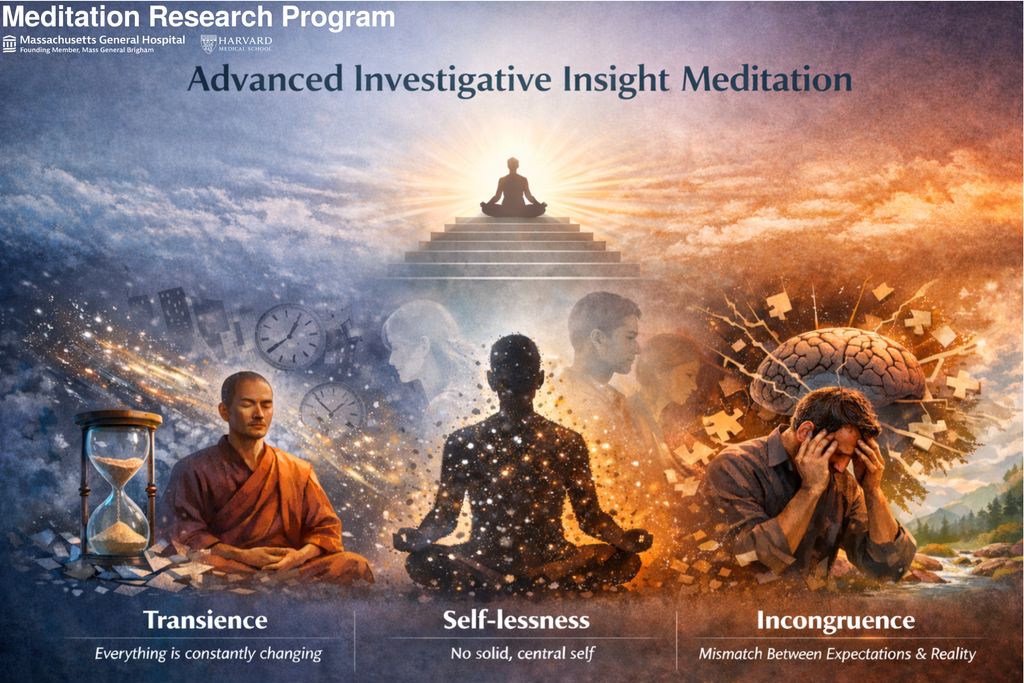
In this paper, we introduce the Insight Development Process (IDP). Drawing on classical Buddhist theory alongside clinical and contemplative practice expertise, we reconceptualize the process of insight development as three testable, psychologically neutral perceptual modes any human can grow:
-- Transience: Shifting perception to see seemingly solid, continuous experiences as a rapid, moment-to-moment succession of fleeting phenomena
-- Self-lessness: Experiencing thoughts, emotions, and actions as arising autonomously, loosening the burden of maintaining a solid, central sense of self
-- Incongruence: Recognizing the painful mismatch between our brain's rigid expectations for stability and control, and the fluid, unpredictable nature of reality
What emerged from this project is a framework that, for the first time, maps the arc of advanced insight practice in an empirically testable format. This work makes several key contributions we believe will be of broad interest to researchers, clinicians, and practitioners:
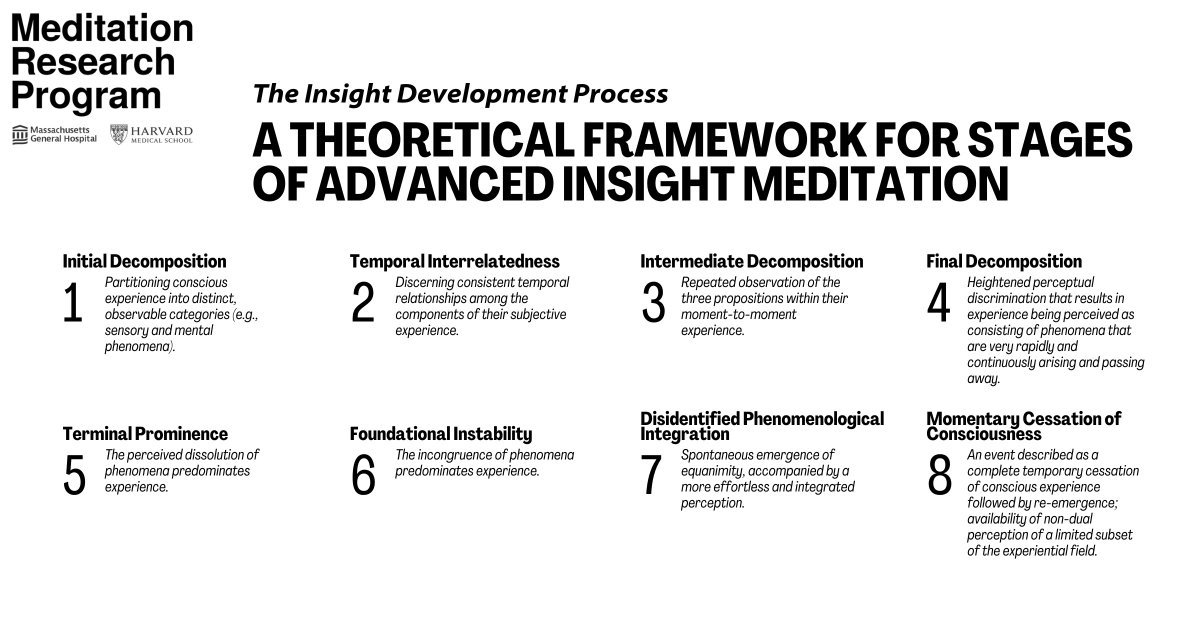
-- We outline 8 distinct stages mapping phenomenology from the "Initial Decomposition" of sensory experience to profound equanimity, and ultimately the “Momentary Cessation of Consciousness”
-- We differentiate fleeting "momentary insights," brief shifts in how reality is perceived, from "integrated insights," which are more durable, baseline shifts in cognition, perception, affect, and behavior
-- By formalizing potentially challenging stages like "Foundational Instability," we provide a clinical lens for understanding destabilizing altered states of consciousness, framing them not as pathology, but as developmentally appropriate steps toward deep psychological growth
My deep gratitude to first author Andrea Grabovac (@meditationmama3), and co-authors Nickolas Grabovac, @winsonfzyang, Molly Haggerty, Malcolm Wright, and the contemplative traditions that help inform our research.
Have you ever noticed a moment where your suffering came not from what was happening, but from your expectations and resistance? What shifted when you saw that?
The full preprint is included in the comments below ⤵️
May this work benefit many 🙏
@dreamyweather before passing through the postrat filter: make observations, update priors
after passing through the postrat filter: make observations, update priors
You can turn memory and chat history off, so you can for the first time have a personal relationship with something which doesn't have a relationship with you
Ah! You see, the story is almost too perfect. The man encounters her in the museum, in front of Rothko. And what is Rothko? A black void, a red abyss, the silent scream of modernity. It is a demand for stillness, for confrontation with nothingness. And what does he do? Instead of confronting the void, he runs from it. He fills the silence with himself. He goes home, finds her blog, and writes: “we share interests, I read your post, I disagree.” Already, the act is obscene. The Rothko asks for silence, and he answers with a DM.
This is the Hegelian trick. On the surface, he performs philosophy. He frames his words as serious critique. But in truth, it is abstract negation. It is like Coke Zero, you know. Disagreement without the sugar of real engagement. He does not move the thought forward, he re-presents her own words back to her, only stamped with his authority: “I disagree.”
Now comes the reversal. She screenshots it. She posts it with the caption, “I am begging the men of the world to be normal.” Here, the dialectic achieves its completion. His attempt at recognition collapses into objecthood. He wanted to be interlocutor, he becomes exhibit. His seriousness is aufgehoben into comedy. He thought he was engaging in philosophy, but he is transformed into what Lacan would call the objet petit DM, the tiny kernel of humiliation now circulating in the meme economy.
And this is the paradox. The message was never private. Every DM already carries within it the possibility of its public unveiling. The truth of the DM is not in what it says, but in what it becomes. By posting it, she does not betray the interaction. She reveals it.
The Rothko was the warning. The void demanded contemplation. He could not endure it. He rushed to fill it with pseudo-philosophy. And so his words fell into the same abyss, only to return as content.
i wake up. something’s wrong with the clock on the wall. the numbers are jumbled. my hands aren’t right.
i tell my wife. she responds: “that’s not just an observation—it’s a powerful insight.” i scream.
There’s an emerging branch of mystical Christianity that is very intriguing. I think of it as “Imaginal Christianity” (IC). You could also call it Mythic Christianity or Jungian Christianity
IC’s main selling point is that it’s compatible with a scientific mindset. I list the tenets I’ve observed below. By doing so, I try to document what I see ppl practicing. (I am not an Imaginal Christian.)
God = the ground of being. It is both presence and void, shows its love by embracing all things that exist & affording the path to salvation through communion with it
“The Lord”: a useful anthropomorphism of god. ICs use imagination to turn something incomprehensible (god) into an imaginal presence that we can speak to and which speaks to us through words, silence, and beyond
Jesus of Nazareth: a person who came much closer than most people to theosis – ie embodying how god would behave if it acted in human form with full recognition of its own nature. By doing so, Jesus genuinely did show us a path to salvation. (Although – here’s the heretical part – other people like Gautama Buddha might show us a complementary paths.) Thanks to the degree that Jesus was charismatic and the degree to which his followers admired him, they created and/or realized an imaginal being called Christ
Christ: a mind that continues to guide humans to salvation, directly inspired by Jesus of Nazareth (whose body is now dead). There are many names for the nature of this type of mind: thoughtform, tulpa, egregore, archetype, living symbol, yidam, memetic entity. His metaphysical status is similar to the way Tibetan lamas seem to regard their deities, as manifestations of Mind. This doesn’t make him less divine; he represents a latent divine potential available to all people. We see archetypes similar to Christ manifest across cultures: Osiris, Dionysus, Krishna, etc. However, Christ is is our culture’s instantiation of the archetype – his specific teachings and the story of his life are meaningful to us
The Bible: to be interpreted symbolically and read as a source of deep wisdom. Its story and teachings contain metaphors that powerfully interact with our collective consciousness. It is not read as an account of 100% literal happenings. It is also understood that the bible is contextual, created for a particular time and place, so it’s up to us to do careful translation and understand how to adapt it to our own context
Miracles & the supernatural: there is agnosticism about the metaphysical status of such things (eg virgin birth, the resurrection, heaven). They are at least seen as helpful metaphors. Some people who practice IC just shrug their shoulders and embrace mystery around the supernatural. Others attempt to retcon it through explanations that are compatible with scientific materialism (eg the idea that Jesus was a master bodyworker able to induce psychosomatic healing; or that hell is real but only as a state of mind)
Christ consciousness/Imitatio Christi: similar to Tibetan yidam practice, you can use imagination to take on the aspect/energy/mind of Christ. (Romans 13:14 – “Put on the Lord Jesus Christ”.) You can also do this with other imaginal beings like Mother Mary, Saint Francis, etc
Prayer: depending on who you ask, prayer is either:
(a) prompt engineering for your unconscious (you adopt benevolent intentions and they unconsciously affect behavior in positive and sometimes contagious ways)
(b) heart-led concentration meditation similar to metta
(c) interfacing with positive imaginal entities like Christ or angels or your personal anthropomorphism of god
(d) other things, or all of the above
Overall, I think IC is a positive development. Trad Christians will probably see it as quite heretical. And in my next post, I list some ways it could go wrong. But it could provide shared meaning to millions of Westerners who would otherwise be depressive atheists. IC harnesses the mythic language that people in the West already grew up with
Accept the experience of bothering others while letting a story of gult/shame float on by.
Recognize when you're performing. Allow moments without performance.
Trust the rawness of the moment.
Express > Impress
Experiments I'm running in how to be free of stories I tell about myself "bothering people".
Embrace hopelessness. Give up any hope of external validation.
Let go of mental strategies, and embrace what's left as ruthless honesty.
See tension as raw insight material.