We’ve raised $50M led by @dragonfly_xyz to go all in on RWAs and bring TradFi liquidity on-chain.
Today, we're launching Phase 1 of our RWA rollout to stress-test our infrastructure before bringing 100+ TradFi markets on-chain this summer.
Today is a monumentous day for quantum computing and cryptography. Two breakthrough papers just landed (links in next tweet). Both papers improve Shor's algorithm, infamous for cracking RSA and elliptic curve cryptography. The two results compound, optimising separate layers of the quantum stack. The results are shocking. I expect a narrative shift and a further R&D boost toward post-quantum cryptography.
The first paper is by Google Quantum AI. They tackle the (logical) Shor algorithm, tailoring it to crack Bitcoin and Ethereum signatures. The algorithm runs on ~1K logical qubits for the 256-bit elliptic curve secp256k1. Due to the low circuit depth, a fast superconducting computer would recover private keys in minutes. I'm grateful to have joined as a late paper co-author, in large part for the chance to interact with experts and the alpha gleaned from internal discussions.
The second paper is by a stealthy startup called Oratomic, with ex-Google and prominent Caltech faculty. Their starting point is Google's improvements to the logical quantum circuit. They then apply improvements at the physical layer, with tricks specific to neutral atom quantum computers. The result estimates that 26,000 atomic qubits are sufficient to break 256-bit elliptic curve signatures. This would be roughly a 40x improvement in physical qubit count over previous state-of-the-art. On the flip side, a single Shor run would take ~10 days due to the relatively slow speed of neutral atoms.
Below are my key takeaways. As a disclaimer, I am not a quantum expert. Time is needed for the results to be properly vetted. Based on my interactions with the team, I have faith the Google Quantum AI results are conservative. The Oratomic paper is much harder for me to assess, especially because of the use of more exotic qLDPC codes. I will take it with a grain of salt until the dust settles.
→ q-day: My confidence in q-day by 2032 has shot up significantly. IMO there's at least a 10% chance that by 2032 a quantum computer recovers a secp256k1 ECDSA private key from an exposed public key. While a cryptographically-relevant quantum computer (CRQC) before 2030 still feels unlikely, now is undoubtedly the time to start preparing.
→ censorship: The Google paper uses a zero-knowledge (ZK) proof to demonstrate the algorithm's existence without leaking actual optimisations. From now on, assume state-of-the-art algorithms will be censored. There may be self-censorship for moral or commercial reasons, or because of government pressure. A blackout in academic publications would be a tell-tale sign.
→ cracking time: A superconducting quantum computer, the type Google is building, could crack keys in minutes. This is because the optimised quantum circuit is just 100M Toffoli gates, which is surprisingly shallow. (Toffoli gates are hard because they require production of so-called "magic states".) Toffoli gates would consume ~10 microseconds on a superconducting platform, totalling ~1,000 sec of Shor runtime.
→ latency optimisations: Two latency optimisations bring key cracking time to single-digit minutes. The first parallelises computation across quantum devices. The second involves feeding the pubkey to the quantum computer mid-flight, after a generic setup phase.
→ fast- and slow-clock: At first approximation there are two families of quantum computers. The fast-clock flavour, which includes superconducting and photonic architectures, runs at roughly 100 kHz. The slow-clock flavour, which includes trapped ion and neutral atom architectures, runs roughly 1,000x slower (~100 Hz, or ~1 week to crack a single key).
→ qubit count: The size-optimised variant of the algorithm runs on 1,200 logical qubits. On a superconducting computer with surface code error correction that's roughly 500K physical qubits, a 400:1 physical-to-logical ratio. The surface code is conservative, assuming only four-way nearest-neighbour grid connectivity. It was demonstrated last year by Google on a real quantum computer.
→ future gains: Low-hanging fruit is still being picked, with at least one of the Google optimisations resulting from a surprisingly simple observation. Interestingly, AI was not (yet!) tasked to find optimisations. This was also the first time authors such as Craig Gidney attacked elliptic curves (as opposed to RSA). Shor logical qubit count could plausibly go under 1K soonish.
→ error correction: The physical-to-logical ratio for superconducting computers could go under 100:1. For superconducting computers that would be mean ~100K physical qubits for a CRQC, two orders of magnitude away from state of the art. Neutral atoms quantum computers are amenable to error correcting codes other than the surface code. While much slower to run, they can bring down the physical to logical qubit ratio closer to 10:1.
→ Bitcoin PoW: Commercially-viable Bitcoin PoW via Grover's algorithm is not happening any time soon. We're talking decades, possibly centuries away. This observation should help focus the discussion on ECDSA and Schnorr. (Side note: as unofficial Bitcoin security researcher, I still believe Bitcoin PoW is cooked due to the dwindling security budget.)
→ team quality: The folks at Google Quantum AI are the real deal. Craig Gidney (@CraigGidney) is arguably the world's top quantum circuit optimisooor. Just last year he squeezed 10x out of Shor for RSA, bringing the physical qubit count down from 10M to 1M. Special thanks to the Google team for patiently answering all my newb questions with detailed, fact-based answers. I was expecting some hype, but found none.
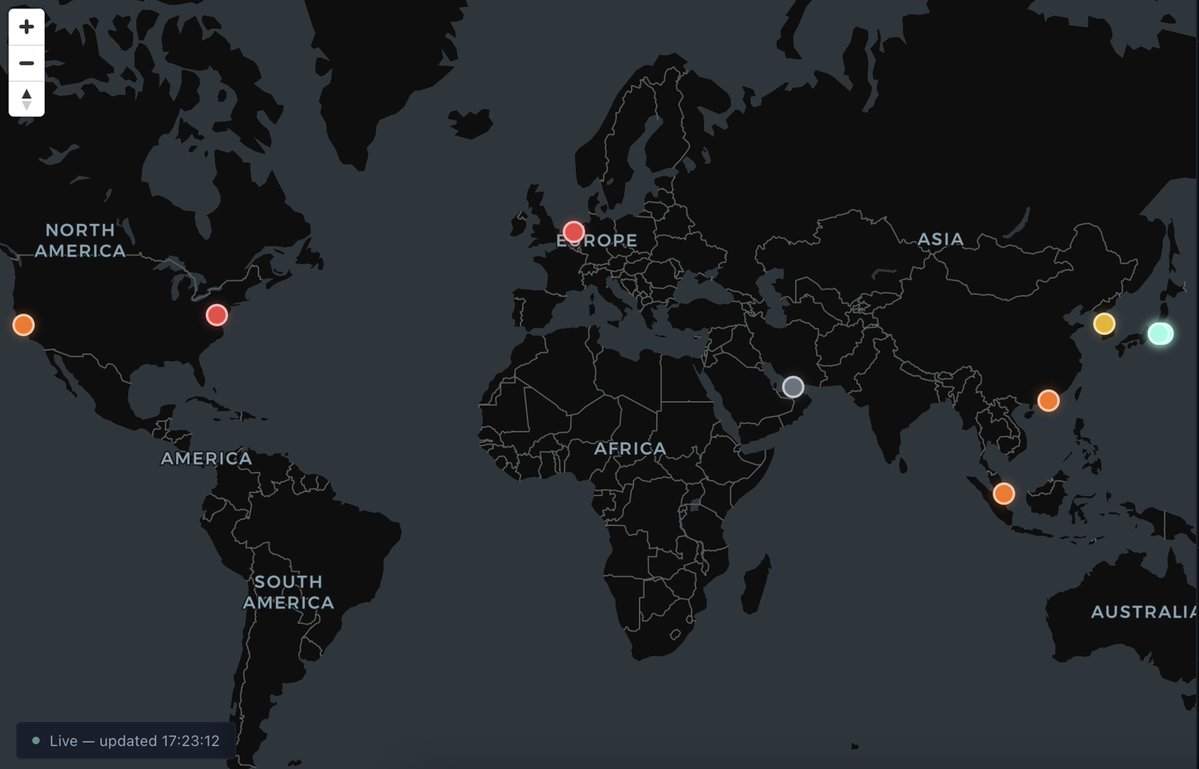
Tokyo is pinging the Hyperliquid API in ~3ms. Amsterdam is sitting at ~221ms. Distance is a tax on your execution. We just deployed a live map of global probes tracking API and direct validator latency to Hyperliquid in real-time: https://t.co/9SwI8ErLeb
🇯🇵 Tokyo: ~15.9ms
🇰🇷 Seoul: ~50.2ms
🇭🇰 Hong Kong: ~66.9ms
🇸🇬 Singapore: ~136.1ms
🇺🇸 Virginia: ~163.5ms
🇳🇱 Amsterdam: ~245.2ms
TERAFAB: the next step to becoming a galactic civilization
Together with @SpaceX & @xAI, we're building the largest chip manufacturing facility ever (1TW/year) – combining logic, memory & advanced packaging under one roof.
To harness as much power as possible from the Sun, we need to send 100 million tons of solar capture into space – per year.
This requires massive scale.
– Capability to launch millions of tons of mass into orbit
– Solar-powered AI satellites
– Millions of @Tesla_Optimus robots to help build it out
All of these need chips: 100-200GW of chips for Optimus alone, plus terawatts for solar-powered AI satellites.
That's more than all the chip manufacturers in the world combined can provide today, or even by 2030 (based on projected production growth).
We're building TERAFAB to close the gap between today’s chip production & the future's demand – a future among the stars
https://t.co/tHumlppgMm
Huge congratulations to TradeXYZ and S&P for this historic partnership. I'm honored that these teams choose to build on Hyperliquid.
Seeing official S&P500 perpetual futures launch exclusively on Hyperliquid is a validation of everyone's past years of hard work: global access to decentralized finance, perpetual futures as 24/7 price discovery, and Hyperliquid upgrading the existing financial stack to house all of finance.
The S&P500 is synonymous with "the market," a single number that captures the essence of the largest economy in the world. Looking forward to tracking the world's most important financial gauge 24/7 on the most liquid permissionless markets.
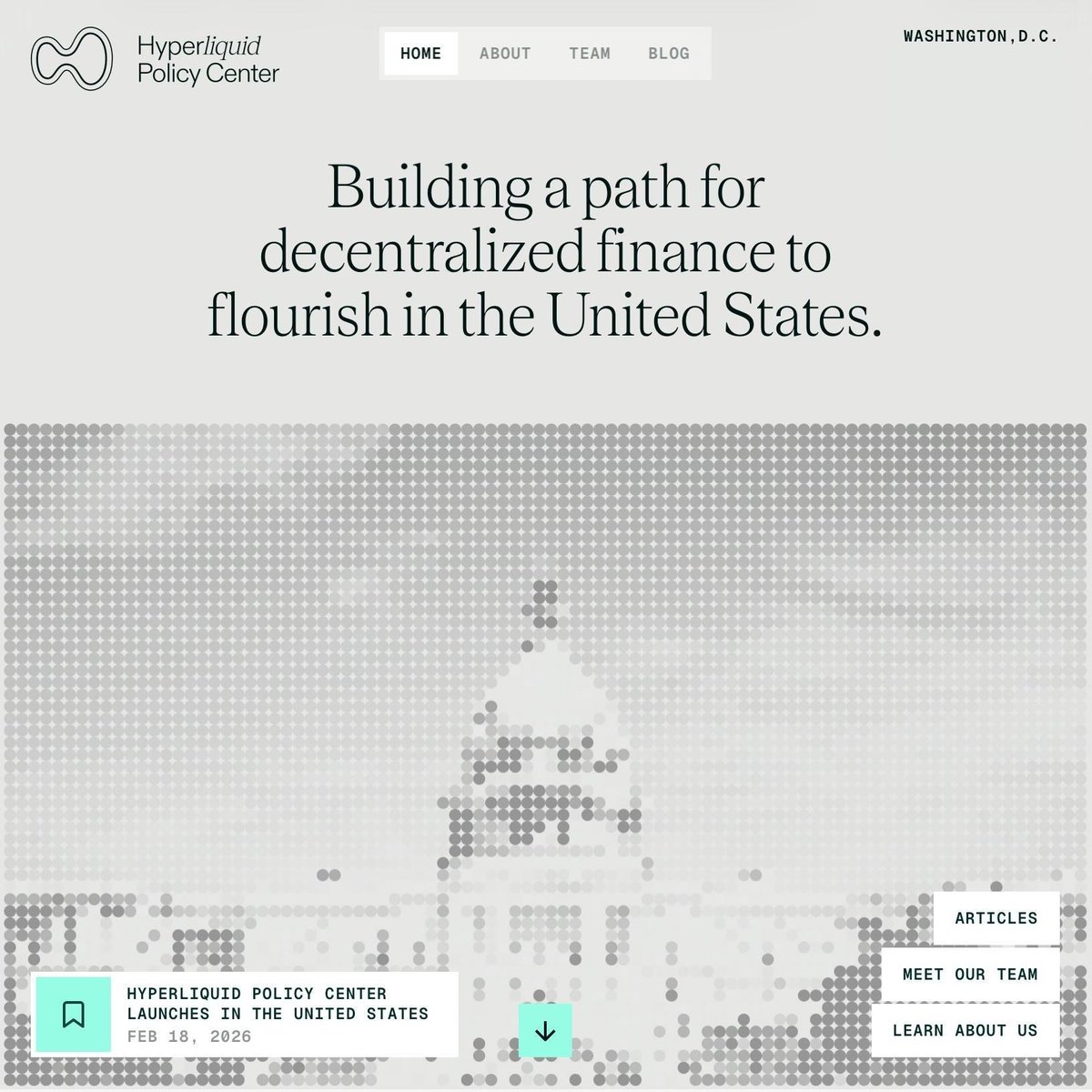
We are Hyperliquid Policy Center.
HPC is a research and advocacy nonprofit focused on advancing a clear path for decentralized finance to thrive in the USA.
We will introduce policymakers to @HyperliquidX and bridge the gap between law and next-generation market infrastructure.
Peter Steinberger is joining OpenAI to drive the next generation of personal agents. He is a genius with a lot of amazing ideas about the future of very smart agents interacting with each other to do very useful things for people. We expect this will quickly become core to our product offerings.
OpenClaw will live in a foundation as an open source project that OpenAI will continue to support. The future is going to be extremely multi-agent and it's important to us to support open source as part of that.
Up to 65% off Higgsfield Black Friday offer EXTENDED for 3 more days!
With a new drop coming soon 🍌
For 9 hours: retweet & follow & like & comment for 300 FREE credits!!!
Last week, @KinetiqFND announced KNTQ, the governance token for the Kinetiq protocol.
As a reminder, the deadline to review and accept the Kinetiq Foundation Terms of Use is November 21st, 2025 at 20:00 UTC.
Heavily KNTQ coded.
Kinetiq has become the fastest growing liquid staking protocol of all time, and has become an omnipresent, synergistic force for users and protocols of every kind on Hyperliquid.
Kinetiq delivers native liquid staking and institutional-grade liquidity primitives built exclusively for Hyperliquid. This allows builders and users of every caliber to stay staked and help secure the network while retaining full liquidity to deploy seamlessly across both HyperCore and HyperEVM.
Therefore, the Kinetiq Foundation has been established to accelerate the growth of the Kinetiq protocol and decentralized finance on Hyperliquid.
With kHYPE, along with the Earn vault in collaboration with @veda_labs, and the largest institutional offering for Hyperliquid staking with iHYPE –– Kinetiq has defined what can be done within Hyperliquid DeFi, and is in endless pursuit of making HYPE the perfect money lego, across the entire suite.
As HyperEVM completes the unified execution layer by being attached directly to the most performant and completely onchain exchange, any application on Hyperliquid can swiftly tap into Kinetiq’s composable offerings, such as liquid staking through kHYPE, or the best risk-adjusted returns on HYPE with Earn, and soon... beyond.
Kinetiq's next step is the genesis of its native governance token, KNTQ.
Users must review and accept the Kinetiq Foundation Terms of Use at https://t.co/HH7ksGalzf before November 21st, 2025 at 20:00 UTC, in order to participate in the KNTQ genesis event.
Further details will be shared after the closure of the Kinetiq Foundation Terms of Use.
Impossible is proud to be an Official Partner for @flyingtulip_ 's Early Access Public Sale!
Highlights
- You will get allocation with the SAME terms as Seed Round investors
- 100% principal protection
- 100% unlock on TGE
- ZERO team tokens unlocked at launch. Team's success is 100% tied to the protocol's performance and revenue-driven buybacks.
- No Inflation. The supply can only decrease.
📣 Sale details to be announced in the coming few days📣
If you want to secure allocation during the whitelist phase, submit your request here:
https://t.co/cH3yjTiOYz
P.S. no your eyes are not deceiving you. We’ve rebranded and are now called Impossible. It’s our bold step forward to deliver even more value to our ecosystem participants starting with @AndreCronjeTech 's unified, execution-aware DeFi platform.
[ ZOOMER ]
NAVER, ONE OF SOUTH KOREAS LARGEST CORPORATIONS, TO ACQUIRE UPBIT AND INTEGRATE IT INTO A "SUPER-APP" FOR TRADING, PAYMENTS AND DAILY LIVING: DONGA