This Canadian woman was given MAID as her only choice for stage 4 cancer in Deathcare Canada. She went to the US and death was not the option the doctors there gave her.
Canadian healthcare used to be good, it is now in desperate fear of collapse. They're bringing in doctors who did not study in Canada and whatever else that entails.
I find the healthcare in the US unquestionably superior. Health insurance is the same since I don't pay income tax in Florida, I pay it on insurance. There is immediate, private healthcare if you need it.
Medically assisted suicide is not an option they offer.
@aphysicist Anti AI movement is becoming a sibling to the green movement.
Decelers are irrationally anti and accelers are pro.
Liberals are anti and conservatives are pro.
Also yet another reason for some to block highways and glue themselves to old paintings 🙄
‼️ Chinese spy in Detroit again ‼️
Sep 11: Federal prosecutors in Detroit charged 🇨🇳 national Di Jin, aka Sophie Jin and Xin Sui, who is portrayed as working for 🇨🇳 MSS while meeting with current and former US government officials, the latest in a series of counterintelligence cases that have raised national security concerns.
Jin, a resident of Tianji in China, was charged with acting as an agent of a foreign government without notifying the US attorney general. If convicted, she faces up to 10 years in federal prison.
The FBI counterintelligence case involves lies, an airport confrontation and claims that Jin was working for the Chinese government while trying to meet with current and former US government officials.
“.. Jin ultimately admitted that she had conducted intelligence gathering work in the United States on behalf of (Chinese) intelligence officials who, in turn, allegedly assisted her with her business interests in China.”
Jin, the general manager of Tianjin Smart City Technology Co Ltd, has entered the US on B1/B2 temporary visitor visas at least 7 times since 2013.
𝗪𝗵𝘆 𝘁𝗵𝗲 𝗴𝗼𝘃𝗲𝗿𝗻𝗺𝗲𝗻𝘁 𝗰𝗵𝗮𝗿𝗴𝗲𝗱 𝘁𝗵𝗲 𝗖𝗵𝗶𝗻𝗲𝘀𝗲 𝗻𝗮𝘁𝗶𝗼𝗻𝗮𝗹
The case against Jin emerged Sep 8 when she tried to enter the US at Detroit Metropolitan Airport. She told customs officials she planned to meet an 81-year-old friend in Washington, D.C., a former US government official referred to in court filings as "Government Contact 1." The official, however, told investigators he was unaware of her travel to the US.
However, Government Contact 1 also indicated that he believed Jin may potentially be an informer” to the Chinese government.
During additional questioning, Jin told investigators she owned two unprofitable companies that she funded by earning fees for connecting politicians and officials to businesses. During her visit, Jin said she planned to meet the government contact and take photos on the street.
But FBI agents had reviewed a message she sent to the government official in April indicating: “Xi’s team just came to (her)” about topics that included procurement, rare earth metals, US Treasury bonds, trade mechanisms and tariff exemption for billions of dollars of non-sensitive goods.
The court filing does not elaborate, and it is unclear if "Xi's team" was a reference to Xi Jinping.
Amid further questioning, Jin told investigators that officials with a think tank that she believed was tied to the Chinese government asked her to travel to Washington to gather unspecified information.
“She said she had reported previous US trips to this 'think tank' through a Chinese contact who used a fake name and told her to delete their messages before travel, which she did a few days before this trip.”
Jin later told agents she had been approached by local intelligence officials with 🇨🇳 MSS as early as 2012.
"Around that time, she had been a participant in a pilot training program in Los Angeles. Jin stated that 🇨🇳 MSS intelligence officers directed her to obtain information from a specific event in the United States and to provide the information to the MSS when she returned to" China.
𝗗𝗲𝗳𝗲𝗻𝗱𝗮𝗻𝘁 𝗰𝗹𝗮𝗶𝗺𝘀 𝘀𝗵𝗲 𝗴𝗼𝘁 𝘀𝗽𝘆𝗶𝗻𝗴 𝗶𝗻𝘀𝘁𝗿𝘂𝗰𝘁𝗶𝗼𝗻𝘀
Jin said she met with intelligence officers in Shanghai in 2024. They sent her to the US later that year to meet with two government contacts and two former US government officials.
“Prior to her departure from (China), Jin stated she met with Shanghai intelligence officers in Shanghai and received directions to obtain information related to Chinese and US relations from her four contacts.”
"Jin stated the Shanghai intelligence officers provided her a cover story if she was questioned while in the United States. They instructed her to state she worked with a 'think tank' in Beijing."
Investigators searched Jin's 3 cell phones this past week and found messages with at least two of the US government contacts.
1/n
https://t.co/c1ohXSA0bU
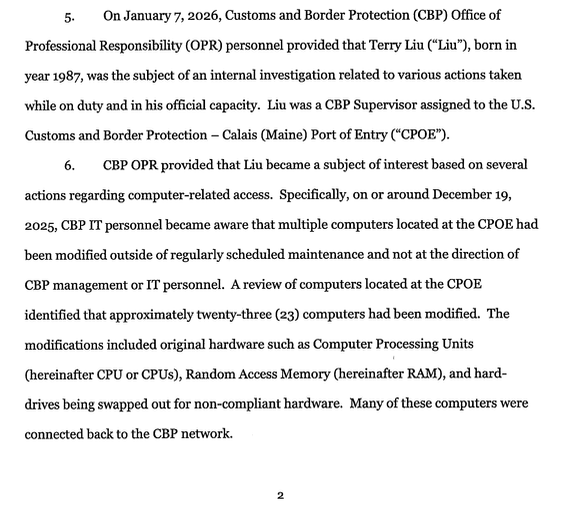
BREAKING: Terry Liu, the Chinese national arrested this week in Maine, has been charged with illegally modifying the hardware of Customs and Border Patrol computers at the Maine-Canada border.
Liu, who described himself as a native of Guangzhou, China, was caught on camera breaking into CBP computers and replacing processors and memory devices before re-inserting them into government networks.
More details to come...
The Intelligence Value of a Plane Spotter
A Chinese university student studying in Canada is in U.S. custody after the FBI says he admitted taking photographs of aircraft and airport facilities for someone he believed worked for a Chinese security service.
Weiheng Zeng, a Chinese citizen and undergraduate at the University of Waterloo, was arrested in Michigan on Aug. 23 after crossing into the United States from Canada. He is charged with making false statements. The allegations have not been proven in court, but the FBI complaint describes something much more interesting than a student who simply liked photographing airplanes.
According to investigators, Zeng was being paid to photograph specific aircraft, capture their tail numbers and photograph airport logistics facilities.
The case began on April 21, when FedEx employees at Chicago O’Hare International Airport noticed Zeng photographing aircraft in a company parking area. Security footage allegedly showed him climbing onto a forklift to get a better angle and trying to open a locked FedEx truck and shipping container. When he attempted to re-enter the United States in August, border officers found numerous photographs of military aircraft on his phone.
Zeng initially told investigators that aviation photography was a hobby. According to the FBI, he later admitted that a contact in China was paying him to photograph particular aircraft and their tail numbers. Zeng said he believed the individual worked for a Chinese security service.
Taking pictures of airplanes is not intelligence collection by itself. But if someone is telling you which aircraft to photograph, which information to capture and which facilities to visit, that starts to look very different. According to the FBI account, Zeng was allegedly being given specific collection requirements rather than simply photographing whatever interested him.
The way they allegedly communicated is also notable. The FBI says the contact mailed Zeng a new China Telecom SIM card every four to five months for use in a Huawei phone. Zeng was allegedly instructed to destroy the SIM cards, delete their conversations and delete the photographs after transmitting them. Payments were reportedly made through bank transfers in Chinese yuan.
The collection itself was simple. The handling of the collector appears to have been much more deliberate. The activity was not limited to Chicago. Zeng allegedly told investigators that the same contact directed him in October 2025 to photograph a FedEx facility at Toronto Pearson International Airport. He was confronted by an employee before getting inside, but reportedly sent the photographs he was able to take and received about $200.
None of the individual requirements sounds especially sophisticated. Photograph an aircraft. Get the tail number. Photograph a logistics facility. But put enough of those pieces together over time and you can begin identifying aircraft movements, recurring patterns, locations and logistics activity.
The collector does not necessarily have to understand why one aircraft or one facility matters more than another. He just has to collect what he was asked for and send it back.
China’s interest in aviation information is not new. Previous U.S. cases have involved Chinese intelligence officers targeting aviation personnel and seeking information connected to military and civilian aircraft and aerospace technology. That does not tell us who Zeng’s alleged contact was or prove that his case was part of a larger operation, but it helps explain why information that looks fairly routine could still have intelligence value.
Zeng was not a diplomat, defense contractor or intelligence professional. He was a university student interested in aviation, which gave him a natural reason to be around airports with a camera.
From a counterintelligence standpoint, the concern is not the camera or the hobby. It is the specific tasking, payment, repeated collection and instructions to hide the relationship. That is what changes the picture.
You do not need someone inside a classified program to collect useful intelligence. Sometimes you just need someone who can get close enough, blend in and bring back exactly what you asked for.
@spacanpanman@spacanpanman do you think ASTS sat coverage will be included by default in the MNO subscription plans? Or offered as an add on (where customer convincing will be needed)?
@nicolasfulghum This is misleading. California has shutdown large portion of non-green power generation and started buying electricity from neighboring states to cover the gap.
At the end non-green vs green power consumption hasn’t changed much. But electricity got much more expensive.