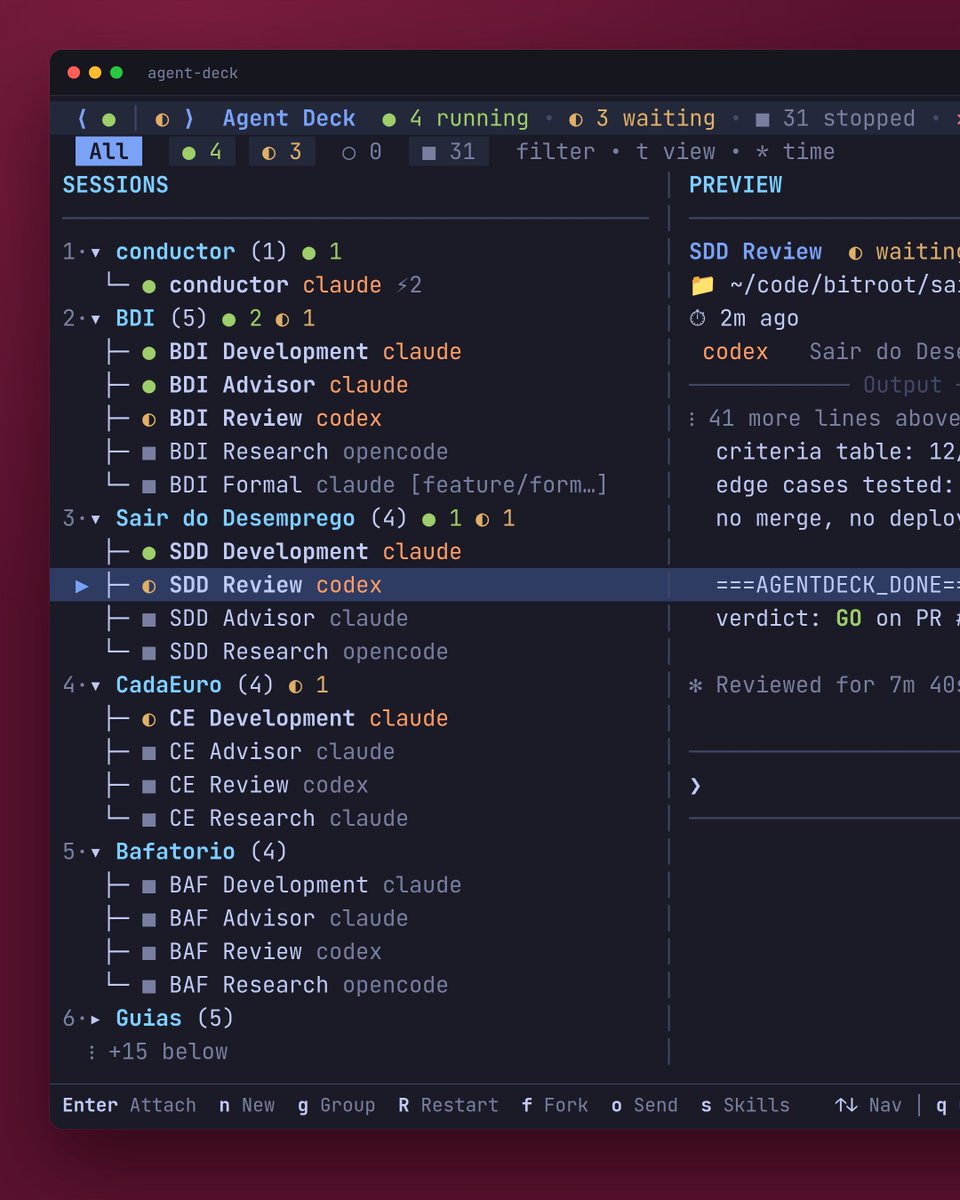
Same idea, but in mine the "slot" is me. Each agent works in its own git worktree, so building in parallel never collides. Merges and deploys wait for my final GO, after Review and the Advisor. That makes them one at a time without a lock. It's slower, but I always know what's in main and in staging. Does your controller also decide the merge order, or is it first come, first served?
This is how my coding agents work today.
I run them with agent-deck. One Claude Code session acts as the coordinator. It manages 38 sessions across 14 projects.
Every project gets the same team. Development writes the code and opens the PR. Review checks it and answers GO or NO-GO. Advisor writes the spec before the work starts and settles disputes. Research gathers what the others need.
Review runs on Codex, a different model from the one that wrote the code. A reviewer on the same model tends to miss the same things.
Review gets a fixed list of criteria and a fixed test table. "Check if it looks good" led to endless rounds of NO-GO. Closed criteria ended them.
No agent merges or deploys to production. I give that order myself, after I read the infrastructure diff.
The coordinator keeps its memory in files, so it survives context resets. When a lesson repeats three times, it becomes a rule in its policy.
The script from my last post watches all of this and pings my iPhone when a session needs me.
If you run coding agents in production, how do you handle review?
A Codex GO isn't the last gate. The Advisor reviews the PR again before anything ships, and I give the final GO after that. When a bug gets past all of us and turns up later, in a smoke test, a cross-review or real use, it goes back to the Advisor. The case it missed becomes a regression test that every review has to pass from then on. The criteria get updated by hand, on purpose. A list that grows on its own fills up with nitpicks.
@jorgjansen Indeed. We had a PR going back and forth on NO-GOs because the criteria were open. The advisor turned them into a fixed test table, and review stopped going in circles.
@ChalithaWi The advisor wins. Review only checks against the advisor's criteria, so usually there's nothing to disagree on. A finding outside the criteria doesn't block, it gets logged. Two NO-GOs on the same PR go back to the advisor, and it decides.
@acudell It doesn't keep them in context. The coordinator mostly checks a status summary with counts per state, and only opens a session when it needs input. Finished sessions report back through a queue it empties. Before a /clear, it writes a handoff note and reloads from that.
They really just got on stage and said this newly designed 4000+ pound car can do flips and go half the speed of sound (380+mph) and will ship in 2028. This is a prank, right?
yeah, software is kinda solved. i reverse engineered gen 1 apple tv remote in ~45 minutes?
it runs on linux over bluetooth, open source
https://t.co/6dqou2TpVZ
Is it just me, or is Opus 5.5 burning through the weekly usage limit much faster lately?
The weekly percentage seems to drop a lot quicker than it did when I first started using it.
Anyone else noticing this?
We're releasing HeyGen Video, built for businesses that need production-quality video without production-level costs.
Pricing starts at $0.01/s through October (50% off)
Built on @Minimax_AI H3, post-trained by HeyGen.
Learn more: https://t.co/O7LDjVOlqH