In addition to enterprises pushing to better understand token costs, I think the consumer models (I use many) are "trying less hard" recently. Meaning, trying to do answer without web search. Angling to give up sooner. I have to believe this is a result of cost optimization.
The same country that put humans on the Moon in 1969 now takes an average of 4.5 years to approve major infrastructure permits.. longer than it took to build the Panama Canal.
Transmission lines average 10 years from permitting to completion. The bottleneck to abundance is not technology, but BUREAUCRACY!
@PhilipJohnston "...batteries to store that energy when the sun's not there"
You may want batteries for other reasons, but if the sun's not there we have a whole slew of more important problems...
you are $300 away from a factory
one of my favorite customers started a 200 employee fab shop with $300
he bought a welder off fb marketplace, started welding stuff for friends, and grew the business 7 years later to where he was doing work for the primes
yes having a welder in your garage is a factory
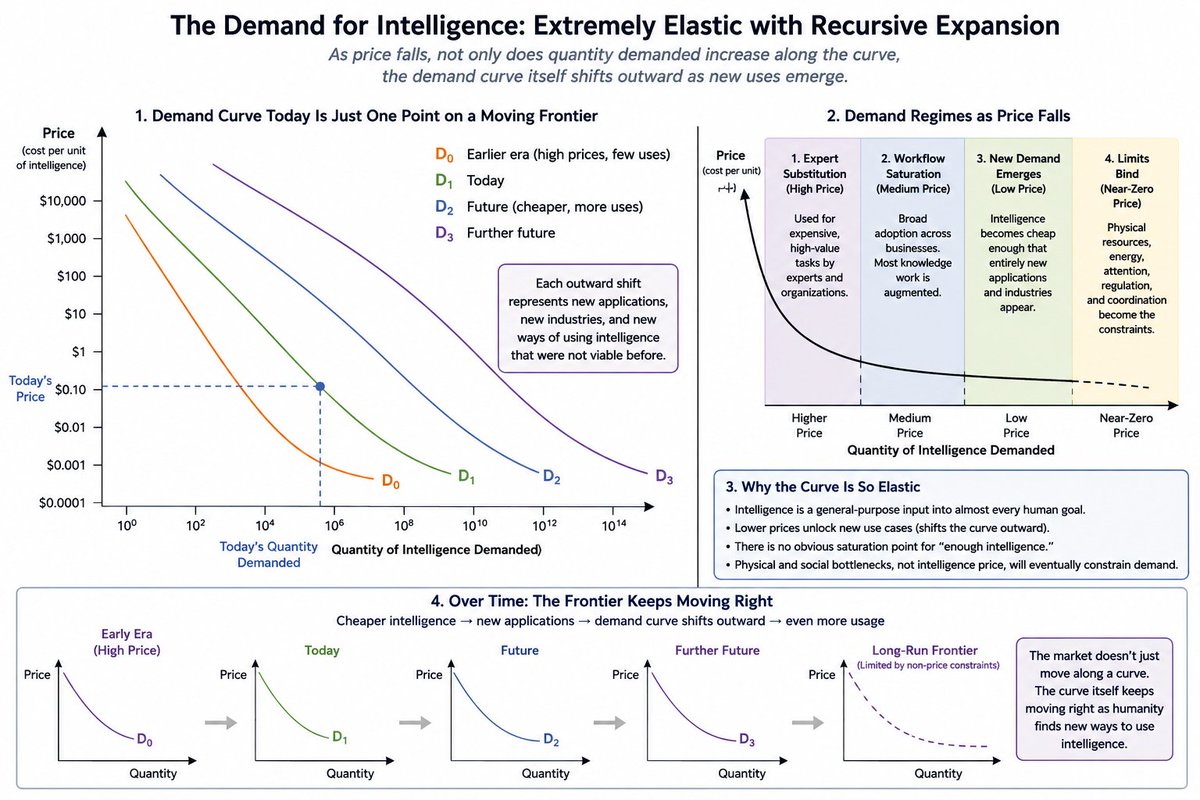
In all of human history, has there ever been a commodity with infinite demand, as there appears to be for intelligence? I can't think of one. Even compute, energy or just silicon/sand are just downstream of intelligence, which is the main demand driver.
In economics, rather than modeling the usual price/demand curve to reach an equilibrium, perhaps you'd have to model price/*rate of demand growth* (ie, the derivative of demand, or some other indicator of velocity)
Interestingly, ChatGPT (below) prefers the framework of "recursive expansion of demand" as increasing intelligence opens new applications/markets.
But the end result is the same -- the demand curve keeps moving to the right, maybe forever.
Which I think is unprecedented.