Another thing:
The built-in delegation mechanism enables the liquid staking solutions to use the existing validator set, and since staking is risk-free (no slashing), subjective curation is not/less needed.
Obviously, the liquid stakers still need to trust that solution.
Another thing:
The built-in delegation mechanism enables the liquid staking solutions to use the existing validator set, and since staking is risk-free (no slashing), subjective curation is not/less needed.
Obviously, the liquid stakers still need to trust that solution.
For example, Chia separates block production from pooling and uses an already decentralized resource as a sybil control mechanism. The result is astonishing.
https://t.co/lLDJpHjlxS
If you ask a BTC maxi to point out the centralization in Ethereum he will give you an autistic answer that doesn't resonate with normies.
This will change after the merge.
Months ago:
$ETH will be ultrasound money and Ethereum will the be the settlement layer of crypto. No one can stop the flippening 🚀🚀
Now:
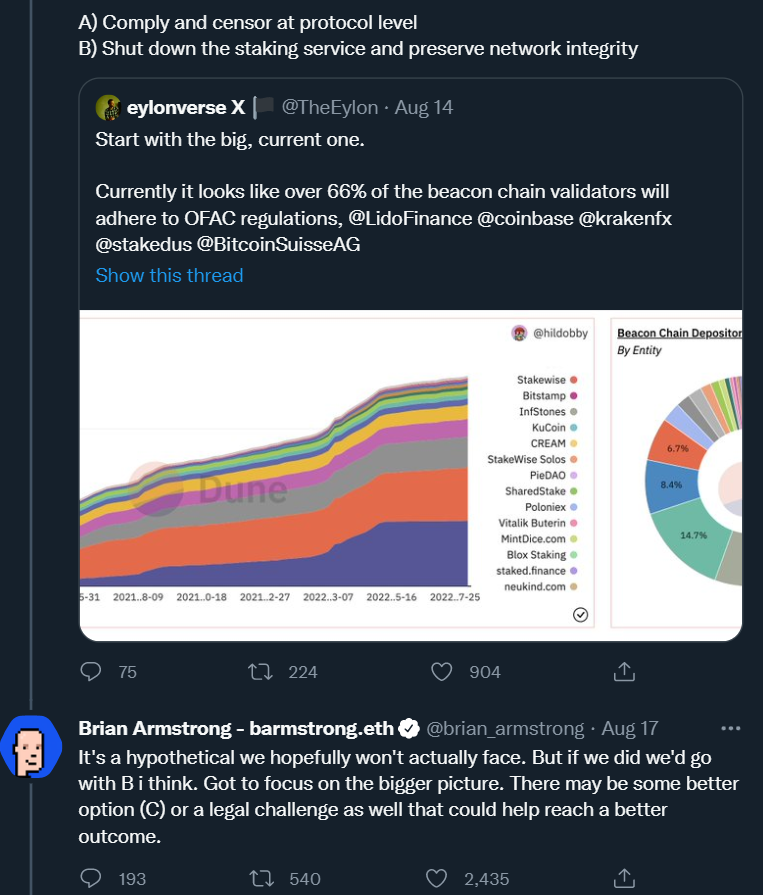
pls put X 🏴 in your display name to protect ethereum
https://t.co/T6ybgdLBUf
For many years, ETH clowns like @apolynya claimed that tech doesn't matter, new L1s are a waste of time, ..etc
Now they have to beg CEOs on Twitter to not censor their chain because their tech is garbage.
@technocrypto You also have the "problem" in PoS that the address by which you fund your stake can be doxxed retroactively and there's a permanent on-chain record of what you did with your signature. As a hasher in some mining pool, it's off-chain (noted, I'm conflating some concepts here)
Privacy at the base layer create other problems (arguably worse).
It's possible for a protocol to be censorship-resistant without having base layer privacy.
https://t.co/9xrHkZz6mb
Welcome to "censorship-resistance" when you don't have default base layer privacy 🙃
If miners can see what a transaction is (especially if it's opting into privacy) expect this sooner rather than later.
And yes, this is a huge potential threat to #Bitcoin as well.
Avalanche scales to tens thousands of validators, finalizes immediately and has some feature that mitigate centralization from liquid staking.
https://t.co/egtTyYJURy
Another thing:
The built-in delegation mechanism enables the liquid staking solutions to use the existing validator set, and since staking is risk-free (no slashing), subjective curation is not/less needed.
Obviously, the liquid stakers still need to trust that solution.
@HuobiGlobal Huobi continued to sell HUSD high-yield products until recently, despite knowing that the issuer was experiencing liquidity problems. Crypto's Moral Hazard.
https://t.co/Ftzu739bXF
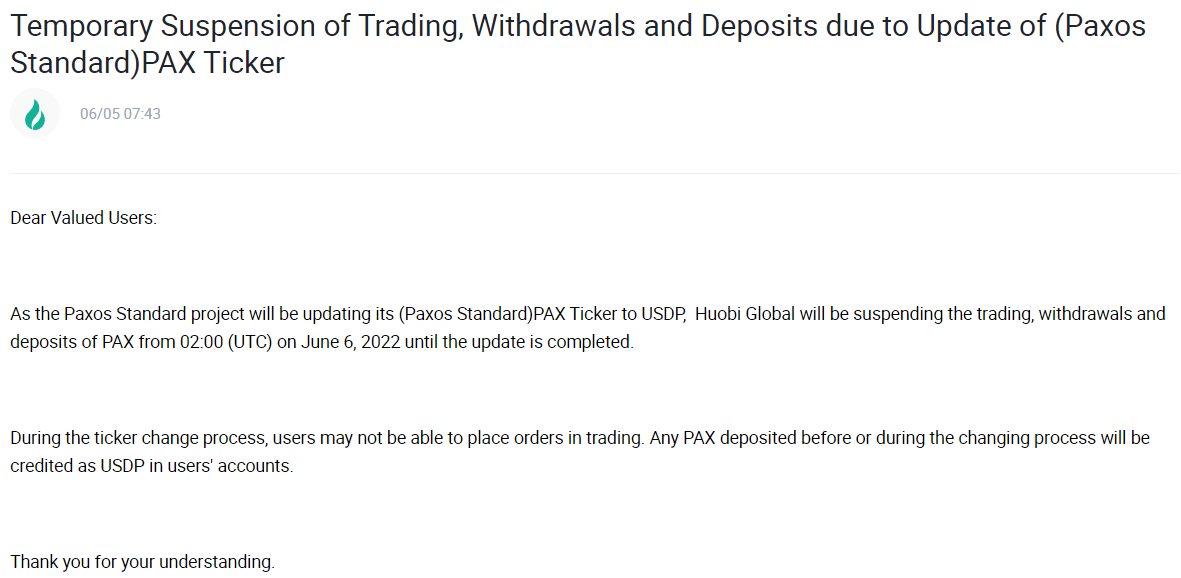
A couple of month ago I contacted @TheBlock__ and other crypto news sites to investigate Huobi for insolvency after they froze $USDP (Paxos USD) for bogus reasons, but of course there was no response.
https://t.co/s7eMxwhkEH
We are aware of the current liquidity issues associated with the HUSD stablecoin, which is issued by Stable Universal Limited and built on the Ethereum network.
@TheBlock__ $USDP eventually got unfrozen after a month. My guess is they were using user funds to buy more time. Now it looks like they decided to sacrifice $HUSD to save the exchange.