We optimized DeepSeek-V4.1-Flash on vLLM for Vera Rubin NVL72 and reached 58× the throughput of GB300 NVL72 at 1.7 million tokens/s/GPU and 387 tokens/s/user on SemiAnalysis AgentX.
Across the curve:
🔹 2.52 million tokens/s/GPU at peak throughput (2.7× GB300)
🔹 1.7 million tokens/s/GPU at P90 387 tokens/s/user (58× GB300)
🔹 1,810 tokens/s at one concurrent session with TP
1/4
Introducing *Switch*: a *harness framework* for *decision models* like Jev
I looked for this the other day and was surprised to not find anything like it
You obviously cannot use a decision model like an LLM in a coding agent harness like @pidotdev, because Jev cannot generate tool calls
But what if there was a framework that "generated the tool calls" for it programmatically, and Jev only had to pick out of that finite set of choices
That is what switch does. You pick a "domain" to implement the decision model in, and it provides a core API to define your state, and the functions that will derive decision model questions out of that state. Chess is a domain, as well as being a rubric judge for evals
It basically standardizes what I imagine a lot of people are already vibe-coding, to an abstract interface: calling a decision-model API through multiple steps, i.e. an agent loop over finite choices
Because of the finiteness of the output of a decision model, you cannot have a general pure decision model harness. Instead, you need to implement specific ones that generate the choices programmatically (or have an LLM generate the choices, but I find the former more interesting)
A primary use case I have for this is use as a judge in an eval. For example, At the end of a task run that involves a bunch of documents, most people currently follow this approach: extract text out of PDF/docx/md files, and dump them right into the context
But what if the visual formatting of the output is a judging criterion? Then you have to dump an image of every page in the input state. But what if you have 200 pages, and your question does not need looking at all of them? What if Jev could navigate through the haystack and find the info it needs?
I have noticed that Jev is not so good at chess nor being a Decision-Model-as-a-Judge. It sucks at chess, and it does not perform well enough to replace GPT 6.1 Sol as a judge in the domain I am working for
But switch is not only for Jev! It is for any decision model including the ones supported by the pi-ai package
So once you can generate enough data with a better model, you should be able to pick an open source one and fine-tune it on your use case to perform better! And the model should be trained in a harness like switch's to be especially performant and cost-efficient
I wanted to get this out because I find the idea very exciting, at least for benchmarking. Jev is currently not there, but decision models obviously will be there at some point, and we can take them there! There are also a lot of potential gains from picking a specific domain, and creating a looping agent that does a job for 100x cheaper!
Let me know if you have any ideas, I am quite keen to try this on new domains!
Repo: https://t.co/PRvdOGt32w
Coding agents are optimizing NVIDIA CUDA kernels.
For Kimi K3 in @vllm_project, we used agent-assisted development to build a unified CuTe DSL decode path that delivers 842 tokens/sec at batch 1 on NVIDIA GB300 NVL72, backed by kernel tests, model evaluations, and reproducible benchmarks.
Learn more ⤵️
Kimi K3 decode on NVIDIA GB300 NVL72: 842 tokens/s at batch 1 with DSpark 🚀
A unified CuTe DSL decode path fuses attention, MoE and communication, delivering 1.5–2× higher decode throughput in several tested configurations and up to 1.8× higher P90 interactivity on the @SemiAnalysis_ AgentX workload.
The post covers the kernel work, the correctness and long-context evals behind it, and benchmark sweeps across batch sizes, context lengths and parallelism configurations.
Full write-up: https://t.co/4JbC73yX76
Great work and collaboration with the @NVIDIA team!
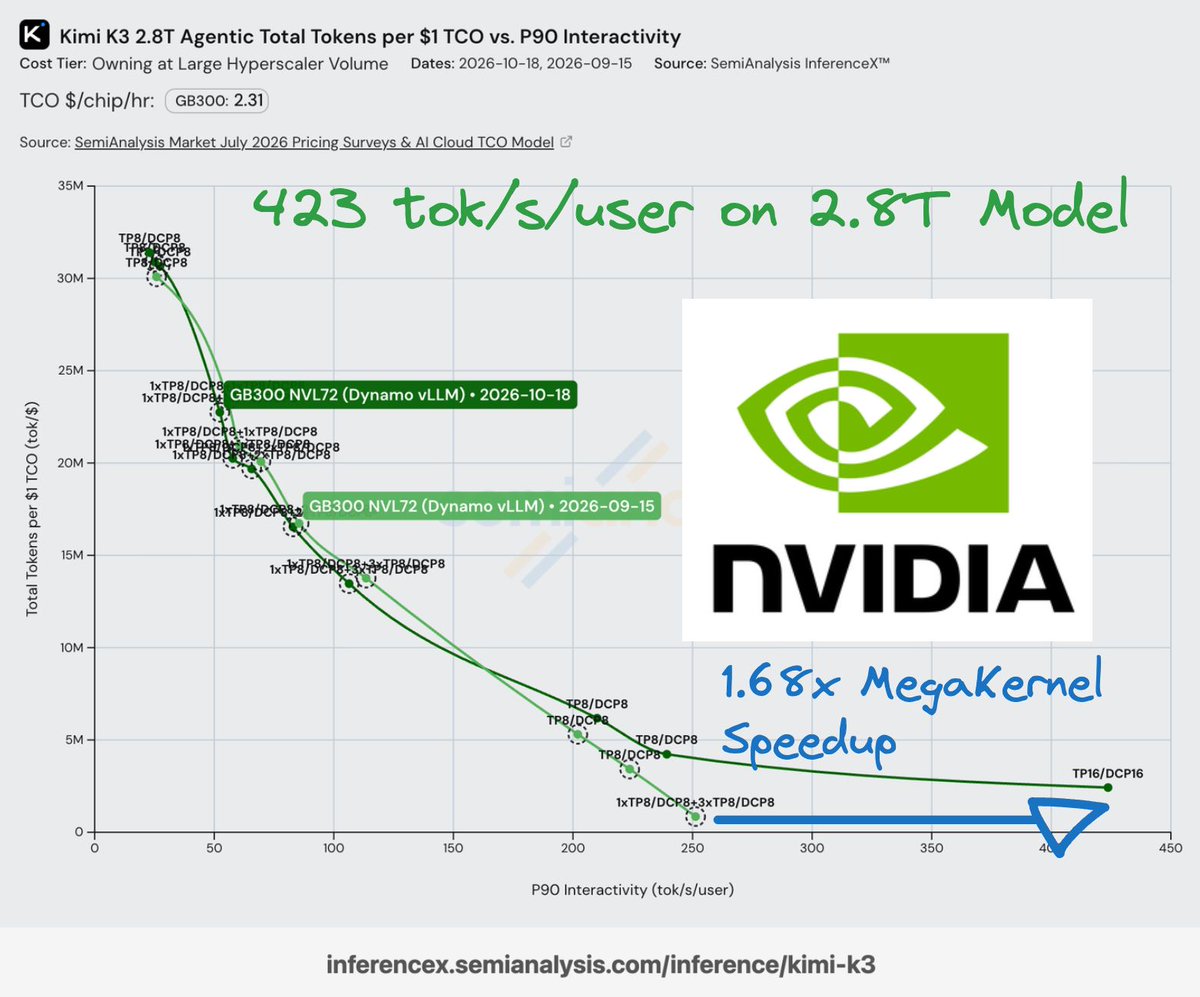
BREAKING NEWS🚨: NVIDIA has just achieved 423 tok/s/user 🚀 on the 2.8T Parameter Kimi K3 model via a new upstream vLLM optimization. 1.68x Faster on the Same Hardware!
This was done by NVIDIA CentML's Benjamin, who wrote NVIDIA's new decode-specialized kernels in Cute DSL via aggressive Megakernel fusion. This is a 12,000 LoC Megakernel and is the future of advanced AI-assisted kernel generation. NVIDIA is already working on DeepSeekv4.1 and other models for vLLM too.
Someone should give this NVIDIA 10x engineer a raise for this great new major feature!
@counathe Report: early results are good vs plain QAT (only 200 steps ran). Lower KL so far both mixed/NVFP4, running full thing tomorrow after training run to check further.
Introducing Nemotron Deciffusion 8B v1: Big-model decisions. One GPU.
AI agents make constant small decisions: which tool, which route, did it work, is it safe. Nemotron Deciffusion is an 8B diffusion model that returns a calibrated probability for every option of up to 512 typed questions in a single forward pass, with no generated text.
⚡ ~24 ms per decision on one NVIDIA GB200 (NVFP4)
🎯 JevBench public: 210/231
🧰 Decision Index 0.3: 53.9 (Tools & Automation 80.2)
📚 BABILong 32k: 99.6
Built on NVIDIA Nemotron-Labs-Diffusion-8B, trained only on commercially licensed data. NVFP4 build via Model Optimizer's Aumann–Shapley AutoQuantize (thanks Joshua Hill). One container, open weights, fine-tuning recipes included.
📝 https://t.co/naFNWZ47MG
🤗 https://t.co/IEXcAQhsyY
#NVIDIA #Nemotron #AIAgents #LLM
vLLM now supports NVIDIA Vera Rubin. The early results show more than 7.8x the throughput of GB200 on MiniMax M3 on AgentX.
@inferact, @NVIDIAAI, @RedHat_AI, and the vLLM community have been bringing vLLM up on Rubin since it was announced. Here is where things stand.
🧵 1/5
Introducing Prime Inference:
We've served trillions of tokens for RL and dedicated customer deployments
To own your intelligence, you need to own your inference
Unpacking our inference stack