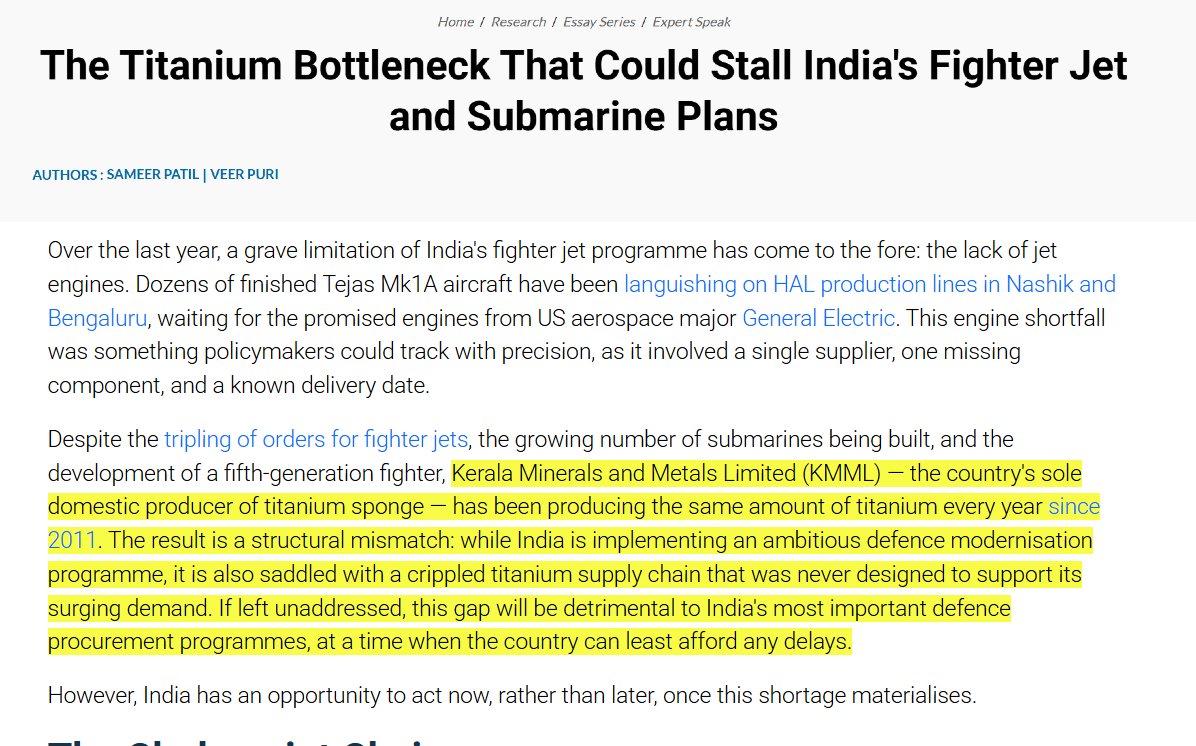
India makes fighter jets, submarines, and is building 5th generation stealth aircraft
All need titanium, super strong and light metal But India has just 1 plant making raw titanium sponge, KMML in Kerala, producing same 500 tonnes yearly since 2011. Only MIDHANI in Hyderabad turns that sponge into usable alloy.
If either facility has any problem, every major defence program gets delayed. India has massive titanium ore on its coastline but cannot convert it fast enough into finished metal for its own military.
Tejas fighter jet was already delayed for years because GE could not ship F404 engines on time. That problem was easy to spot, 1 missing part from 1 company. Titanium shortage is harder to see because it sits quietly behind multiple programs.
Tejas needs it, AMCA stealth fighter needs it, submarines need it, all pulling from same tiny supply chain with 0 backup. US military figured this out 50 years ago and forced defence contracts to use domestic titanium.
India still has no such rule
India signed agreements to expand titanium production years ago, including KMML teaming up with steel giant SAIL. Those remain proposals on paper, not running factories.
PTC Industries wants to build private titanium sponge plant in Odisha. Problem is defence-grade titanium takes years just to qualify before military can use it. If expansion does not start now, it will not be ready when AMCA hits production in 2035.
This should be treated like missing engines were, with named owners, public timelines, and real accountability
https://t.co/Vsj1cWz6S7
China blocked transfer of battery-making know-how to companies outside China
Amara Raja had signed deal with Chinese firm Gotion for LFP cell technology that deal stalled. Now Amara Raja is developing cells on its own, hired engineers from Tesla, and plans to produce 2 GWh of NMC cells by mid-2027.
Exide secured technology and equipment early, before restrictions hit, and is shipping samples from its Bengaluru plant right now. Pain is real in short run, but both firms are building knowledge that imports could never deliver
India targets 50 GWh of battery cell production under its PLI incentive scheme. So far, only 1.4 GWh got built, all by Ola Electric. Ola then cut plans from 20 GWh to 5
Reliance asked for more time. Companies that lost PLI bids, Amara Raja and Exide, are moving faster because they built outside government program with fewer restrictions on timeline and sourcing.
India R&D spending sits at 0.64% of GDP while China spends 2.43% that gap explains why cell manufacturing is behind domestic demand plus Now demand is so high that Nobody want to miss this
But Chemistry is the main game + Effective Ratio
China dominates 99% of LFP cathode supply and 97% of graphite anode production. When Beijing restricted battery tech exports in 2025, Indian manufacturers lost access to shortcuts they had been planning around.
That hurt in short term But Exide locked in tech licenses and equipment before curbs hit, giving them first-mover position. Amara Raja pivoted to in-house NMC development with global talent.
If Indian firms treat this window seriously and invest in deep R&D instead of seeking next licensing workaround, forced independence turns into real capability.
And this is Why I love China and Thanks a lot One should always choose Better peers in life :)
https://t.co/SvXIIeJdsf
For decades, Naxal insurgency prevented any mineral exploration in southern Bastar, Chhattisgarh
Security forces cleared armed resistance by March 2026. Now, Chhattisgarh approved 45 mineral exploration projects for 2026-27, with 35 focused on lithium, rare earths, graphite, and related minerals. Bastar sits on very old rock formations known to host these deposits elsewhere in India.
Government earned Rs 16,738 crore in mining revenue from Chhattisgarh in 2025-26. Opening up previously inaccessible terrain for geological survey is first step toward knowing what resources exist underground
India launched National Minerals Mission in 2025 with Rs 34,300 crore budget over 7 years. Geological Survey ran 230+ exploration projects in 2025-26.
Government auctioned record 212 mineral blocks that year, including 22 for lithium, graphite, and rare earths. 8 auction rounds completed so far. Rajasthan has 80m+ tonnes of rare earth deposits. J&K has 5.9m tonnes of lithium, discovered but not yet extractable.
Bastar opens up another corridor that was locked behind armed conflict for 40+ years. Mapping is now possible - Mining will take much longer
China processes 87% of global rare earths and refines 58% of global lithium. India imports almost all of these today. Government approved Rs 7,280 crore scheme to build 6,000 tonnes per year of rare earth magnet manufacturing.
Dedicated rare earth corridors planned for Odisha, Kerala, AP, and Tamil Nadu. Bastar exploration results could eventually add Chhattisgarh to that list.
But finding minerals underground is only first step. Refining, separation chemistry, and magnet production require specialized plants India does not yet have at commercial scale.
Exploration creates optionality >>>>>
https://t.co/zM4jHovbci
Viyash Scientific combined 2 pharma companies in late 2025, joining animal health distribution with drug ingredient manufacturing under single roof
In Q1 FY27, revenue grew 20% and profit doubled. US human drug business grew 60% because company now makes its own raw materials instead of buying them. India animal health business also grew 60% after partnering with Boehringer Ingelheim to sell companion animal products starting January 2026.
Making your own ingredients and selling finished products through global distribution drives both revenue and margins higher.
Pet pharma differs from human pharma in ways that protect margins. In human drugs, generics take over 90% of market and prices drop fast.
In pet drugs, generics hold less than 15% share and still price at 60-70% of branded products. Vets prescribe based on trust, not procurement tenders.
Viyash controls about 60% of global companion animal drug ingredients and has mapped 15-20 products losing patents before 2035. Company bought Italian firm BioForLife to reach 80%+ of Italian vet clinics.
Low generic penetration plus ingredient control creates durable advantage
Viyash wants to reach $1bn revenue by 2032. Right now, animal health is only 12% of total revenue. Remaining 88% comes from human health drugs, ingredients, and contract manufacturing.
Growth plan depends on companion animal products becoming much bigger share as drug patents expire over next decade. Company plans 7-8 new pet drug launches per year.
R&D team has 340+ scientists across India, Spain, and Turkey. Balance sheet is nearly debt-free at Rs 86 crore net debt.
Clean financials and ingredient control give room for acquisitions that expand distribution
China sold $3.77tn worth of goods to global markets in 2025 and ran record $1.2tn surplus that sounds like dominance
But it happened because Chinese consumers are not spending enough, so factories depend on foreign buyers to keep running. If EU or US restricted market access for specific Chinese goods, those factories lose customers they cannot replace domestically.
Western demand is not weakness. It is unused bargaining power sitting right in front of policymakers who keep treating it like dependency.
Chinese companies own Western brands people trust. Geely owns Volvo. SAIC owns MG. WH Group owns Smithfield Foods. These brands sell because of Western shelf space and consumer loyalty, not because of who owns them.
US already banned Polestar from selling new cars after 2027 model year because of Chinese ownership and data security risk. Volvo survived by restructuring governance. That precedent shows ownership and data access can be used as conditional tools, not just complained about
China used rare earth export controls in 2025 to squeeze global supply chains. It controls 90% of processing and imposed licensing that delayed shipments and forced buyers to reveal who uses what minerals and for what purpose.
Rush Doshi and Kurt Campbell argue countering Chinese scale requires coordinated allied action, not solo efforts. Western countries hold comparable tools in market access, capital listings, and brand control.
Gap is not in tools, it is in willingness and coordination to deploy them as bargaining chips and now Now Supply Chain is the front seat game now :)
Leveraging interdependence to combat China's industrial policy https://t.co/hHxazrFB8o
Great post by Gulzar Natarajan.
“Western media often portrays China’s export surplus and FDI as signs of global dependency, overlooking China’s vulnerabilities. This perspective ignores the leverage Western countries hold through market access, local production, and control over brands and technology. By utilizing these bargaining chips, Western countries can counter China’s industrial dominance, similar to how China uses its control over rare earth metals.”
Pentagon launched online store called https://t.co/0iNPqjTAoF where military units can shop for counter-drone gear
Kaizen Labs built it in 9 weeks for $15m. Buyers log in, filter by threat type, check test data, and submit orders. Poland, Romania, UK, Australia, South Korea can shop from same catalogue. NATO separately committed $40bn over 5 years for counter-drone.
India spends big on defence but still takes 3-4 years per tender. When threats move fast, buying needs to move fast too.
Counter-drone is now among fastest-moving defence markets globally. Anduril won $20bn Army contract in March 2026 and is chasing $100bn valuation.
Kuwait bought $2bn of Anduril gear after Iranian drones hit its airport. Motorola paid $1.5bn for D-Fend, which makes tech that hijacks rogue drones mid-flight. India approved $5.5bn in counter-drone and air defence spending this year.
But without digital marketplace linking field units to vetted Indian vendors, money sits in budget while threats sit overhead & India need this too :)
India already builds solid counter-drone tech. BEL produces D4 anti-drone systems with radar, jammer, and laser. Zen Technologies launched AI-powered system detecting 100+ drones at 15km range.
DRDO tested V-SHORADS for short-range air defence. 676 startups joined iDEX defence innovation program. Problem is not capability, it is discovery. No commander in India can log into single portal, see all tested products, and order what fits.
Pentagon did this with https://t.co/0iNPqjTAoF. India copying that model would be cheap, fast, and overdue
https://t.co/tZW3y7Q9OM
Ukraine produced 2.2 million FPV drones in 2024 alone, has 500+ manufacturers, invented fiber-optic guided drones to beat jamming, and used naval drones to shoot down Russian fighter jets
Ukraine has over 30 certified training centers and pilots who repair and rebuild drones in the field between missions.
Ukraine figured out with fiber-optic drones, AI targeting, and interceptor drone defense through daily combat iteration. The Pentagon is trying to buy what Ukraine built through pain.
Ukraine drone operators told NATO trainers that 90% of drone warfare success is team training, not the hardware.
Every country watching this conflict is learning the same thing, cheap mass produced fast beats expensive platforms delivered late.
Three years of nonstop real combat, iterating daily. And still, only 43% of FPV sorties actually hit target. 25% of drones fail before launch. 31% get jammed mid-flight.
The country with more drone combat data than anyone on earth is still figuring out what works.
Ukraine built its drone ecosystem from the ground up with volunteer workshops, startup founders, and soldiers taping aluminum foil to FPVs so radar could see friendly drones.
That kind of learning can't be bought with a budget line, and there are secret IP tech etc., too which yu cannot find online
In a 2025 NATO exercise, 10 Ukrainian drone operators from the Nemesis brigade destroyed a British brigade and Estonian units attempting a simulated armored assault.
Ten operators against a full combined arms force. Ukraine's edge wasn't the hardware, their drones cost $200 to $1,000 each.
The edge was thousands of hours of real combat learning about electronic warfare, terrain, counter-jamming, and target selection.
Ukraine shows you can't skip the iteration. You have to earn it by mission by mission.
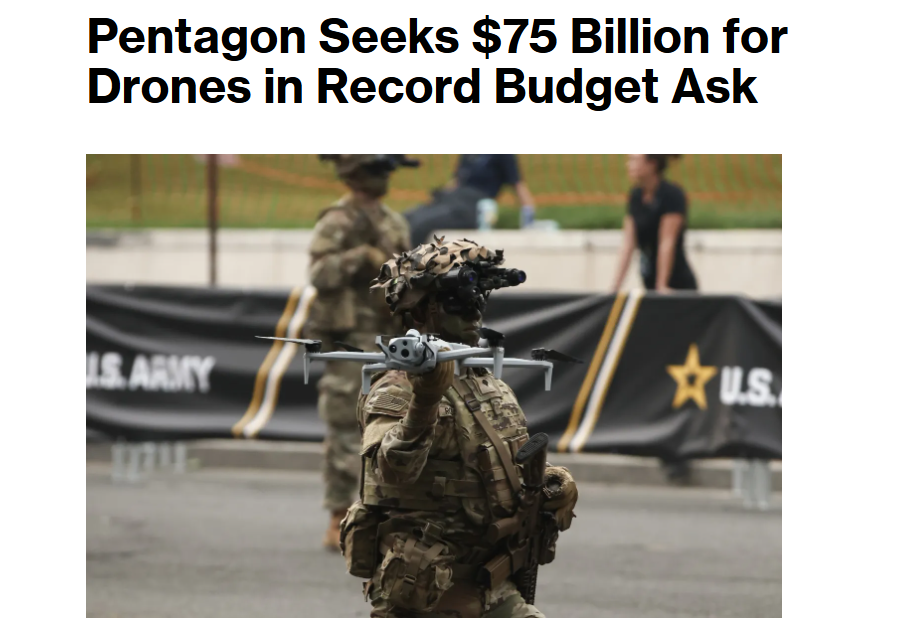
Pentagon is spending $75b on drones while Ukraine runs its entire war for $60b
Ukraine makes 200,000 FPV drones a month at dirt cheap costs and iterates designs every few weeks based on what works on the front line.
US couldn't even get its Replicator program to deliver thousands of drones on time - it shipped hundreds after two years and multiple test failures.
Throwing money at a problem that needs speed and battlefield feedback loops is how you burn cash and still fall behind.
DAWG, the office getting $54.6b for drones next year, had a budget of $225m this year. That is a 243x jump in one fiscal year.
This is the same Replicator program that failed - drones went adrift, software couldn't coordinate systems from different makers, and boats were bought before anyone checked if they could handle Pacific distances.
If you want to understand drones, read Ukrainian outlets. Even after reading a lot of defence stuff, I missed the fibre optic angle that Ukraine is using in drones.
I even read somewhere how fibre optics thread are getting dangerous in the Ukraine war but I missed connecting the dots. Still ended up getting into Sterlite though.
Invested & Biased :)
https://t.co/snqBRwfGQt
Ukraine produced 2.2 million FPV drones in 2024 alone, has 500+ manufacturers, invented fiber-optic guided drones to beat jamming, and used naval drones to shoot down Russian fighter jets
Ukraine has over 30 certified training centers and pilots who repair and rebuild drones in the field between missions.
Ukraine figured out with fiber-optic drones, AI targeting, and interceptor drone defense through daily combat iteration. The Pentagon is trying to buy what Ukraine built through pain.
Ukraine drone operators told NATO trainers that 90% of drone warfare success is team training, not the hardware.
Every country watching this conflict is learning the same thing, cheap mass produced fast beats expensive platforms delivered late.
Three years of nonstop real combat, iterating daily. And still, only 43% of FPV sorties actually hit target. 25% of drones fail before launch. 31% get jammed mid-flight.
The country with more drone combat data than anyone on earth is still figuring out what works.
Ukraine built its drone ecosystem from the ground up with volunteer workshops, startup founders, and soldiers taping aluminum foil to FPVs so radar could see friendly drones.
That kind of learning can't be bought with a budget line, and there are secret IP tech etc., too which yu cannot find online
In a 2025 NATO exercise, 10 Ukrainian drone operators from the Nemesis brigade destroyed a British brigade and Estonian units attempting a simulated armored assault.
Ten operators against a full combined arms force. Ukraine's edge wasn't the hardware, their drones cost $200 to $1,000 each.
The edge was thousands of hours of real combat learning about electronic warfare, terrain, counter-jamming, and target selection.
Ukraine shows you can't skip the iteration. You have to earn it by mission by mission.
Pentagon is spending $75b on drones while Ukraine runs its entire war for $60b
Ukraine makes 200,000 FPV drones a month at dirt cheap costs and iterates designs every few weeks based on what works on the front line.
US couldn't even get its Replicator program to deliver thousands of drones on time - it shipped hundreds after two years and multiple test failures.
Throwing money at a problem that needs speed and battlefield feedback loops is how you burn cash and still fall behind.
DAWG, the office getting $54.6b for drones next year, had a budget of $225m this year. That is a 243x jump in one fiscal year.
This is the same Replicator program that failed - drones went adrift, software couldn't coordinate systems from different makers, and boats were bought before anyone checked if they could handle Pacific distances.
If you want to understand drones, read Ukrainian outlets. Even after reading a lot of defence stuff, I missed the fibre optic angle that Ukraine is using in drones.
I even read somewhere how fibre optics thread are getting dangerous in the Ukraine war but I missed connecting the dots. Still ended up getting into Sterlite though.
Invested & Biased :)
https://t.co/snqBRwfGQt
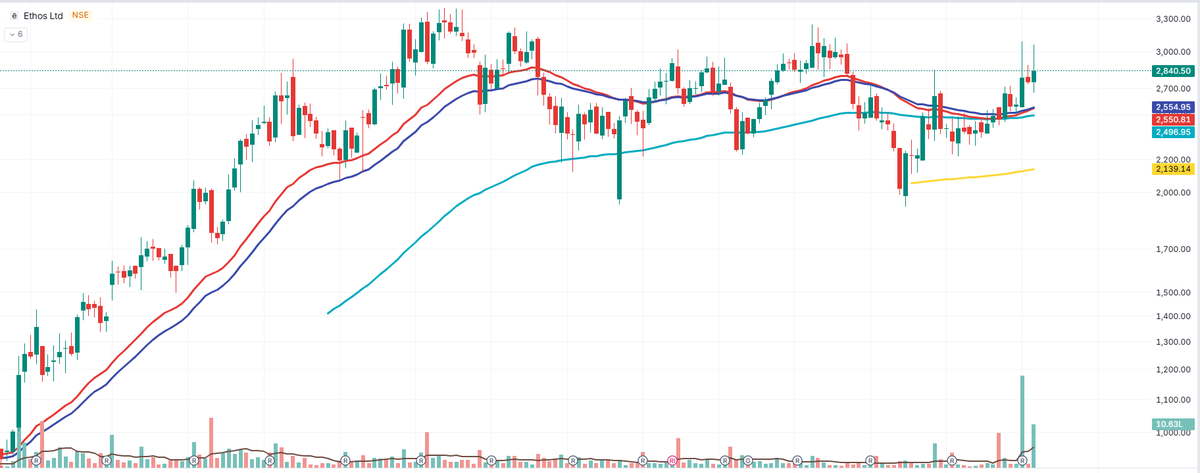
Ethos is no longer just India biggest luxury watch seller. It is deliberately shifting upstream by owning Swiss brands (especially Favre Leuba via Silvercity Brands) and building manufacturing/IP control in Switzerland.
This is a structural change in strategy from pure retail to brand ownership and Swiss roots.
AI has nudged robotics a lot, and in the last 3 years it has evolved massively
Now, from the AI war, the Physical AI war has started. The US currently does not have enough suppliers who can manage manufacturing and simultaneously produce components at scale with nano-level precision. Building that supplier ecosystem will take time
Let’s hope Indian companies that are already close to this level of precision manufacturing can enter this domain. It is highly possible through joint ventures, and I think soon we will start seeing this show up in company filings.
I don’t think any potent supplier will ignore the Physical AI space, especially robotics
The reason why I am saying this and putting up this thesis is because we have already seen the same pattern in the last 5 years.
Due to capex and new opportunities, many players jumped into railways, defence, and aerospace. A few bought companies, some entered through joint ventures, while others first got certifications and then started receiving orders.
We have seen this from Sona BLW to Belrise, Motherson, Sansera, Balu Forge, etc.
So I think in the next 3–5 years, this Physical AI and robotics supply chain will also start getting built, and Indian precision manufacturing companies could become part of it.
WATCH: A humanoid robot training for the “Robot Olympics” in Beijing runs too fast, fails to stop, slams into a safety cushion, and breaks at the waist
India gold loan market has exploded to over ₹3.3 lakh crore and is growing very fast
Tata and Godrej bought existing gold loan businesses, while Aditya Birla is building a large branch network of its own (target 1,000 branches). Big groups are moving in because gold loans are secured, growing rapidly, and fit well with the shift away from risky unsecured lending.
Rising gold prices and India’s massive household gold stock are the main fuels.
This marks a clear change - gold loans are no longer a niche product. They are becoming a core part of retail lending for large Indian financial groups. Tata, Godrej and now Aditya Birla have all entered the gold loan business in quick succession
This is no longer a small southern niche dominated by Muthoot and Manappuram. Large diversified groups see it as a major growth area
Why the sudden boom?
Gold prices have risen sharply - Higher prices mean people can borrow more against the same jewellery. This has boosted loan sizes and demand
Shift from unsecured to secured lending - RBI has tightened rules on personal loans and other unsecured credit. Gold loans are fully secured, short-term, and easier to recover.
Huge idle household gold - India has one of the world’s largest private gold holdings (estimated ~25,000 tonnes). Only a small part is currently used for formal loans.
Fast growth numbers - Outstanding gold jewellery loans reached about ₹3.3–3.4 lakh crore by May–June 2026. NBFC gold loan portfolios grew nearly 70% year-on-year.
Overall gold loans grew 50% in FY26 - one of the fastest retail lending segments.
The business looks safe, but operational risks remain - wrong valuation of jewellery, theft from branches, or a sudden sharp fall in gold prices can still hurt.
But this is going to create a really new Big Segment in LOAN Space :)
India is planning a special Green Channel for European and UK companies
This is a dedicated fast-track system to give them personal hand-holding, quicker government approvals, and faster problem-solving when they want to invest in India.
It will work like the existing Japan Plus and Korea Plus desks
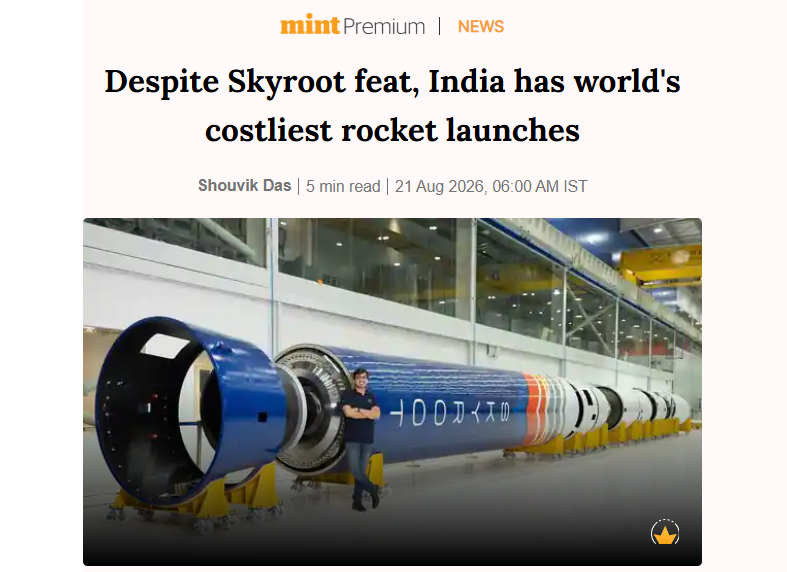
India is most expensive country to launch satellites, at $13,302 per kg
USA is cheapest at $3,225 per kg thanks to SpaceX Falcon 9. India costs 4x more. Study published in Economics Letters by Cambridge and Turin researchers compared 6 countries with launch capability.
ISRO rockets are not reusable. SpaceX reuses its rocket boosters 25+ times. That is why costs differ so much. India is building NGLV Project Soorya, its first partially reusable rocket, targeting $1,900 per kg.
But it will not fly for several years
Skyroot Aerospace became first Indian private company to reach orbit on July 18, 2026. Its Vikram-1 rocket carried 350 kg into 450 km low Earth orbit. Impressive milestone.
But each Vikram-1 launch will cost about $4M, which works out to $11,000 per kg. SpaceX Falcon 9 charges $3,225 per kg and carries 22,800 kg per launch. Skyroot plans commercial operations from 2027 with monthly launches.
India now has private and government rockets. Neither matches SpaceX on cost per kg yet. Closing that gap requires reusability and it will be really hard to achieve by the way
India wants to earn $3.5B per year from launching foreign satellites by 2033. Right now, India is most expensive launch market among 6 space-capable nations at $13,302 per kg.
SpaceX charges $3,225 - Gap is 4x. ISRO launched roughly 60 missions over 30 years. SpaceX launched 165 in 2025 alone.
Volume brings cost down. Low cost brings more customers. More customers fund more launches. India has not entered this cycle yet. NGLV with reusable stages could change this but remains in development.
lets hope >>>
This expansion is driven by cloud growth, data localisation, and rising AI demand. Hyperscalers (Amazon, Google, Microsoft etc.) and large Indian players are expanding fast.