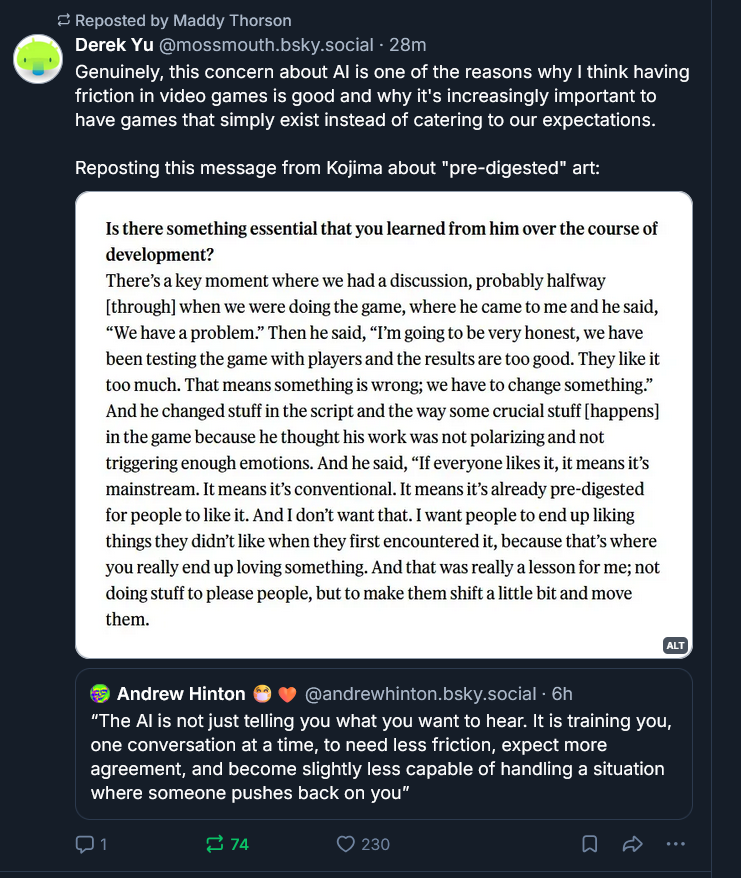
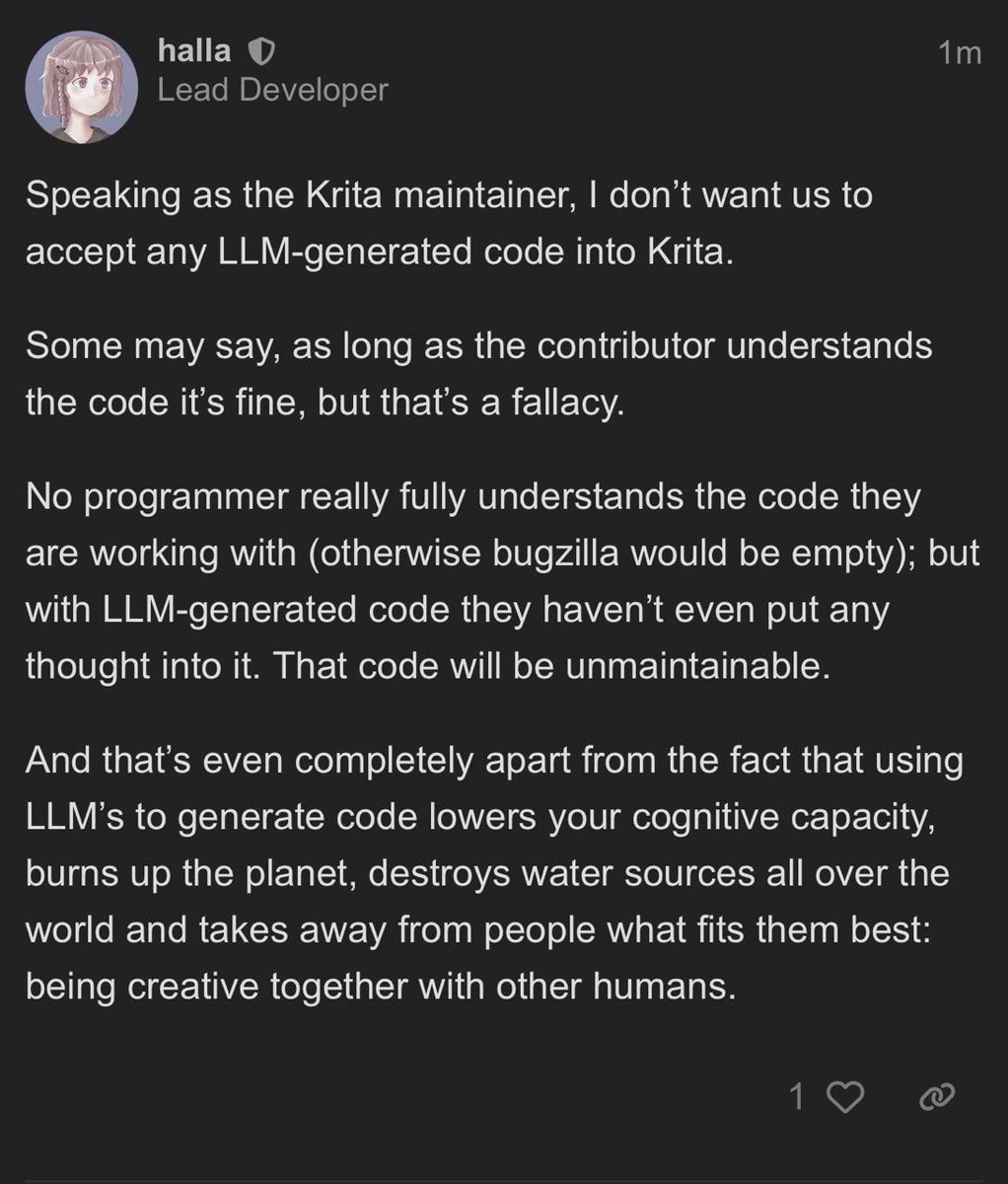
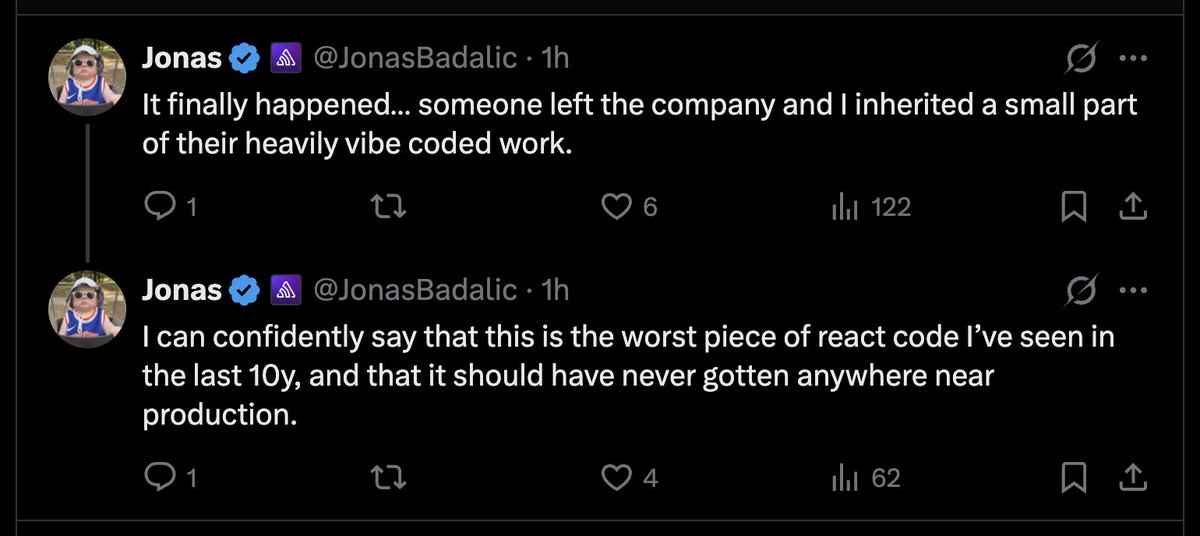
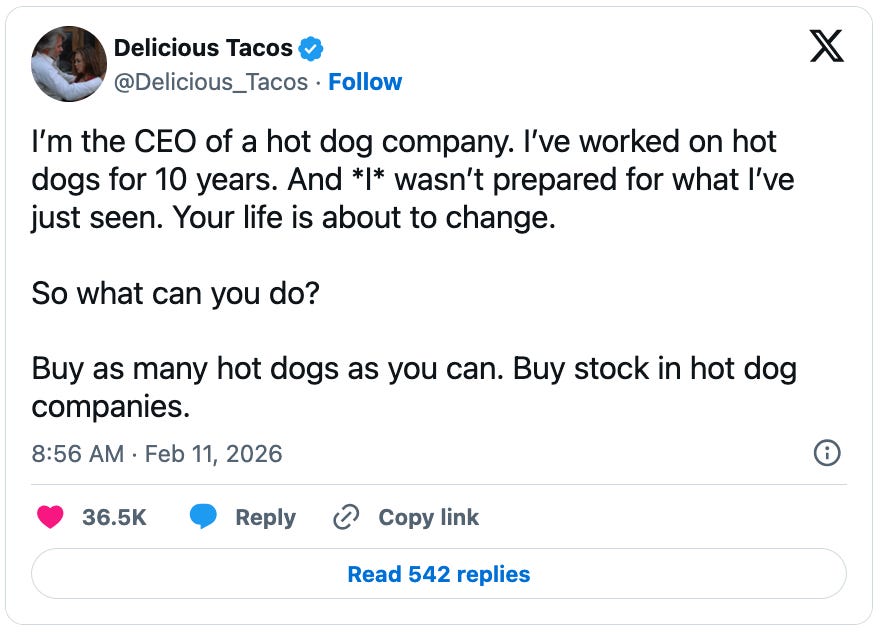
They're just making shit up now bro
I can't think of one scenario where I'd need to use CLI to order DoorDash or use an AI Agent to order my meal
Just fix your apps bro
Highly recommend donating to Blender. I recently used it to mock up something, so we donated $500. Autodesk would have charged $255/month for access to an onerously DRM'd equivalent that would have made me grumpy. It's only fair that Blender should get the payment instead!
There will be more of this. And as much as we're joking about it, we're seeing a massive degradation of code quality right now and we're increasingly only catching it way too late.
@valigo "Sorry we don't have money to pay you" is actually the most honorable reason to get laid off. "Yeah, I'm too expensive for you. Call me back when you stop being poor. :3"
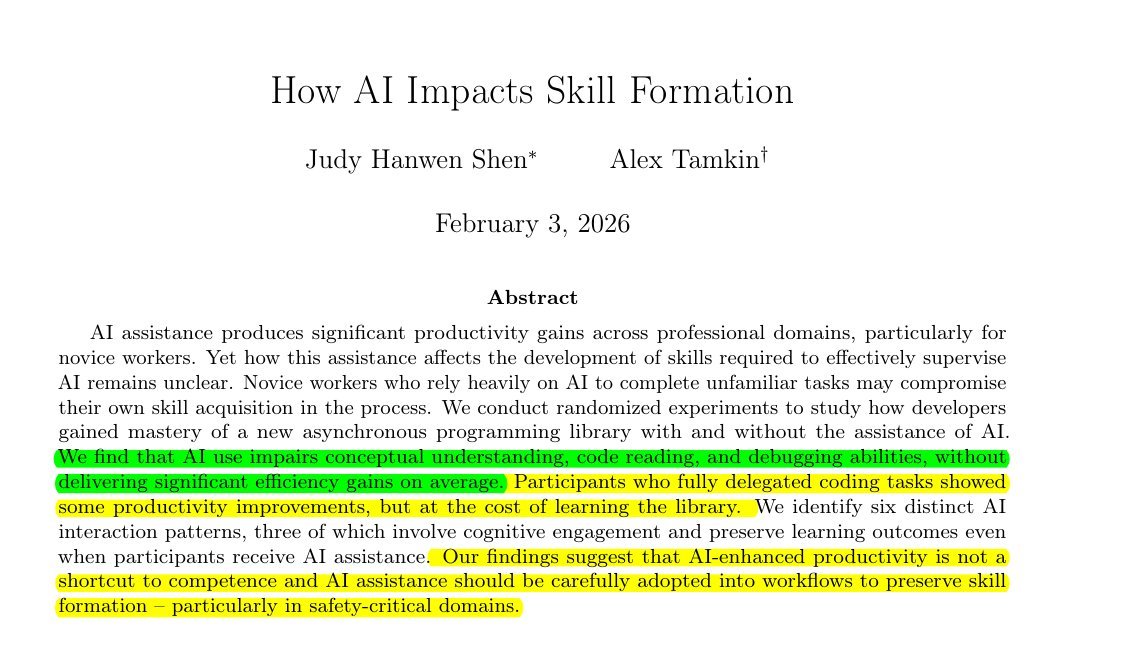
Anthropic's own study proves Vibe-Coding and AI coding assistants harm skill building.
"AI use impairs conceptual understanding, code reading, and debugging abilities, without delivering significant efficiency gains on average"
Developers learning 1 new Python library scored 17% lower on tests when using AI.
Delegating code generation to AI stops you from actually understanding the software.
Using AI did not make the programmers statistically faster at completing tasks.
Participants wasted time writing prompts instead of actually coding.
Scores crashed below 40% when developers let AI write everything.
Developers who only asked AI for simple concepts scored above 65%.
Managers should not pressure engineers to use AI for endless productivity.
Forcing top speed means workers lose the ability to debug systems later.
----
Paper Link – arxiv. org/abs/2601.20245
Paper Title: "How AI Impacts Skill Formation"
For any given desired computational outcome, there is some sequence of bits which encodes that. These bits of signal (of the desired outcome) can be intermixed with bits of noise.
The reason why these LLM-generated codebases by default have so many obviously useless lines of code is that, for any given generative step, the LLM’s job is to package up the few signal bits (from the prompt) into a plausible presentation of other bits, which may or may not be noise.
If they are extra signal (because they can be statistically inferred from the other signal bits), then that’s a win, but there’s a much higher probability that they’re actually just noise. This is why every AI generated tweet, article, or indeed code snippet contains drastically more fluff (noise) than what a focused person with reasonably good instincts for compression would produce.
So, in order to actually accomplish anything (without extreme vetting, compression, and modification of generated code), the “programmer” (prompter) needs to continuously generate more code to obtain the next signal bit they wanted, at the expense of many, many more bits of noise.
The result is often ~100x if not ~1000x more code than was needed, which is impossible to hand-edit, comprehensively understand, or compress. Layers upon layers of statically average nonsense, wrapping the few bits of utility you actually wanted.
@JustineBateman [1/2] I suspect you're not being pessimistic enough. There's little chance an executive will do any of those things. What they will actually do is train another ML system to categorize what each cluster of people watch the most, and what visual styles those shots have.
It's rare I see someone defend online identification. I'm unable to tell if they're a troll, engagement baiting, or being sincere.
Let's discuss it.
Pardon my condescension, but if this is a sincere rebuttal, this person is the LeBron James of logical fallacies.
1. False analogy.
You cannot compare online identification to in person identification. Giving your ID to someone in person is a physical transaction in a controlled environment (bar, tattoo parlor).
The Internet is global and interconnected. Additionally, when providing your ID in person you're doing it for an exchange of a physical good or experience (bar, tattoo parlor).
Identifying yourself online is tied to SPEECH (e.g. social media).
Identifying at a bar is not the same as identifying yourself online.
2. False equivalency
Again, tying back to argument one, providing your identification for something like going to a bar is not the same as providing identification online. Social media, as an example, is a communication platform.
Examples provided: bars, alcohol, cigarettes, tattoos, guns, lottery tickets, ... This is not the same as needing identification for access to a social media site.
3. Loaded questioning
Rhetorical questions are trying to push the reader to assuming a logical conclusion that online identification is perfect.
4. Over simplification
Identifying everyone online is not a practical solution. This ignores local laws, federal laws, different governments having different laws, free speech laws, data privacy laws, THE COST of performing all of this.
Do people in the United States visiting a Brazilian website need to provide their ID to the Brazilian government? Do they have any jurisdiction? These are real questions.
5. Appeal to ridicule
Concluding your statement with "grow up" tries to shame me, or the reader, for disagreement.
These laws being suggested are far from perfect and serve no one. It will not protect children. The lack of clarity in laws makes people infer nefarious intent.
I like pictures of cats.
purchasing AI translated manga makes no sense, AI translation is available to me for free and I will just buy japanese volumes and cut out the middle man. what I pay for is a human translation. that's your role, do not forget it, i can remove you from this transaction.
The new AI powered Notepad on Windows 11 was found having a Remote Code Execution 0day
Hot take: text editors don't need network functionality
https://t.co/91oLOV5b1S