Yep. Listen to everyone telling you #bitcoin is going to let you jump on board at 3k. Because that’s just what $btc does, Let’s everyone get on board. The train will leave the station when most are still in line. Bitcoin will reach 50k eoy.$ltc $etc $xrp $dgb
The hardest part of investing is not buying. It is refusing to sell.
@APompliano learned it the painful way: he mined ETH around $5, sold after a huge move, then watched it run to $1,400.
Anthony Pompliano, investor and entrepreneur:
"I am now convinced that actually selling is the much harder exercise."
"If you go and you look at some of the best investors in the world, they just never sell."
That is the Bitcoin lesson. It is also the Eli Lilly, Nvidia, SpaceX, and power-law lesson.
The mistake is usually not missing the winner. It is letting go too early.
If the June 2026 low ultimately proves to be the market bottom, then it would mark the beginning of a new cycle under the low-to-low methodology followed by many cycle analysts. In that framework, the previous cycle would have spanned from the November 2022 low to the June 2026 low, making any major peak in 2027 a left-translated cycle, as the peak would occur relatively early in the new cycle rather than toward its latter stages. This differs from the more traditional crypto narrative, which tends to focus on halving-to-halving or peak-to-peak cycles. In my opinion, if June 2026 is ultimately confirmed as the cyclical low, then a 2027 peak should indeed be viewed as a left-translated cycle, reinforcing the idea that this cycle has evolved rather than been invalidated. Ultimately, I do not believe the label matters nearly as much as the outcome. Whether you view this as a left-translated new cycle beginning in June 2026 or as an elongated cycle that started with the November 2022 low, both frameworks point toward the same conclusion: the market appears to be positioning itself for a major peak sometime in 2027. It would simply be considered early under the traditional four-year cycle framework or late if you believe this cycle has been extended by global liquidity, institutional adoption, and the evolving macroeconomic backdrop. Either way, I think this market will explode in 2027. Focus less on the terminology and instead position yourself accordingly and seize this opportunity. ⚒️
why has crypto been weak? It is competing with money for ai + robotics, and that will be the case for sometime. It is just a huge money pit of demand and will be for some time. It is also something that most investors can see, feel and touch. While crypto alts have a pretty poor history over any period of time. This is just a reality and we all know that. Altcoins are 15 years old now with little to show in the real world.
Does that make BTC a bad buy here? No, if anything this general range is a great buy imo long term. Is it going to have the same upside performance? unlikely. Just like this past cycle was the first one where the alt market didn't make new highs. Global markets have had as much accommodation as possible and unfortunately crypto has been the weakest link.
Are you getting paid for the risks you have taken in crypto for the past year? Probably not. But things are at more attractive prices now. It doesnt mean they can't have big bounces either. But I think its hard for them to keep pace in general with the AI market for sustained periods of time. Just due to flows, and new emerging tech. But its just something to consider if you are all in crypto. Maybe even allocating 5-10% of that to some of this trade over the next few years. This isnt something new im saying either, I have been saying this.
The real question is where does this end?
You can’t go on expanding the scope of interventions, at some point you have to eat the pain or you permanently distort the market.
Of course this argument has been used before, and to no effect — markets are fine despite prior interventions.
Where does this end logically? We can push it out of our minds probably for a few decades, but it makes the game impossibly hard. If you’re not allocated, you’re losing massively. At some point though; you will end up losing while allocated. The hope is you’ve been in long enough to retain the gains.
A problem for our children.
Where does Bitcoin go from here? @LynAldenContact returns to break down price action, macro, what really happened with Strategy's $STRC, and the protocol fight dividing Bitcoin right now.
We get into:
- Whether Bitcoin has found its floor
- The lowest sentiment Lyn's ever seen
- The crash in Strategy's $STRC and whether holders should be worried
- Her grounded take on the protocol fight and the "existential threat" talk
- Why the Big Print everyone's waiting for still isn't coming
Now streaming on all podcast platforms.
Six months ago Ethereum was almost $5,000. Today it's under $2,000. When I put that to Tom Lee in Paris, his response was: "Has anything really changed?"
Tom Lee (@fundstrat) is one of Wall Street's most-followed forecasters. While the market wrote Ethereum off, he made the case to me that it's one of the most mispriced assets in the world right now.
His framing stuck with me. Gold is worth ~$22 trillion. The stock market over $100 trillion. Real estate ~$300 trillion. And to make those assets composable and move them on-chain, he argues, you run them on Ethereum, which sits at a fraction of that. "If Ethereum is at 300 billion, it's grossly undervalued."
We cover:
- Why he calls this "crypto spring", fundamentals stronger than ever while price lags
- Why tokenization is "not even a question," and what happens when Wall Street actually moves on-chain
- Why AI agents carrying wallets and making payments is, in his words, "pretty close to 100%" within three years
- Why he can see Ethereum as a 1, 2, or even $5 trillion network "in the next few years"
- What most investors are missing at exactly the wrong moment
That's his call, not mine, but it's one of the clearest bull cases I've heard on why the biggest move may still be ahead.
Full conversation is live. 👇
Is Ethereum the most undervalued asset in crypto right now?
The funniest moment in the Oval Office today was when a reporter saw I was there and then asked the President of the United States if he wanted to put bitcoin in children’s Invest America accounts 😂
Ethereum to $20,000+.
If you're holding ANY alt-coins, this video is probably the single most important piece of content you can watch right now,
The focus is on $ETH, but understanding the implications of what is being said here is important because it will affect the ENTIRE alt-coin market as a whole.
There is a lot here, but stick through it till the end and I know you will not be disappointed, trust me.
Likes/shares appreciated, enjoy! 👇
https://t.co/EPRuD2Cibf
going to say this again
for crypto, think the downside is very very limited at this point. the worst of it is imo certainly over if the bottom isn't already in.
the challenging aspect may be that we haven't done the time capitulation yet like we historically get where volatility dies and we trade in a one percent range for 6 months as price starts to coil and tighten and every fakeout means we are going to 0 and then to 600k. that may still happen and price may just compress into a smaller range as time passes. something to consider. it is very rare to v reverse.
i continue to advocate for owning both crypto, and equities. you don't need to be loyal to one or the other
Let's just simplify everything for a moment here.
This is the first patch of choppy trading I can ever remember that I feel happy talking about.
I've basically been non-existent during this time, deliberately trying to avoid any over-trading, instead focusing my attention fully elsewhere. And I've completed that successfully for the first time.
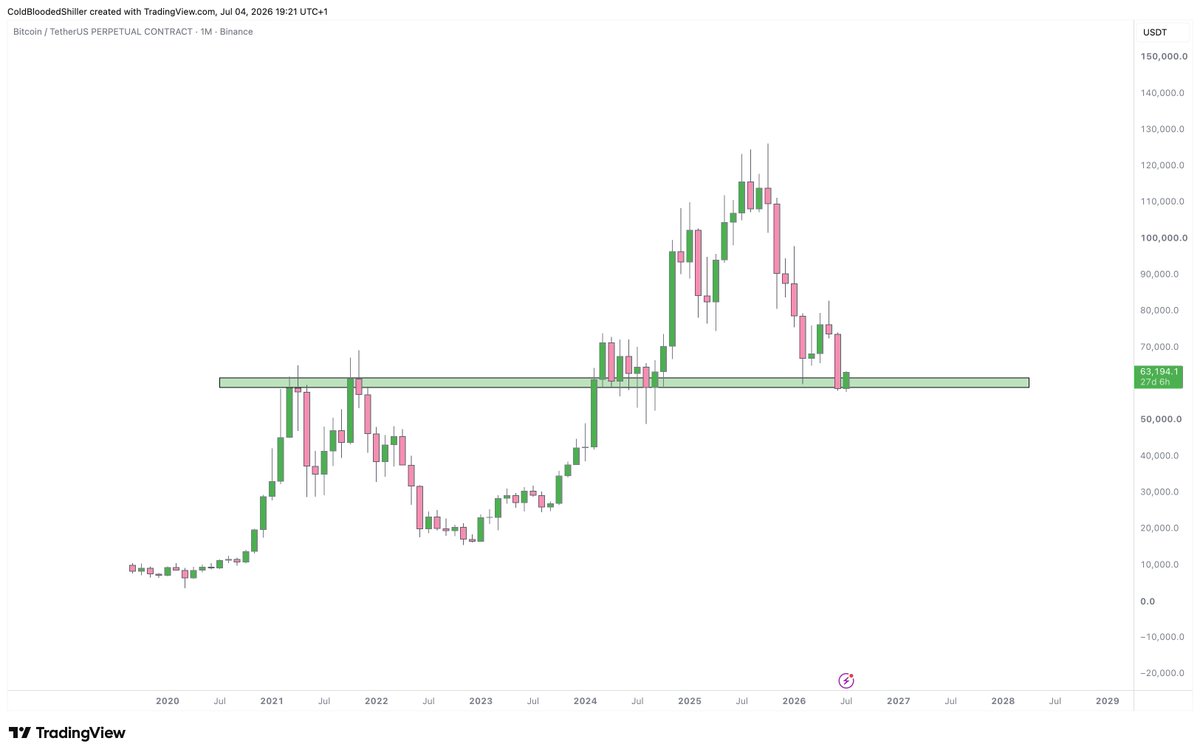
However when we look at this $BTC chart we are now in the most significant zone for the last 6 years.
From here, it looks as though we have opportunity, whether that be macro bottom, LTF bounces or simply momentum shifting while we hang around.
At least it feels as though it's a time to become more interested in the markets now, and not simply pooling all my attention and resource into TCG.
bitcoin exchange reserves at a 7-year low. long-term holders sitting on 16.1m BTC, all-time high. corporate treasuries absorbed 175k+ BTC in 2026 alone. and now coinbase institutional says 100+ countries have committed to sovereign BTC strategies. only 2 have disclosed holdings so far. bhutan proved you can mine with stranded hydro at zero cost basis and nobody even knows until arkham finds your wallets. that model scales to every country with surplus energy and weak financial infrastructure. entire nationstates will soon begin buying up your bitcoin and most of them won't announce it
The overwhelming consensus today is that Bitcoin is headed much lower.
Maybe it is. The trend is still down on the higher time frames, macro uncertainty remains elevated, and there are legitimate reasons to be cautious.
But markets have a funny habit of making the majority feel smartest right before they make them the most uncomfortable.
So let's suspend our biases for a moment and ask a different question.
If Bitcoin were actually in the process of putting in a major bottom, what evidence would we expect to see?
A month ago, I laid out the historical case. At the time, I argued that Bitcoin was beginning to enter the same conditions that had accompanied every previous major cycle low. It wasn't a prediction. It was simply an observation that several independent indicators were beginning to align.
Since then, that case has become stronger.
The weekly bullish RSI divergencewith oversold conditions I discussed has now been confirmed. The daily chart is showing the same thing. Momentum is improving even as price remains near its lows, exactly the type of behavior technicians look for when trends begin exhausting themselves.
Bitcoin also continues to find support around its 50-month moving average, a level that has historically marked major long-term buying opportunities. It is also trading around the 200 Weekly MA, a level that has marked every bottom.
On-chain metrics continue to show underwater supply at levels typically associated with broad capitulation, suggesting a significant amount of forced selling has already taken place.
At the same time, whale accumulation has exploded. Large holders are accumulating Bitcoin at the fastest pace ever recorded. These were the same wallets that sold the top. That's worth paying attention to. Historically, the biggest players don't wait for perfect headlines or obvious trend reversals. They accumulate while uncertainty is highest and conviction is lowest.
Then there's sentiment.
Fear and greed is in the gutter.
Also, every major Bitcoin bottom eventually becomes associated with a narrative that feels impossible to overcome while you're living through it. In previous cycles it was Mt. Gox, China's mining ban, COVID, Luna, Celsius, and FTX. At the time, each felt like an existential threat. Looking back, they were signs of peak fear and capitulation.
Today that narrative has become Strategy.
The conversation has shifted away from Bitcoin itself and toward whether Strategy can continue financing its accumulation. The prevailing belief is that dilution is inevitable, capital markets are closing, and Bitcoin can't sustainably recover until Strategy fails first.
But nearly every one of those arguments depends on the same assumption: Bitcoin continues falling.
If Bitcoin stabilizes, trades sideways, or begins recovering over the coming months, much of the bearish case against Strategy begins to unwind naturally. Financing improves. Market confidence returns. Access to capital opens back up. The feedback loop everyone is worried about today begins working in the opposite direction.
In other words, perhaps the market has cause and effect backwards. Strategy doesn't necessarily need to survive in order for Bitcoin to recover. If Bitcoin is already entering a bottoming process, many of the concerns surrounding Strategy may simply resolve themselves.
This brings me to what I think is the most important point.
Major bottoms don't form when everyone suddenly becomes bullish. They form when the market quietly stops going down despite nearly everyone expecting it to.
That's exactly what bullish momentum divergences represent. Price continues testing lows, sentiment remains terrible, headlines stay negative - but underneath the surface, selling pressure begins fading. Momentum improves before price does. Strong hands quietly absorb coins from weak hands. By the time the news turns positive, much of the move has already happened.
None of this guarantees we've seen the final low. Markets don't provide certainty, and major bottoms are rarely clean. They tend to frustrate both bulls and bears before a new trend emerges.
But when I step back and look objectively at the evidence, I see a market where weekly and daily bullish divergences have now been confirmed, long-term support continues to hold, whale accumulation has reached unprecedented levels, on-chain capitulation resembles previous cycle lows, and sentiment has become overwhelmingly one-sided.
Could Bitcoin still make another lower low? Absolutely.
Could this process take longer than anyone expects? Of course.
But if you're intellectually honest enough to consider both sides, I think the bullish case today is far stronger than most people are willing to admit. And historically, that's often what major turning points have looked like.
Got it. Sell Bitcoin because it’s no longer outside the system.
Bitcoin, a decentralized blockchain with a fixed 21 million supply, is exactly doing what its strongest proponents said it would do: move from fringe experiment to core financial infrastructure. To then argue “because it’s becoming legit, it’s a sell” is logically weak.
The original Bitcoin thesis was that hard‑capped, censorship‑resistant money would eventually be pulled into the center of the system – into banks, ETFs, tokenized credit and regulated rails.
Legitimacy isn’t a betrayal of the thesis; it’s the payoff.
Once you accept that, you can’t coherently say: “I believed in Bitcoin when it was unregulated and misunderstood, but now that the protocol is being wired into mainstream collateral and settlement, I’m out.” That’s just an emotional trade wrapped in pseudo‑principle.
If the reason you bought Bitcoin was precisely that, one day, it would force Wall Street, Washington and global finance to treat its scarcity and neutrality as real, then the moment that process is underway is not a fundamental bear signal. It’s the confirmation that the original logic was right.
Crypto sentiment is at its worst level since the FTX collapse; the RSI is at an all-time low, Google searches are down, and the fear and greed index is screaming danger, so I sat down with my friend Tom Lee (@fundstrat), Fundstrat's (@FundstratCap) chief strategist and Bitmain's CEO, to get his honest take on where Bitcoin, Ethereum, and the entire crypto market go from here. If you're sitting on unrealized losses right now and wondering whether to hold or fold, this is the conversation you need to hear.
Watch/Listen on X, YouTube, and Spotify.
Timestamps
0:00 Tom Lee Introduction
1:12 Is capital being sucked out of crypto into AI?
3:05 Is Bitcoin in a 4-year cycle?
6:58 Tom Lee on Ethereum: "Price is lagging fundamentals."
8:55 Tom Lee: "AI agents might become wealthier than us."
9:46 Is Tom Lee worried about Quantum resistance in Bitcoin?
11:22 Anthony: "Michael Saylor has become the Bitcoin narrative."
14:35 Anthony's Bitmine bull vs bear case
18:21 Post-FTX conviction: Bitcoin went from $15K to $126K, what does that teach you?
21:47 Tom Lee: These are dark days, but July is a new month
Bitcoin will go back up when there are more buyers than sellers.
American open-source AI models are the future.
I explained both to @Varneyco this morning.
Let's go over $BOT since there's a lot of misunderstandings around it and NAV.
Why own bot? Bc you get liquid exposure to the leading robotics companies. It's essentially a bet that there will be mark appreciation from further funding rounds sometime over the next 12-18 months. *IF* you believe that happens, THEN its likely a pretty good bet. If you think Figure, apptronik, or any others raise more capital, then you essentially should see that jump in AUM. When value is created in the private rounds, it should be expressed in the public shares.
Two: you aren't going to get to buy it at nav bc that implies that you are going to buy a valuation that was never available to the public in the first place, and get to buy at that nav while being liquid while their shares are illiquid and may not IPO for several years. It's a closed end fund, of course there is a premium. You are paying a premium to get to trade liquid shares of pre-ipo companies
The main risk is that you see one of the portco's do a down round. But considering VC funding is set to increase over the next year or two for robotics. It is more likely than not you get to capture some of that upside.
This just my take, and opinion. Subject to change if new information comes in. In terms of the issuance, it is accretive and has been done privately. If you own shares, and they raise for example. 36m, your shares capture that value that bc it increases the nav per share . That money then goes on the books, which can then is re-invested into a new robotics company, which then in theory does a round, and we capture the mark up. Theoretically.
Do your own research. This is just my opinion.
I am long from 29. For you, you'll have to decide if its something you even want to own, and where it makes the most sense. My bet, or thesis, is that we see private valuations continue to markup further.
𝗧𝗥𝗘𝗡𝗗𝗜𝗡𝗚: A random guy at a bar tried getting Packers QB Jordan Love to pick up his MASSIVE tab.
"Give me 5 bottles of tequila. 6 bottles of champagne and 3 bottles of vodka and put it on his tab."
Love's reaction was priceless 😭😭