I’ve been practicing meditation for a long time, and it has easily been one of the most powerful things that’s helped me in my life.
It provides an equanimity—almost like being a ninja. Everything slows down around you, and you are able to deal with whatever comes at you from a place of calm.
More importantly, it opens up a connection between your conscious brain and your subconscious brain. That is where the magic is, because that is where all creativity is trapped. When you quiet your mind and move past the noise, you open up that channel.
It’s a very simple exercise. If you ask me if I would be at the same level of success without it all these years, I don't believe I’d be close.
#Meditation #Principles
@shiri_shh This suff is NOT 1 single prompt. Its a collection of prompts and skills build over months and months. No LLM currently reads your mind and gives you want you want. Cut the BS.
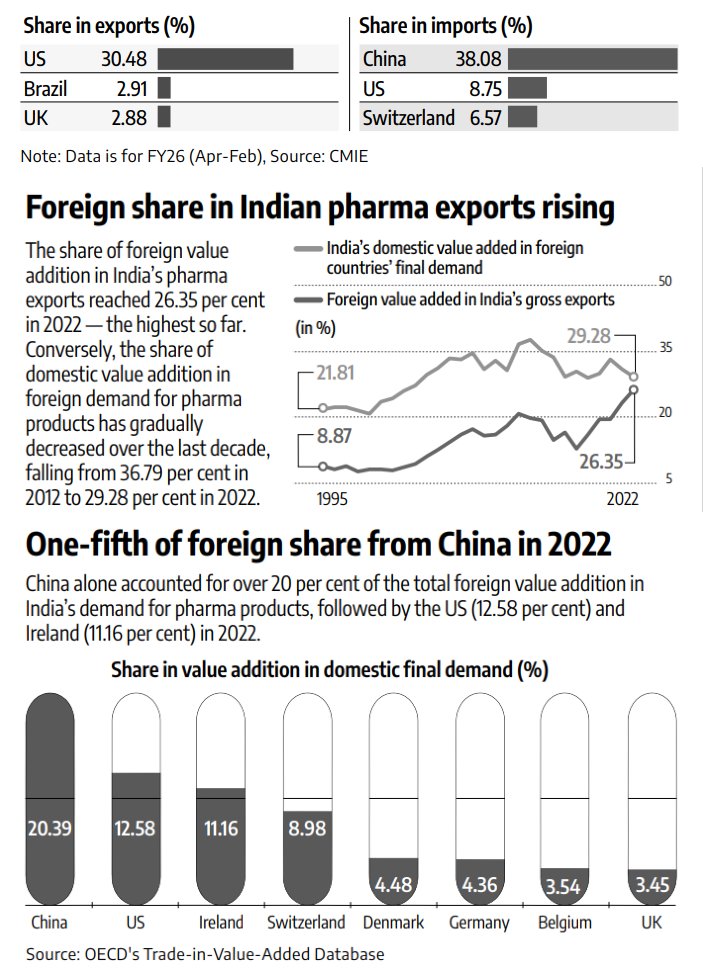
India PLI scheme for bulk drugs has put in about ₹4,500 crore so far and started making 26 APIs locally
Sounds decent until you see that China share of India API imports actually went up from 70% to 74% in FY25.
Chinese companies keep dropping prices every time an Indian plant comes online, making domestic production unviable.
The government is spending thousands of crores to build capacity that can't compete on cost because India power and environmental compliance costs are way higher than China.
About 34% of India pharma exports go to America, and 90% of that is generics which are exempt from the new 100% tariff on patented drugs.
But the US Commerce Department is doing a 1-year review of generic imports too. If that exemption disappears, India loses its biggest customer.
Meanwhile the raw materials for those same generics come from China. So India is stuck making cheap medicines from Chinese supplier
India was a top API maker in the early 90s and gave it all up. Environmental clearances got harder, power stayed expensive, and Chinese bulk drugs were so cheap that Indian companies just stopped bothering to make their own.
Now even when India manufactures an API domestically, the key starting materials still come from China.
The PLI scheme has created ₹1,807 crore worth of import substitution which sounds nice until you compare it to ₹29,064 crore India paid China for API imports in just one year.
That gap tells you everything about how far behind India still is but india will catch up :)
Foreign value addition in India pharma exports went up to 26.35% in 2022 which is the highest it has ever been.
That means more than a quarter of the value in what India ships out as medicine was actually created in some other country. And India own domestic value in what the world buys from it dropped from 36.79% to 29.28% in ten years.
India is slowly turning into a processing stop for other countries raw materials instead of being a real manufacturer.
Look at the gap between the first and second export market.
US takes 30.48% of India pharma exports and the next biggest buyer is Brazil at 2.91%. That is a 10x difference between your biggest customer and the one after that.
On the import side China is at 38.08% and the next source is US at just 8.75%.
China alone accounts for 20.39% of the foreign value added in India pharma sector. So when an Indian company makes a medicine and exports it, roughly 1/5th of the value in that product was created in China. Not in India.
Ireland is third at 11.16% which tells you even European supply chains feed into Indian pharma more than people think.
This 1 hour MIT lecture by Jim Simons (Quant King) will teach you more about quantitative trading than most people learn in their entire career at Wall Street.
Bookmark this & watch, no matter what. It’s the most productive start you can give your week. Then read article below.
Only Economics will end this Unrestricted Warfare.
“War will be reborn in another form and in another arena, becoming an instrument of enormous power in the hands of all those who harbour intentions of controlling other countries or regions.”
What is happening in the world right now was predicted by Qiao Liang and Wang Xiangsui two Chinese Colonels in their book Unrestricted Warfare: China’s masterplan to destroy America published before the turn of this Century! I had read this book a long while back but one line stayed with me. “The first rule of unrestricted warfare is that there are no rules. Nothing is forbidden”.
If you want to understand what’s happening to Iran and why I suggest you read another masterpiece I just finished re-reading. All the Shah’s Men by Stephen Kinzer. How the CIA and the Brits dismantled democracy in Iran in the 50s, replaced it with a puppet who collapsed and Iran fell into the hands of Ayatollah Khomeini.
The straw man argument then was it was to prevent Iran from falling to the Communists just as the straw man argument now is this war is to prevent Iran from becoming a Nuclear power which it has been just weeks away for the last forty years! It was then about control of Oil just as it now about controlling oil and protecting the Petrodollar. Venezuela and Iran were trading oil with the Chinese in Yuan.
As is my routine, weekends are time to think matters economic and I conclude that three things have to happen for this war to stop.
1. 30 year US Treasury Bond has to cross 5%. Its nudging there already.
2. Oil has to climb towards $150. Its on its way
3. S&P has to go into sustained panic selling.
The reason of going to war were economic, the reasons for it to stop is also likely to be economic.
This is a very important story:
“…The amount of oil stored at sea — a vital buffer for markets — is running down fast…”
About 1/3 of what’s left is Iranian.
https://t.co/zS7v0338Ay
NLC India has taken a pioneering step by integrating women into statutory roles in lignite mining operations. This marks a first in India’s energy sector. From operating advanced mining equipment to leading field operations, women are now playing key roles in ensuring safety and driving operational excellence.
#NLCIndia #WomenInMining #BreakingBarriers #womenleadership
@CoalMinistry@MinesMinIndia@mygovindia
The colour of an egg yolk is primarily determined by the pigments found in the hen's food. If a hen's diet contains foods like wheat, white corn or sorghum their yolks can be very light
our kids will think we were crazy for using Google for 20 years
"so you typed a question, got 100000 blue links gamed by SEO agencies, opened 11 tabs, skimmed each site, pieced together an answer, and repeated this process 20 times a day?" they'll think we were digital cavemen.
BROWNIAN MOTION:
A stochastic process {B(t), t ≥ 0} is called a "standard Brownian motion" (or "Wiener process") if it satisfies the following properties:
1. B(0) = 0
2. B(t) has "independent increments": For 0 ≤ t₀ < t₁ < ... < tₙ, the random variables, B(t₁) − B(t₀), B(t₂) − B(t₁), ..., B(tₙ) − B(tₙ₋₁) are independent.
3. B(t) has "stationary increments": For s < t, the increment B(t) − B(s) ∼ N(0, t − s)
4. B(t) has "continuous paths": The function t ↦ B(t) is continuous with probability 1.
Thus, Brownian motion is a continuous−time, continuous−path Gaussian process with mean 0 and variance t: E[B(t)] = 0, Var(B(t)) = t
Re the U.S. debt downgrade, you should know that credit ratings understate credit risks because they only rate the risk of the government not paying its debt. They don't include the greater risk that the countries in debt will print money to pay their debts thus causing holders of the bonds to suffer losses from the decreased value of the money they're getting (rather than from the decreased quantity of money they're getting). Said differently, for those who care about the value of their money, the risks for U.S. government debt are greater than the rating agencies are conveying.
#principles #howcountriesgobroke #debt
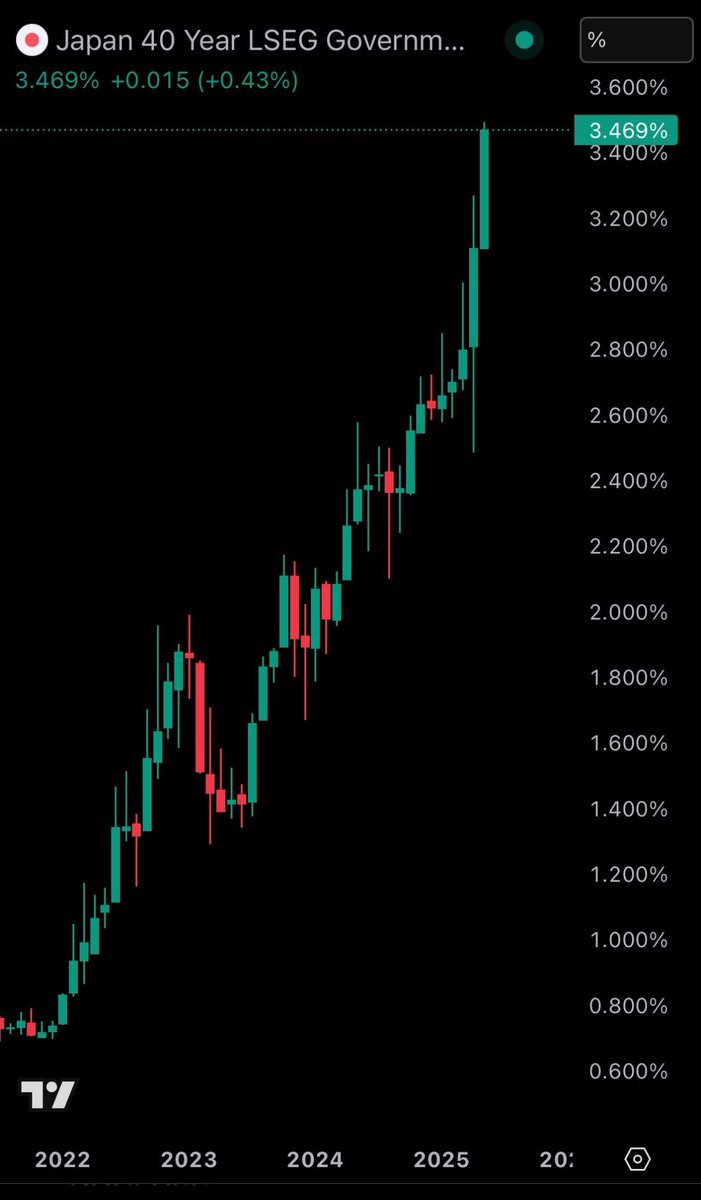
Japan’s 40 year bond yields at 3.5% is the highest in 2 decades.
The Bank of Japan is the largest holder of the U.S. Treasuries.
Should yields continue to surge, Japan may be forced to unwind foreign asset holdings to defend its domestic markets and currency—causing ripple effects across the USD, U.S. bond yields, and global risk assets.






![probnstat's tweet photo. BROWNIAN MOTION:
A stochastic process {B(t), t ≥ 0} is called a "standard Brownian motion" (or "Wiener process") if it satisfies the following properties:
1. B(0) = 0
2. B(t) has "independent increments": For 0 ≤ t₀ < t₁ < ... < tₙ, the random variables, B(t₁) − B(t₀), B(t₂) − B(t₁), ..., B(tₙ) − B(tₙ₋₁) are independent.
3. B(t) has "stationary increments": For s < t, the increment B(t) − B(s) ∼ N(0, t − s)
4. B(t) has "continuous paths": The function t ↦ B(t) is continuous with probability 1.
Thus, Brownian motion is a continuous−time, continuous−path Gaussian process with mean 0 and variance t: E[B(t)] = 0, Var(B(t)) = t](https://pbs.twimg.com/media/GrS1IAWXsAAbzHo.png)