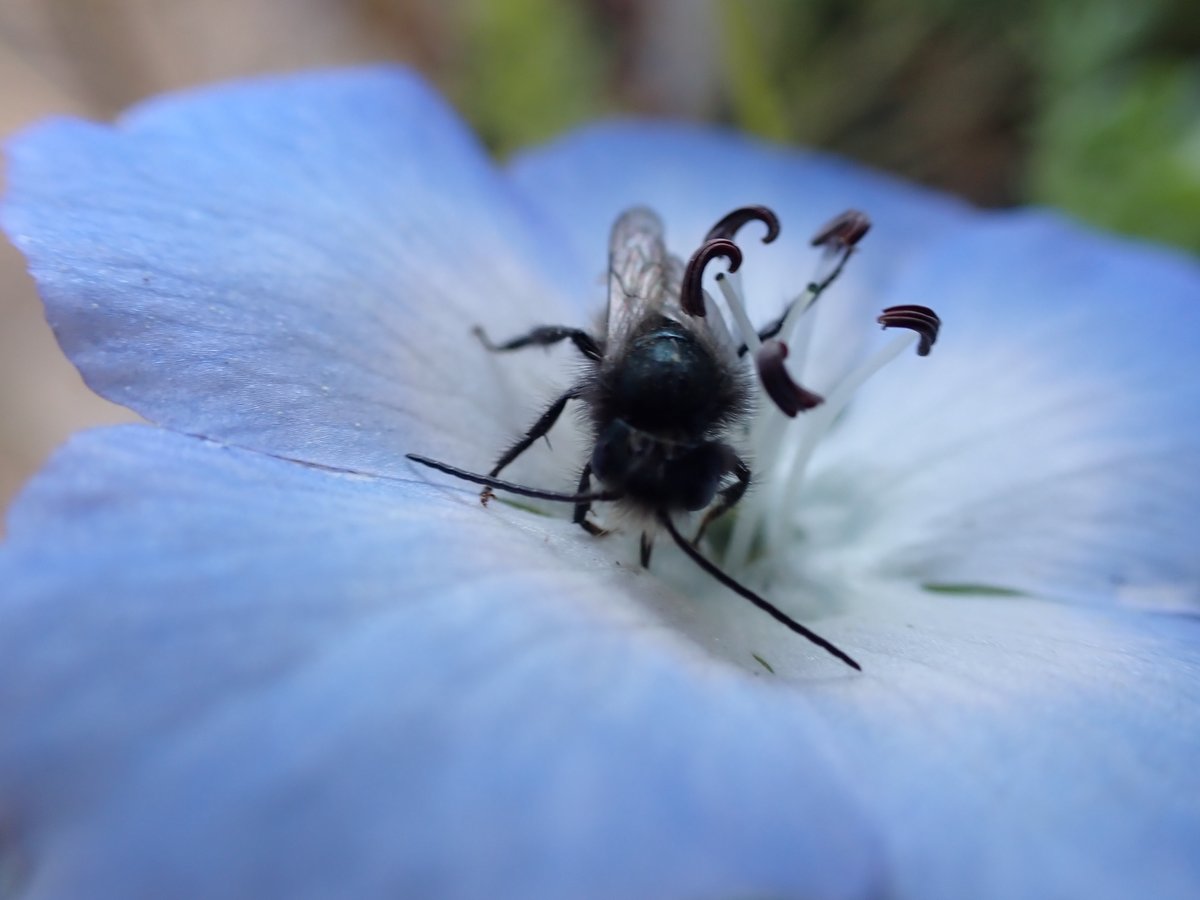
✨because two is better than one✨: we talked about complexities of #phenologicalshifts that still limit our ability to predict their consequences for plant–pollinator #mutualisms and suggest ways to overcome them --> #OpenAccess in @ICB_journal: https://t.co/3MzH50o86K
✨Fresh from the press✨: check out our last article where we investigated how invasive plant species can disconnect native plants from their pollinators --> Tourbez et al. https://t.co/LyBIMQIObc 🐝🌼🌸🌷
@Scott_Zona Yes, interesting study plant. If you're interested, we've been working on G. lutea for several years now, both on pollinators and nectar components (including GABA and b-ala). Papers are mainly from Rossi et al. and Bogo et al. from Bologna, Italy.
Super proud of this work, finally published in @Ecology_Letters. With @nowhere_23 and N.Rafferty we set up a new design to experimentally manipulate plant-pollinator communities and check how they respond to warming temperatures. Want to learn more? Download the #OpenAccess paper
#Botany2022 Very cool, original, experimental work from Nicole Rafferty, @dema_nat@UCRiverside on how warming affects plant communities and their bee pollinators using replicate caged arrays in the glasshouse. Looking forward to their next @NSF funded experiments
Hello fellow twitters, my amazing PI - Nicole Rafferty @EeobUcr is #hiring a new #postdocposition starting this fall 2022 to work with #plants 🌼and #pollinators 🐝 in a greenhouse warming experiment! Here is the link to the ad: https://t.co/WppyQq3pYL
Feel free to #RETWEEET
Hello #PBESA2022 people, tomorrow 04/13 I'm going to present (virtually) the results of my last work where we tested the effects of #warming on🌼 #plants and 🐝 #pollinators
Check it out at the Symposium "Plant-Pollinator Interactions in a Changing World" - @esa_pac@nowhere_23
✨Finally out my post on @FunEcology blog "Behind the paper" ✨
I'm talking about my last paper (➡️https://t.co/ZqQlFi8AfC) where we investigated #Flowers#VOCs and #pollinator communities associated to them and how they change or not 🐝🌼
I hope you'll enjoy it!
Cuckoo male bumblebees perform slower and longer flower visits than free-living male and worker bumblebees https://t.co/Np6lq4sxOj
🐝Enjoy our last paper! by @nowhere_23 et al. now available in @PeerCommunityIn Zoology
Cuckoo male bumblebees perform slower and longer flower visits than free-living male and worker bumblebees https://t.co/Np6lq4sxOj
🐝Enjoy our last paper! by @nowhere_23 et al. now available in @PeerCommunityIn Zoology
Our new work co-lead with @dema_nat is @EcographyJourna Editor's choice of February.
We analyze an amazing dataset to show spatio-temporal changes in flowering synchrony, and how they relate to climate change
@EeobUcr