the slow ghosts got scared, boosted all the way
so this is my halloween entry the hallway is dark, the ghosts are coming and then the boost ring starts spinning the ghosts labeled slow and lag get one look at it and scream their way back down the hallway, while the character shouts boo right back
honestly the scary part of halloween is slow data when blocks arrive late, everything feels stuck in the fog and rlnc is what optimum uses to speed that up
so yeah, boost is the fast lane and lag is the ghost that always loses get boosted this halloween @get_optimum #BoostedMeme
ghosts on my tail and the road is already lit green
halloween ride boost in the gas slow data cant keep up the real scary part is getting left behind
@get_optimum#BoostedMeme
a time limit is part of the training signal
if a session has a clock on it, the clock ends up in the data
an operator with five minutes doesn’t move the same way as one with an hour. they go faster near the end, skip the careful approach, and accept a grasp they’d otherwise redo. none of that shows up in the footage as a mistake. the episode completes, the review passes it, and the model learns a trajectory shaped by a timer it never saw
the same goes for a queue. the people waiting behind you change how long you’re willing to hesitate a model trained on sessions recorded under pressure learns pressure as part of the task
when a team asks whether a dataset is good, ask what the operator had to work with
none of this means the data is worthless. it means the conditions belong next to the footage, so whoever trains on it knows what shaped it @PrismaXai
prismax’s latest note is about memory
their π0.5 rollout stack used about 22 GB of VRAM. 24 GB laptop cards are getting harder to find, so they went looking in their own code and found two things. the library was initializing a large random fp32 backbone before loading the real model. and they were keeping PyTorch models in memory alongside TensorRT engines that had already been built. removing both brought usage down to 11.2 GB, which fits a 16 GB card like the RTX 5080 or 5070 Ti
what stays with me is how ordinary both problems were. the stack worked. the extra weight didn’t stop anything, so there was no reason to look at it. that’s usually how this kind of waste survives: working code rarely gets questioned
so the question i’d put to any team short on hardware: what is still sitting in memory that the system doesn’t use anymore? @PrismaXai
ghosts on my tail and the road is already lit green
halloween ride boost in the gas slow data cant keep up the real scary part is getting left behind
@get_optimum#BoostedMeme
primus lets you prove a fact about your web data onchain without showing the data itself
most of the data that matters for finance lives off chain: exchange balances, payment history kyc. protocols cant read it and publishing it isn’t an option so you’re stuck choosing between exposing everything and using nothing
primus is trying to remove that choice zkTLS proves a piece of web data came from its real source, without revealing your login or the raw records. a lender can check “balance above X” and get a yes or no FHE covers the other half by running computation on encrypted inputs so the data never has to be decrypted to be used
the first live example is proof of reserves for USD* on solana. primus verifies the off chain data brevis proves the math and anyone can check the backing ratio on the transparency page binance and hyperliquid reserves are next
zkTLS shows where data came from not whether the source is honest a proof is a snapshot, so anything tied to live balances needs refreshing the attestor network runs in TEEs with staking, but per their docs, penalties and governance arent live yet and operators are whitelisted
privacy shouldnt mean nobody can verify anything @primus_labs
Introducing Primus Confidential Finance (https://t.co/E7HDEdlMjv), where privacy meets transfer and yield on-chain.
We're excited to announce a collaboration between Primus @primus_labs, Unitas @UnitasLabs, and United Stables @UTechStables to launch a Confidential Finance Product on @BNBCHAIN, powered by the Fully Homomorphic Encryption (FHE) technique.
This isn't just another confidential transfer or on-chain vault. It's a new standard for how private, compliant, and capital-efficient on-chain finance can work. 🧵
prismax’s latest note is about memory
their π0.5 rollout stack used about 22 GB of VRAM. 24 GB laptop cards are getting harder to find, so they went looking in their own code and found two things. the library was initializing a large random fp32 backbone before loading the real model. and they were keeping PyTorch models in memory alongside TensorRT engines that had already been built. removing both brought usage down to 11.2 GB, which fits a 16 GB card like the RTX 5080 or 5070 Ti
what stays with me is how ordinary both problems were. the stack worked. the extra weight didn’t stop anything, so there was no reason to look at it. that’s usually how this kind of waste survives: working code rarely gets questioned
so the question i’d put to any team short on hardware: what is still sitting in memory that the system doesn’t use anymore? @PrismaXai
topic: refusal in a robot is not moving and almost none of it gets recorded
language models learn to refuse from examples thousands of prompts where the right answer is no so the model learns that saying no is part of answering
a robot doesn’t get that. the closest thing to a refusal is not moving, and almost nothing in a dataset looks like that demonstrations are successful episodes they show what to do they rarely show the moment an operator decided not to do something: stopping short of a grab because the object sat too close to the edge, or waiting instead of pushing
so it learns the motions the restraint never makes it into the file. it lives in the operator’s head, and from outside it looks like nothing happened
safety in a physical system depends partly on behavior like that, and it’s exactly the behavior that doesn’t show up in the data
@PrismaXai has an essay series called “No Robot Is Safe,” which gets at this from the llm side. i’d add one point if the data has no examples of declining, the model can’t learn declining from it, however good the review is. review can reject a bad episode it can’t add a good one that was never made
so here’s the question i’d ask any team collecting this stuff: are you recording the decisions not to act, or only the actions?
A Python pipe buffer was holding camera frames until 64 KB had piled up. That quietly added hundreds of milliseconds to our π0.5 rollouts.
New from @castorhat: how we found it, and what changed on the robot once it was gone. https://t.co/xTAueR4wOV
never really thought about what a wrong vote is for a validator until i looked into the head vote
when a validator is picked to attest it has to say which block it thinks is the latest, and it only has until about four seconds into the slot to say it, so if the block hasnt reached it yet it can end up voting for the previous one
so a late block can turn into a wrong vote
the mainnet announcement has one number about this that stuck with me, one operator saw wrong head votes drop 51 percent after switching to mump2p
its just one operator and its the teams own announcement so i wouldnt call it the average
as far as i can tell they dont say why it dropped, but a block showing up in time to be voted on seems like the obvious reason
didnt expect a networking upgrade to come down to whether a validator has to guess
@get_optimum
drew one lane stuck at a red light and one wide open, then felt a little unfair doing that to gossipsub, it still delivers blocks, just later
in their own side by side testnet the median was 132ms on gossipsub against 53ms on mump2p, so the gap is real but smaller than the drawing makes it look
what i like about the gateway is nobody has to pick a lane for good, it runs next to the consensus client and gossipsub keeps working underneath, so whichever path gets the block there first is the one that counts
the new lane doesnt get trusted upfront either, the dashboard tracks what share of slots mump2p arrived first
and if the gateway goes down the validator still attests and proposes like before
not the flashiest part of the project but its the part that made trying it sound reasonable to me @get_optimum
@cryptooflashh @ada_pegasus@CryptoSundayz
Post #72
@get_optimum Weekly with JT #10
This week came with a lot of surprises, first MumP2P went live, and also the 999 NFTs collection
Congrats to the new refined, you all deserved it
@blockchainjeff hosted the community call as promised by him last two weeks
A🧵👇🏾
drew one lane stuck at a red light and one wide open, then felt a little unfair doing that to gossipsub, it still delivers blocks, just later
in their own side by side testnet the median was 132ms on gossipsub against 53ms on mump2p, so the gap is real but smaller than the drawing makes it look
what i like about the gateway is nobody has to pick a lane for good, it runs next to the consensus client and gossipsub keeps working underneath, so whichever path gets the block there first is the one that counts
the new lane doesnt get trusted upfront either, the dashboard tracks what share of slots mump2p arrived first
and if the gateway goes down the validator still attests and proposes like before
not the flashiest part of the project but its the part that made trying it sound reasonable to me @get_optimum
@cryptooflashh @ada_pegasus@CryptoSundayz
the sender shouldn’t have to carry everything alone
when a block is produced, one node has to push it out to the network, that upload is a real cost, and as blocks grow it becomes a bottleneck at the source
→ peer-turbo, one of optimum’s research directions, asks a different question, what if the nodes receiving the block also help deliver it
→ with rlnc, a peer that already holds some coded pieces can create new ones and pass them on, so the original sender doesn’t have to send every piece to every peer directly
→ the model suggests up to 10x lower bandwidth requirements at the source under specific conditions, that is a projection from a model, not a measured result on a live network
→ the open questions that matter most to operators are how cooperation holds up when peers are slow or unreliable, and how much extra work each helper takes on
→ if you’re following optimum’s research, this is the part to follow, scaling by cooperation between nodes is a different path from scaling by bigger servers, and the data will show which one holds up
@get_optimum
@cryptooflashh @ada_pegasus@CryptoSundayz
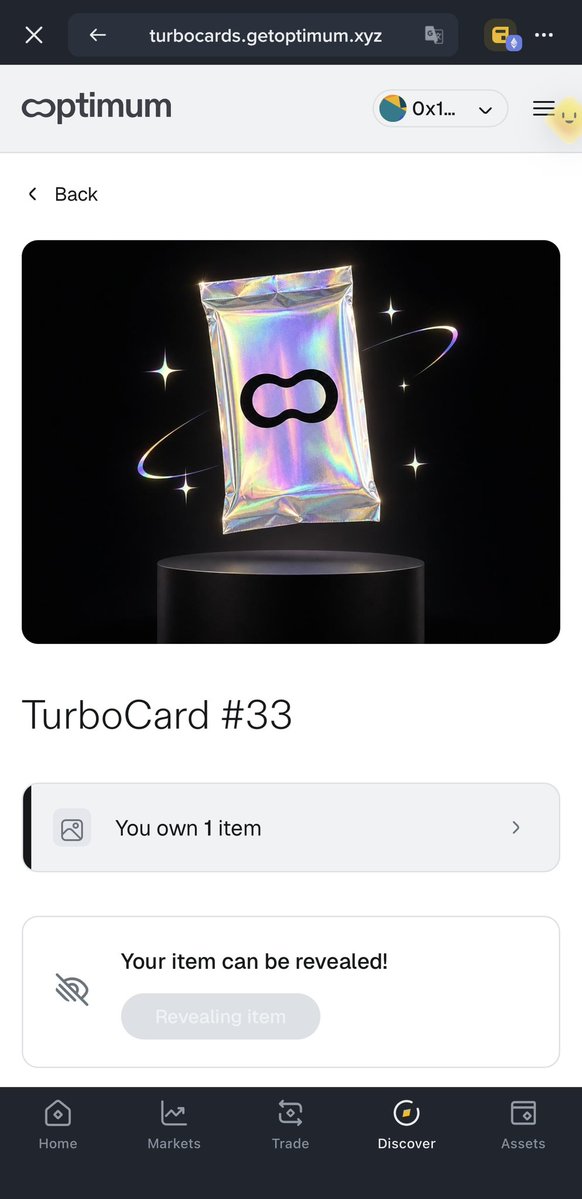
⚡ Just minted my Optimum Turbo Card: #33
Slot 15116975
Latency: 96ms
Speed Boost: 3.6x
Each card is a real Ethereum slot where @get_optimum sped up a block across the network. Only 999 exist.
Here's how to get yours 👇
1️⃣ Get an access code
Codes drop on X, Discord, community calls and partner quests.
First batch: Friday, Oct 23
2️⃣ Unlock it
Go to https://t.co/0b7YrBWZvF
→ Follow Optimum
→ Connect your wallet (double-check the URL)
→ Enter your code
3️⃣ Mint & reveal
Select your card → Mint now → Confirm → Reveal 🃏
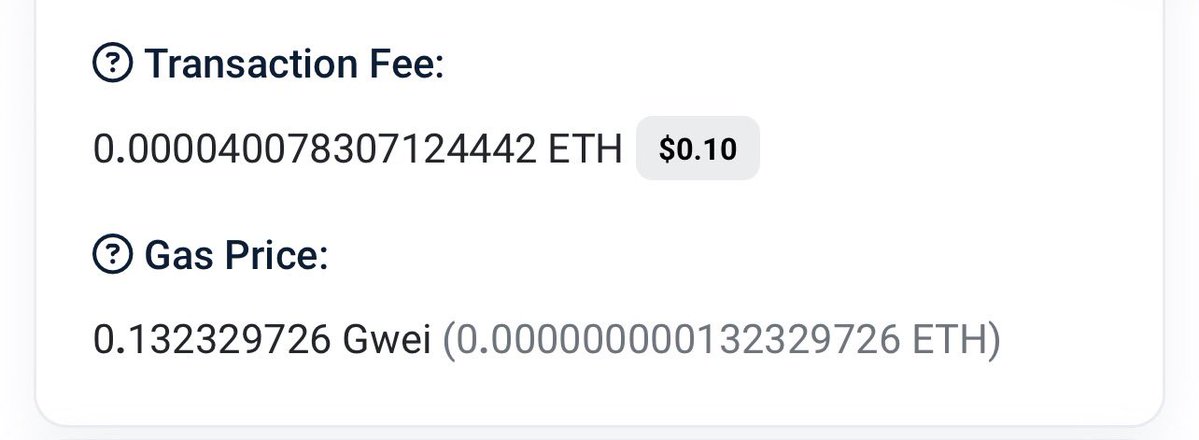
Prepare ethereum:native L1 for gas fees maybe arround $0.1 (better to prepare $1-$2)
Can't see it in your wallet? Check OpenSea with the same wallet.
Good luck on the next drop 🔥